
Best Entry Level Studio Monitors for Home Studios and Small Setups
Answer: For beginners and budget-conscious musicians or content creators, these entry-level monitors and monitoring solutions deliver clear, reliable sound without a steep price tag. This guide highlights five solid options that pair well with compact workspaces, desktop studios, and hobbyist setups. It also explains who should choose each option and why, helping you pick the right monitoring solution for near-field listening and basic mixing tasks.
Buying quickly the top picks at a glance:
| Product | What It’s Best For | Why It Stands Out |
|---|---|---|
| ESI nEar i5 5″ Studio Reference Monitor | Near-field studio work | Transparent sound; flexible inputs; compact form |
| Audio-Technica AT-LP60XBT Bundle With 3-Inch Monitors | Home vinyl setup with small monitors | Turntable plus compact powered monitors bundle |
| Kefine Loric IEMs | On-the-go monitoring and personal listening | PU+ Titanium diaphragm for clear highs and deep bass |
| Sennheiser IE 100 Pro | Professional on-ear monitoring | Powerful, precise 10 mm driver, comfortable fit |
| SENNHEISER IE 100 PRO | Professional in-ear monitoring | Single-driver clarity with ergonomic design |
ESI nEar i5 5″ Studio Reference Monitor
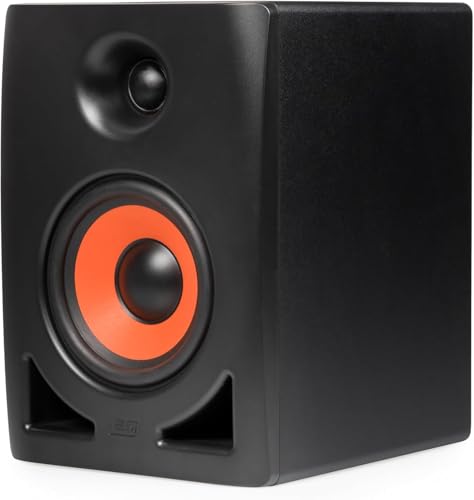
The ESI nEar i5 is a compact 5″ two-way active reference monitor designed for near-field work. It delivers studio-quality sound suitable for recording, editing, mixing, mastering, and on-screen work. It uses a curved paper-cone woofer with a silk-dome tweeter and computer-optimized waveguides to produce defined lows and smooth highs. Balanced XLR and 1/4″ TS inputs accommodate diverse setups, and a 21-step volume control lets you dial precise levels. Best for: beginner producers and editors who want reliable, transparent reference in a small space.
Caution: While versatile, the unit is a single speaker; consider pairing with a second monitor for stereo imaging and broader room coverage if your workflow evolves.
LMBGM A9 UHF Wireless In-Ear Monitor System

This wireless in-ear monitoring system provides a compact option for stage use, home studios, or rehearsal spaces. It features a mono balanced XLR and unbalanced TS input, with a 30-meter range and low latency. The design emphasizes durability with a premium metal housing and a comfortable beltpack for longer sessions. Best for: performers and presenters needing freedom of movement without cables. Caution: In-ear systems may require a separate splitter or mixer to integrate with existing stage or studio rigs.
Audio-Technica AT-LP60XBT Bundle With 3-Inch Monitors

The bundle pairs a Bluetooth-equipped Audio-Technica AT-LP60XBT belt-drive turntable with a pair of 3-inch powered studio monitors. The turntable is designed for easy setup and vinyl playback, while the compact monitors are suitable for desktop studios or small rooms. Best for: entry-level vinyl enthusiasts who want a simple, all-in-one listening and monitoring solution. Limitation: The bundle emphasizes basic monitoring; true mixing accuracy may require more advanced near-field monitors for critical tasks.
Kefine Loric IEMs

The Kefine Loric IEMs use a PU+ titanium diaphragm for rich vocals and crisp treble, paired with dual-magnet, dual-chamber drivers for deep, controlled bass. A 160-core silver-plated copper cable supports pristine signal transmission, and a lightweight design keeps fatigue low during long sessions. Best for: portable monitoring on the go or on-location editing where space is limited. Limitation: In-ear monitors can isolate sound, which may reduce situational awareness in loud environments.
Sennheiser IE 100 Pro In-Ear Monitors

The Sennheiser IE 100 Pro features a 10 mm dynamic transducer for powerful, precise monitoring with a comfortable fit. The single-driver design supports a slim, ergonomic form factor suitable for long sessions. Best for: professionals seeking reliable, portable in-ear monitoring with accurate response. Limitation: As a wired in-ear option, it requires a cable and a compatible source; not ideal for wireless workflow without adapters.
SENNHEISER IE 100 PRO (Black)

The SENNHEISER IE 100 PRO improves on the monitoring experience with a robust 10 mm dynamic transducer and a secure fit designed for extended use. The single-driver design emphasizes a compact build while delivering clean, distortion-free sound. Best for: professionals who need precise, portable monitoring in constrained space. Limitation: Like the IE 100 Pro, it relies on a wired connection; consider cable management in tight studios.
Buying Guide: Key Purchase Considerations
- Sound goal: Do you need near-field reference monitoring for mixing accuracy, or in-ear monitors for portability and stage use?
- Space and setup: Small rooms benefit from compact powered monitors or high-quality in-ear systems that minimize desk clutter.
- Connections: Look for balanced XLR inputs for clean signal paths, and consider TS inputs if you plan to integrate with guitars or keyboards.
- Mobility vs stability: Wired monitors stay stationary; wireless IEMs offer mobility but require reliable interference-free frequencies.
- Durability and comfort: Durable housings and comfortable ear tips are essential for long sessions, especially with portable IEMs.
- Future-proofing: If you anticipate expanding to multi-monitor setups, start with a monitor that scales well with additional units or a matching second pair.
FAQ
- What is the difference between near-field monitors and in-ear monitors for beginners? Near-field monitors provide a fixed listening reference in a room, while in-ear monitors offer portable, on-the-go listening with isolation.
- Which option is best for a small desk setup? A compact powered monitor like the ESI nEar i5 is a solid desktop choice, or a portable IEM system for on-the-go listening.
- Do I need a subwoofer with entry-level monitors? For most entry-level uses, especially near-field work, a single compact monitor can be sufficient; add a sub later if low-end accuracy becomes a priority.
- Are wireless in-ear monitors compatible with home studios? Yes, but they require careful frequency management to avoid interference and may need a mixer or splitter to integrate with studio gear.
- What should I consider when choosing between wired and wireless monitoring? Wired monitoring offers low latency and reliability, while wireless options provide mobility. Choose based on your workflow and environment.
- Can I mix music with in-ear monitors? In-ear monitors can be used for reference listening, but many professionals prefer near-field monitors for accurate room calibration during mixing.