Best Equalizer Pedal for Guitar: Top 5 Graphic EQs for Tone Shaping
Answering the common buyer question, a reliable graphic equalizer pedal helps guitarists sculpt tone with precision across multiple frequencies. This guide showcases five well-suited options for live stage work, studio recording, or home practice. Each pick targets different players—beginners seeking simple tone shaping, blues players needing punchy mids, metal players aiming for high-gain clarity, and creative makers exploring dynamic textures. Below, compare capabilities, best-use scenarios, and limitations to help you choose the right fit.
Summary of selected products
| Product | Best For | Key Benefit | Limitations |
|---|---|---|---|
| BOSS GE-7 Equalizer | General guitarists; studio and stage | Seven bands with guitar-optimized frequencies | Limited to 7 bands |
| RVONE 10-Band Equalizer | Everyone from bedroom producers to live players | Low-noise operation and true bypass | Power adapter not included |
| EX 7 Band EQ Equalizer Mini | Compact setups; beginners to intermediate | 7 bands in a small footprint, true bypass | Smaller knobs may be harder to adjust on stage |
| SONICAKE 10-Band Tone Group | Shaping punchy tones and studio precision | 10 bands for precise sculpting | Analog design may vary with gear |
| STRICH 10-Band EQ Pedal | Durable build and detailed tone control | Ten bands, robust aluminum shell | Requires a DC 9V adapter (not included) |
BOSS GE-7 Equalizer Pedal

The BOSS GE-7 is a classic seven-band graphic EQ designed specifically for guitar signals. Its frequencies cover essential guitar ranges (100 Hz, 200 Hz, 400 Hz, 800 Hz, 1.6 kHz, 3.2 kHz, 6.4 kHz) with ±15 dB boost/cut per band. A dedicated level control lets you match output to your amp or effects chain. Best for players who want straightforward, dependable tone shaping without adding complexity to the signal path. A potential limitation is the fixed band set—if your tonal goals require more bands or more granular options, another model may suit you better.
Who this is best for: Players needing reliable, straightforward EQ shaping for guitar with consistent performance in live and studio contexts.
RVONE 10-Band Equalizer Pedal

This 10-band pedal emphasizes versatile tone shaping for guitar, bass, and pedalboards with low-noise operation and true bypass to preserve signal integrity. Its broad 31.25 Hz–16 kHz range provides a wide canvas for blues warmth, modern EDM punch, or clean studio tones. Best for players who want a studio-grade signal path on a pedalboard and value quiet operation during high-gain sessions. A caution: the package may not include a power adapter, so ensure you have the correct 9V supply ready.
Who this is best for: Players needing a flexible, transparent EQ that works well in both live and studio environments without adding hiss or noise.
IOppWin Guitar Pedals 5-Band Graphic EQ

The IOppWin 5-band EQ provides precision control across five critical frequencies with ±18 dB boost/cut. Its compact, road-ready metal shell makes it an attractive choice for pedalboards that need serious tone shaping without a large footprint. Best for players who want tight, surgical EQ adjustments in a small form factor. Note that with fewer bands, it may be less capable of complex tonal sculpting than 10-band units.
Who this is best for: Players prioritizing a tiny footprint with solid, reliable 5-band control for on-the-fly adjustments.
EX 7 Band EQ Equalizer Mini
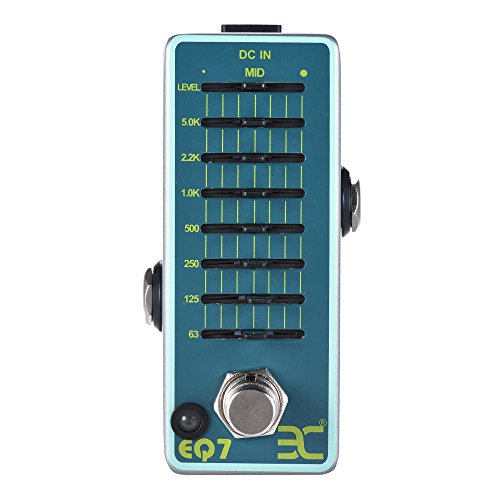
The EX 7 Band EQ Mini packs seven adjustable bands (63 Hz–5 kHz) with ±15 dB boost/cut into a compact, stage-ready chassis. Features include true bypass and a bright LED indicator to confirm engagement. It’s an ideal choice for players who want more tonal options than a two-band preamp while maintaining a small, travel-friendly footprint. Limitation: small footprint can make precise adjustments challenging in dim lighting or during fast stage changes.
Who this is best for: Musicians who need seven bands in a compact form, suitable for quick tonal tweaks in live or studio settings.
SONICAKE EQ Equalizer Guitar Effects Pedal Tone Group 10-Band

The SONICAKE 10-Band Tone Group offers 100% analog operation with ten sliders for precise tonal sculpting across a broad spectrum. Each band provides up to ±15 dB gain, giving guitarists the ability to shape complex, studio-ready tones or nuanced live performances. Best for players who value an all-analog signal path and broad tonal palette. A consideration: some users may notice variance in response compared to digital EQs depending on guitar and amplifier interaction.
Who this is best for: Players aiming for detailed, analog-intensive tone shaping with ten independent bands for intricate control.
STRICH 10-Band EQ Pedal for Electric Guitar

STRICH offers a ten-band graphic EQ with a robust aluminum shell and ten independent frequencies from 31.25 Hz to 16 kHz, plus a master band. It notes a dedicated DC 9V power requirement (adapter not included). This pedal is well-suited for players who want a sturdy, road-ready option with precise, broad-frequency control. The need for an external adapter is a practical consideration for those who prefer batteries or already have a pedalboard power supply.
Who this is best for: Players seeking a durable, high-bandwidth EQ with a solid construction and clear, independent band control.
Buying Guide: Choosing The Right Equalizer Pedal
What should you consider when selecting an EQ pedal for guitar?
- Number of bands: More bands offer finer control but larger footprints and more complexity. Decide if you need 5, 7, or 10 bands based on your tonal goals.
- Signal path: True bypass preserves your guitar’s core tone, but some players accept a minor, intended coloration from non-bypass options for a particular effect.
- Frequency coverage: Look for a range that suits your instrument and genre. Guitar-focused pedals often emphasize typical guitar frequencies, while bass-inclusive units cover lower zones as well.
- Build and durability: Road-ready metal enclosures are valuable for performers who travel or tour frequently.
- Power requirements: Some pedals require specific adapters or power arrangements. Check compatibility with your pedalboard power supply.
- Tone goals: If you want surgical control for recording, choose pedals with wider frequency options and higher boost/cut values.
Practical tips
- Start with a flat baseline, then adjust one band at a time to hear its effect in context with your amp and other pedals.
- Pair an EQ with compression or overdrive to craft more musical dynamics, especially on stage.
- For live settings, label your profiles or snapshots to switch quickly between tones for different songs.
Frequently Asked Questions
- What is an EQ pedal best used for?
Answer: To shape overall tone, reduce muddiness, brighten highs, or emphasize certain mids to suit your playing style and venue. - Do I need a 10-band EQ for stage use?
Answer: Not always. Ten bands offer the most control, but seven or five bands can be sufficient for many players. - How does true bypass affect tone?
Answer: True bypass minimizes signal coloration when the pedal is off, helping preserve your guitar’s original tone. - Can I use an EQ pedal with bass guitar?
Answer: Yes. Some models cover a broad frequency range suitable for bass. Check the product specs to confirm bass compatibility. - Is external power necessary?
Answer: Many pedals require a 9V DC supply; verify adapter requirements to ensure compatibility with your pedalboard power bank. - Which pedal offers the most tonal flexibility?
Answer: Ten-band models generally provide the most precise control across a wide spectrum, ideal for studio work.