Best External Sound Cards for Recording: Pick the Right USB Interface
Choose the best external sound card for recording by matching your setup to practical needs: multi‑channel output for desktop music production, high‑quality mono or stereo capture for podcasts, or simple plug‑and‑play USB DAC upgrades for laptops. The top options listed here are suited for home studios, hobbyists, or professionals who need reliable USB audio interfaces without complex installs. The following table summarizes five strong choices and their strengths to help you compare quickly.
| Product | Best For | Key Benefit |
|---|---|---|
| StarTech ICUSBAUDIO7D | Desktop and laptop users needing 7.1/5.1/2-channel output | SPDIF digital output and wide channel support |
| Cubilux 7.1 USB Surround | Gamers and movie lovers who want immersive 7.1 sound | Full 7.1/5.1 surround with high‑res output |
| Cubilux CB5 USB Audio Interface | Podcasters and multi‑track creators | 5‑in/1‑out with multi‑track recording support |
| SABRENT AU‑MMSA | Windows/macOS users needing easy driverless setup | Driverless plug‑and‑play |
| UGREEN USB to Audio Jack | Upgrade to higher‑quality output on laptops | High‑resolution DAC, simple plug‑and‑play |
StarTech.com 7.1 USB Sound Card ICUSBAUDIO7D
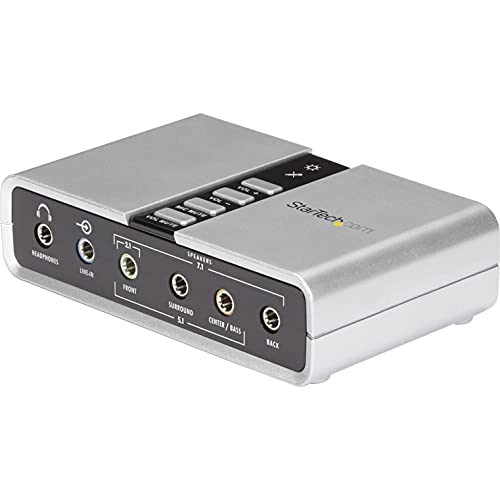
This external USB sound card adds up to 7.1 channels via a single USB port, with options for 7.1, 5.1, and 2‑channel output using 3.5mm jacks, plus a headphone port, line‑in, and mic inputs. It upgrades built‑in audio on laptops or desktops and supports 44.1KHz/48KHz for analog playback and recording. SPDIF digital output is available, though only at 48KHz for digital playback. Best for multimedia creators who need a simple upgrade without internal card changes.
- Best for users needing 7.1/5.1/2‑channel flexibility
- Better for those who require SPDIF digital output
- Avoid if you need USB audio with higher sampling beyond 48KHz for digital playback
Cubilux CB5 USB Audio Interface

The Cubilux CB5 turns a USB port into a compact 5‑in/1‑out interface with two stereo mic/line inputs, line‑in, line‑out, and a headphone jack for monitoring. It supports multi‑track recording and assigns independent device names for simple session management. It uses a built‑in chip to deliver up to 96KHz/24‑bit capture, making it suitable for podcasting and basic studio recording. Consider this model if you need multiple inputs in a compact form factor.
- Best for multi‑input projects and beginner to intermediate studios
- Better for multi‑track recording workflows
- Avoid if you require professional‑grade bus power or higher sample rates beyond 96K/24‑bit
SABRENT USB External Stereo Sound Adapter AU‑MMSA

The SABRENT AU‑MMSA provides a driverless USB‑powered interface with stereo output and a mono microphone input. It is supported across Windows, macOS, and Linux variants and is designed for straightforward plug‑and‑play use. This model suits casual recording, streaming, and basic listening upgrades for users who want a simple, driverless option.
- Best for quick, no‑drama setup on mixed operating systems
- Better for lightweight recording and basic monitoring
- Avoid if you need multiple channels or advanced asio/driver features
UGREEN USB to Audio Jack Sound Card
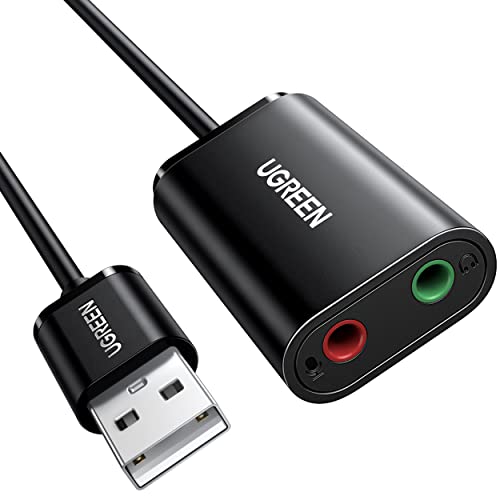
The UGREEN USB to Audio Jack adapter offers a simple DAC upgrade with dual 3.5mm jacks for headphone and mic, plus USB power. It emphasizes high‑resolution output and a straightforward plug‑and‑play experience with no drivers required. This option is ideal for laptops or desktops that want improved sound quality without adding complexity to the setup.
- Best for upgrading laptop or desktop sound quality quickly
- Better for 16bit/48kHz playback with a DAC chip for clarity
- Avoid if you need multiple inputs or advanced audio routing
Buying Guide: External USB Sound Cards for Recording
What to consider when selecting an external USB sound card for recording:
- Number of inputs and outputs: Do you need mic, line, and monitor outputs? Multi‑in devices help with podcasts or small ensembles.
- Sampling rate and bit depth: Higher rates (e.g., 96KHz/24‑bit) offer better fidelity for recording, though many casual uses are fine at 44.1/48KHz.
- Connectivity and compatibility: Ensure USB bus power suffices; check compatibility with your OS and whether drivers are required or optional.
- Digital vs analog options: SPDIF or optical outputs are useful for digital workflows or interface with receivers and monitors.
- Portability vs. performance: Compact devices travel well but may limit inputs; larger units often provide more features and higher headroom.
- Latency and monitoring: Look for zero‑latency monitoring or direct monitoring features if you record while monitoring live.
FAQ
- Do external USB sound cards require drivers? Some models are driverless and plug‑and‑play; others may need drivers for full functionality.
- Can I record stereo audio with these devices? Yes, most provide stereo input/output options, with some offering multiple channels for recording.
- Will these upgrade my existing computer sound? Yes, they can upgrade both playback and recording quality over built‑in audio.
- What is the best option for a beginner podcast? A device with multiple inputs and simple monitoring, such as a 2‑input interface, is typically ideal.
- Is 7.1 surround useful for recording? It’s more relevant for playback and immersion; for standard recording, focus on mic inputs and preamps.
- Are these compatible with Mac and Windows? Most listed options support both; verify the exact model for OS specifics.