
Best HDMI Audio Extractors for Clean TV to Sound System Connections
Answer: If you need to pull audio from an HDMI signal to feed a soundbar, receiver, or speaker system, an HDMI audio extractor is the right tool. The top picks below are best for different setups—whether you want 4K video pass-through, DTS/Dolby support, or simple PCM output. This guide helps buyers choose the right extractor for home theater, gaming consoles, or streaming boxes.
Summary table of selected products
| Product | Best For | Output Options |
|---|---|---|
| VPFET HDMI Audio Extractor (B084T4QDFP) | 4K setups needing optical and 3.5mm outputs | Optical, 3.5mm PCM |
| IHTHER HDMI ARC to Optical Audio Adapter (B0HBVN2VP2) | ARC-enabled TVs feeding soundbars | Optical |
| J-Tech Digital 4K HDMI Audio Extractor (B074HHSJVN) | Dolby/DTS passthrough with HDMI video | Optical, 3.5mm |
| VPFET 4K HDMI Audio Extractor (B08KVR1LNG) | HDMI to stereo with quick setup | 3.5mm, RCA |
| OREI 4K@60Hz HDMI Audio Converter (B07BHYXVTY) | High-end pass-through with broad audio formats | Optical |
VPFET HDMI Audio Extractor 4K HDMI to Optical 3.5mm AUX

Best for mixed-output setups where both optical and 3.5mm are needed. This extractor supports 2.0ch PCM and 5.1ch passthrough, with a 4K@30Hz capability and HDCP 1.4 support. It is suitable for users who want to connect a TV, Blu-ray player, or game console to an AV receiver or external speaker system via optical or analog audio.
Who it’s best for: buyers who want a straightforward 4K HDMI input with dual audio outputs. Why chosen: flexible output options help accommodate both older AV receivers and newer soundbars. Limitation: some devices may require switching between 2.0ch PCM and 5.1ch modes for audio output; not all sources will deliver 4K video with ARC/eARC support.
192KHz HDMI ARC to Optical Audio Adapter

Best for TVs with ARC that need a reliable optical output to a soundbar or home theater system. This unit handles PCM, LPCM, Dolby 5.1, and DTS 5.1 formats, and it’s designed for plug-and-play use with a 192KHz/24-bit sampling rate. It requires a TV with ARC and a compatible audio system that can accept Dolby/DTS over optical.
Who it’s best for: ARC-enabled TV owners seeking a simple bridge to an optical input. Why chosen: clear focus on ARC to optical conversion with minimal setup. Caution: Not suitable for HDMI eARC or non-ARC ports, and Dolby/DTS formats may require compatible sound processing in the receiver.
4K 60Hz HDMI Audio Extractor Converter (J-Tech Digital)
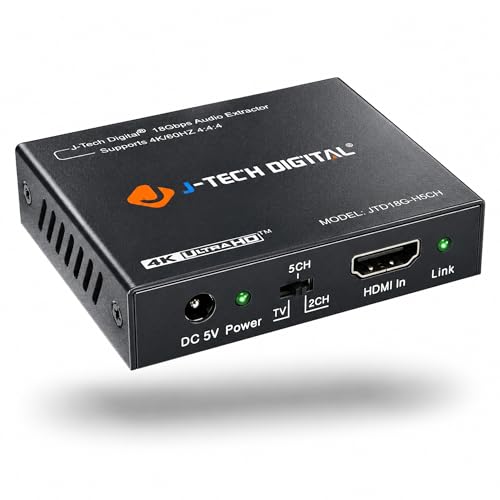
Best for users requiring Dolby Digital/DTS passthrough alongside HDMI video. This device supports 4K@60Hz pass-through and can output audio via optical or 3.5mm. Note that it only passes Dolby Digital/DTS and omits decoding for analog output unless the source is PCM. Choose this if your setup centers on external receivers supporting these formats and you don’t need multi-channel decoding on the extractor itself.
Who it’s best for: home theater fans with compatible receivers and a preference for explicit optical or analog outputs. Why chosen: strong support for modern HDMI with stable audio pass-through. Limitation: does not decode multichannel audio on the analog output and may require source-set PCM for analog use.
VPFET HDMI Audio Extractor Splitter 4K

Best for those who want a single HDMI input with both 3.5mm and RCA stereo outputs. It supports 4K@30Hz and EDID-aware operation to align audio and video. This model is suitable for PS4/Fire Stick and Blu-ray players when you want to feed an external stereo or AV receiver.
Who it’s best for: gamers and media players needing a quick splitter to stereo audio. Why chosen: reliable dual-output approach and EDID-driven compatibility. Limitation: max 4K@30Hz; higher refresh rates or 4K@60Hz may not be supported depending on the source device.
OREI 4K@60Hz HDMI Audio Converter Extractor

Best for high-resolution video pass-through with broad audio formats including LPCM, Dolby Digital, DTS, and more. The unit supports HDCP 2.2 and 4K@60Hz pass-through, with an optical output for multi-channel sound delivery. It does not provide ARC, so use this when your TV lacks ARC or you prefer a dedicated optical path.
Who it’s best for: home theater setups needing wide video compatibility and robust surround sound options. Why chosen: broad format support and consistent 4K pass-through. Limitation: No ARC support; optical output is the sole audio path on this model.
Buying Guide
What should you look for in an HDMI audio extractor?
- Video pass-through capabilities: Check maximum HDMI resolution and refresh rate (e.g., 4K@30Hz or 4K@60Hz). Match with your display and source devices.
- Audio output types: Optical (TOSLINK) and 3.5mm are common. Some units also offer RCA. Choose based on your receiver inputs.
- Audio formats supported: PCM, LPCM, Dolby Digital, DTS, Dolby TrueHD, and Dolby Atmos/DTS:X may be relevant depending on your system. Ensure your setup can handle the formats you use.
- ARC/eARC support: If your TV uses ARC/eARC to send audio to a soundbar, a dedicated ARC-compatible extractor can simplify wiring. Some units only work with standard HDMI ports.
- EDID behavior: Auto-detect and EDID options help ensure audio and video stay synchronized, especially when multiple devices are connected.
- Ease of use: Plug-and-play with minimal setup is ideal for most users. USB power is common; ensure a nearby power source is available.
Which setup fits your needs?
- Simple stereo audio from a 4K source: Look for models offering 3.5mm or RCA stereo outputs with PCM support.
- Surround sound from a TV or game console: Prioritize devices that support Dolby/DTS passthrough and optical output.
- ARC/eARC TV environments: Choose units explicitly designed for ARC to optical conversion if you want to connect to legacy sound systems.
- High-refresh gaming and streaming: Confirm the extractor can handle 4K@60Hz if your sources output that format.
Common gotchas to avoid
- Don’t assume every extractor supports 4K up to 60Hz with every source; some are limited to 4K@30Hz.
- HDMI 1.4 vs 2.0/2.1 can affect bandwidth and HDR support; verify compatibility with your devices.
- Some devices cannot decode multichannel audio on analog outputs; ensure your receiver can handle the formats you plan to use.
- ARC/eARC limitations: ARC is not the same as eARC; if you need eARC, verify that feature specifically.
FAQ
- What is an HDMI audio extractor used for? It pulls audio from an HDMI signal so you can send audio to non-HDMI receivers or speakers.
- Do these devices require drivers? No, most are plug-and-play with no software required.
- Can I get Dolby Digital or DTS through the optical output? Many models do; verify the supported formats in the product features.
- Will this work with 4K TVs and game consoles? Yes, if the extractor supports 4K pass-through and the correct output format is chosen.
- Is ARC or eARC required? Not always; ARC/eARC compatibility is device-specific and may limit which port you use on the TV.
- What about audio sync issues? Opt for EDID-aware or auto-detect features to minimize lip-sync problems.