
Best Far Field Microphone Array Solutions for Clear Voice Capture
Answering clear voice capture needs across spaces, these far field microphone arrays are ideal for developers, smart-home builders, and meeting professionals who require reliable 360° audio pickup up to 5 meters. The top picks are designed to work in noisy or reverberant environments, with built-in AEC, beamforming, and DoA features to enhance speech with minimal setup. This guide highlights five Seeed Studio XVF3800-based arrays and explains who each product is best for—whether you’re prototyping, deploying in a kiosk, or setting up a conference room. The quick-reference summary below helps you compare key capabilities at a glance.
| Product | Best For | Key Benefit |
|---|---|---|
| reSpeaker XVF3800 USB Microphone Array, Bare Board | Developers and AI voice apps needing full control | Open-board flexibility with 360° pickup up to 5 m |
| reSpeaker XVF3800 USB Microphone Array with Case | Ready-to-ship installations and educational kits | Includes protective case for portability |
| reSpeaker XVF3800 4-Mic Array with XIAO ESP32S3 and Case | Enclosed prototypes and compact devices | Integrated ESP32S3 for edge processing in a compact package |
| Sipeed 6+1 Mic Array | Signal localization and basic beamforming on a compact array | Six primary mics with one assistive mic for localization |
| reSpeaker XVF3800 4-Mic Array with XIAO ESP32S3 Bare Board | Modular integrations where enclosure control matters | Open-board option for custom mechanical design |
Seeed Studio reSpeaker XVF3800 USB Microphone Array, Bare Board
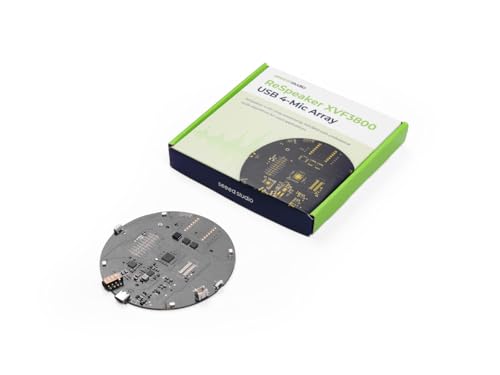
Best for developers who want full control over enclosure and integration. The XVF3800 engine enables AEC, adaptive beamforming, dereverberation, DoA, VAD, dynamic noise suppression, and 60dB AGC. It supports far-field voice capture up to 5 meters with a circular four-microphone array. The USB interface requires no drivers, and it is compatible with Windows, macOS, Linux, Raspberry Pi, and NVIDIA Jetson, making it a versatile base for AI voice applications and robotics. Choose this if you need maximum customization and per-application tuning.
Best for: developers, hardware engineers, and AI voice projects that demand open hardware and flexible mechanical design.
Caution: While very flexible, the bare-board form requires enclosure and mechanical integration work, which may extend the build timeline.
Seeed Studio reSpeaker XVF3800 USB Microphone Array with Case

Best for classrooms, kiosks, and small conference spaces that require portable, ready-to-use hardware. The built-in XVF3800 features remain the same—three core benefits are 360° far-field capture up to 5 meters, advanced AEC, and plug-and-play USB. The included case protects the array during transport and supports straightforward deployment in teaching labs or demo stations. This option reduces setup time for multi-user environments and helps ensure consistent voice pickup across the room.
Best for: educators, event kiosks, and demonstration pods seeking quick deployment with transport protection.
Caution: The case adds some bulk; plan for slightly larger mounting and cable routing compared with the bare board.
Seeed Studio reSpeaker XVF3800 4-Mic Array with XIAO ESP32S3 and Case

Best for enclosed prototyping where you want an integrated microcontroller. Onboard XVF3800 delivers AEC, beamforming, dereverberation, DoA, VAD, AGC, and noise suppression before audio reaches your application, and the 360° four-microphone array supports pickup from multiple directions up to 5 meters. The included case minimizes enclosure design work, letting you focus on validating voice interactions and evaluating form-factor constraints in a compact footprint.
Best for: teams building enclosed voice devices or kiosks that require a compact, ready-to-integrate package.
Caution: Some users may prefer a fully custom enclosure, which can reduce the convenience provided by the case.
Seeed Studio ReSpeaker Mic Array v2.0 Microphones XMOS’s XVF-3000
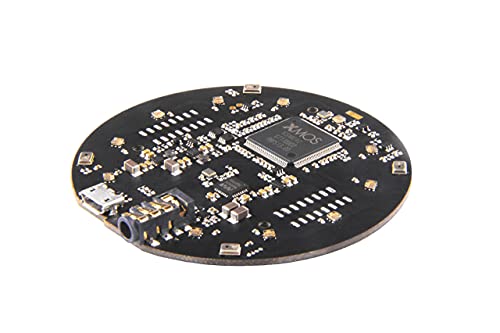
Best for foundational far-field voice capture with straightforward integration. The XVF-3000 enables far-field capture up to 5 meters, using DoA to focus on the speaker while ignoring extraneous noise. It supports USB Audio Class 1.0 (UAC 1.0) and is favored for projects aiming to add reliable voice pickup to custom devices. Choose this when you want legacy-compatible, easy-to-use hardware with well-understood interfaces for quick prototyping.
Caution: It relies on DoA for directionality, which may require calibration in highly reflective rooms or unusual layouts.
Seeed Studio reSpeaker XVF3800 4-Mic Array with XIAO ESP32S3, Bare Board

Best for custom integrations where enclosure control is essential. This bare-board option preserves mechanical flexibility while maintaining full XVF3800 processing for AEC, beamforming, dereverberation, DoA, VAD, and AGC. The four-microphone array provides consistent 360° pickup up to 5 m, supporting diverse deployment scenarios from robots to kiosks and embedded devices. Choose this if you want maximum freedom to create a tailored housing and user experience.
Caution: Requires additional hardware design and assembly, which may extend project timelines for hardware prototyping tasks.
FIFINE K6 Karaoke Microphone

Not a far-field microphone array, but included to contrast dedicated handheld vocal mics with multi-mic capture options. This device focuses on dynamic vocal performance rather than room-wide voice pickup. It is best for live singing or presentations where a hand-held mic is preferred and background noise needs to be managed with cardioid pickup. Avoid using in a fixed, room-wide voice capture setup where array mics provide a cohesive 360° field.
FIFINE K690 USB Studio Recording Microphone
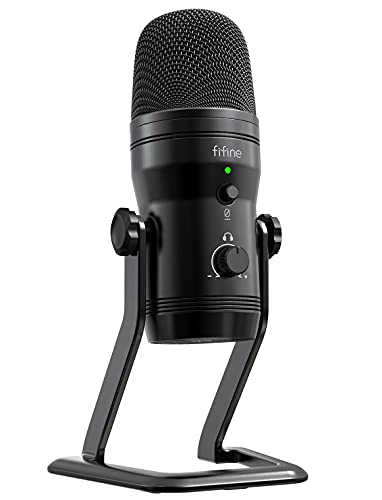
Best for versatile desktop recording with multiple pickup patterns. The K690 offers cardioid, omni, bidirectional, and stereo modes, enabling flexible recording setups beyond far-field array requirements. It is suitable for podcasting, ASMR, and streaming where varied microphone patterns are beneficial. If your primary goal is a single, adaptable USB microphone for diverse tasks, consider this as a complementary choice rather than a direct replacement for 360° far-field systems.
Buying Guide: Key Considerations for Far Field Microphone Arrays
- Coverage area: Most 4-mic XVF3800 arrays support up to 5 meters of far-field capture; confirm room size and required pickup radius before selecting.
- Processing features: look for built-in AEC, beamforming, dereverberation, DoA, and AGC to reduce post-processing needs.
- Interface and integration: USB plug-and-play is ideal for quick deployment; bare-board options offer maximum enclosure flexibility.
- Enclosure and mounting: cases simplify transport and deployment; bare boards require custom enclosures and mounting solutions.
- Compatibility: ensure compatibility with your operating system and development environment (Windows, macOS, Linux, Raspberry Pi, NVIDIA Jetson).
- Room acoustics: highly reverberant spaces may benefit from additional acoustic treatment and calibration for best DoA accuracy.
- Future expansion: consider whether you may want to add edge processing (ESP32S3 or similar) or integrate with existing AI pipelines.
FAQ
- What is a far-field microphone array used for?
It is used to capture speech from multiple directions at a distance, improving clarity in meetings, smart devices, and robotics.
- Which product is best for rapid deployment?
The reSpeaker XVF3800 USB Microphone Array with Case offers quick setup with protective housing for easy transport.
- Do these arrays require drivers?
Most Seeed XVF3800 USB models are plug-and-play; drivers are not typically required on supported systems.
- What should I consider when choosing between bare board and case variants?
Bare boards maximize customization and enclosure control; cases speed up deployment and reduce mechanical design work.
- Can these arrays work with edge devices like ESP32?
Yes, some variants include ESP32S3 boards for onboard processing, enabling edge AI capabilities.
- Are these suitable for large conference rooms?
They are designed for up to about 5 meters of pickup; for larger rooms, consider multiple arrays or additional room acoustics optimization.