
Best Fiber Optic to Coaxial Adapters for Reliable Home Networking and AV
Looking for the best fiber optic to coax adapter solutions for a home network or TV setup? This guide spotlights five practical options that transform fiber signals for cable TV, audio, and data transmission. It targets common buyers: homeowners upgrading FTTH, home theater enthusiasts linking fiber to coax-based gear, and IT-conscious users needing reliable, plug-and-play adapters. Below is a quick buying overview and a summary of the chosen products to help you compare at a glance.
| Product | Best For |
|---|---|
| QIANRENON Cable TV Passive Fiber Mini Receiver | FTTH fiber-to-TV signal conversion for in-home setups |
| Bi-Directional Coax Digital Audio Adapter | Two-way digital audio between coax and optical Toslink |
| XMSJSIY LC to FC Fiber Optic Adapter | Precise fiber interconnections with low loss |
| DIYTECH Fiber Optic And Coax Wall Plate | Integrated fiber and coax wall plate for clean installs |
| Groword UPC-LC SC FC Adapter Kit | Versatile adapter kit for mismatched fiber cords |
QIANRENON Cable TV Passive Fiber Mini Receiver Module

Best for: FTTH environments needing stable fiber-to-TV conversion. This passive receiver handles SC/APC fiber input with an imperial F-type output, designed for in-home cable digital/analog TV signals. Its filtering function aims to reduce signal noise and improve HD stability, making it suitable for compact residential setups where fiber access meets home TV networks. Caution: as a passive unit, it relies on compatible signal strength and may not replace active headend devices in larger deployments.
Bi-Directional Coax Digital Audio Adapter

Best for: Audio-focused setups where you need to convert between coaxial and Toslink signals. This 2-way digital audio converter supports Coax to Toslink and Toslink to Coaxial, with plug-and-play operation and no software required. It provides noise-free transmission for connecting amplifiers and speakers. Limitation: as an audio-centric adapter, it does not handle video signals or data transmission beyond digital audio formats.
XMSJSIY LC to FC Fiber Optic Adapter

Best for: Precise fiber interconnection between devices, offering an FC/UPC male to LC/APC female hybrid. It emphasizes low insertion loss and high return loss across 1310 nm and 1550 nm wavelengths. The high-temperature and chemical-resistant ceramic sleeve supports stable performance in diverse environments. Caution: performance depends on proper alignment and cleanliness of fiber connectors to maintain specified loss figures.
Groword UPC-LC SC FC Fiber Optic Adapter Kit
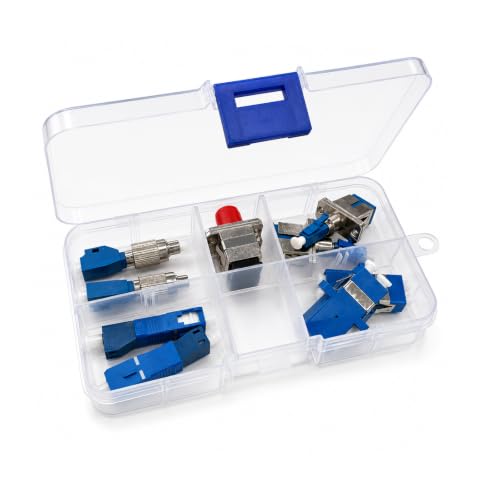
Best for: Complete kit users who need to connect mismatched LC, SC, and FC fiber cords for data center wiring, fiber testing, or telecom construction projects. The kit includes multiple adapters and an adjustable storage box, enabling organized workflows. Caution: ensure correct pairings (connector type and ferrule style) to avoid unnecessary adapters, and verify compatibility with your fiber type (single-mode versus multi-mode).
Buying Guide
Key considerations for choosing fiber optic to coaxial adapters:
- Signal type and compatibility: Confirm whether you need passive fiber-to-TV, digital audio, or inter-device fiber connections. Select adapters designed for your fiber type (SC, LC, FC) and connector polish (UPC/APC).
- Insertion loss and return loss: Look for ceramic ferrules and precision alignment to minimize light loss. Low insertion loss and good return loss improve signal integrity, especially in long cable runs.
- Environmental suitability: Consider temperature tolerance and durability if the device will sit in a rack, cabinet, or outdoor area. Some adapters specify operating ranges suitable for telecom-grade installations.
- Ease of installation: Plug-and-play or simple plug-and-play with no software is advantageous for quick setups. Avoid solutions requiring drivers in typical home environments.
- Versatility vs. specialization: A multi-adapter kit offers flexibility for mismatched cords, while single-purpose adapters optimize performance for a specific task. Budget considerations may favor kits for broader use.
- Physical design: All-metal or ceramic ferrule components enhance wear resistance and stability. Compact designs help with space-constrained installs like wall plates or behind AV racks.
FAQ
- What is a fiber optic to coax adapter used for?
It enables signal conversion or interconnection between fiber and coaxial components, supporting TV signals, audio, or data transmission in mixed-technology setups.
- Are these adapters suitable for home theaters?
Yes, especially the ones designed for Toslink and coaxial audio, and wall-plate solutions that keep installations neat.
- Do all adapters require active power?
No, most listed options are passive and rely on the source signal; active devices may be needed for longer runs or degraded sources.
- What should I check before buying a fiber adapter kit?
Check connector types, fiber mode (single- vs multi-mode), insertion loss specs, and whether the kit covers the needed pairings for your project.
- Can I mix adapters from different brands?
While possible, ensure compatibility in connector types and ferrule standards to minimize loss and misalignment.
- Is APC polish important?
APC (Angled Physical Contact) reduces back reflections, which is beneficial for precise fiber links and high-return-loss requirements.