Best Graphic Equalizer Spectrum Analyzer for Home Studios
Answering the search for a graphic equalizer spectrum analyzer, this guide compares five top options ideal for home studios, DJ setups, or hobbyists seeking precise frequency control and visual feedback. Each pick targets a different user type, from musicians needing versatile input options to DIYers wanting easy installation. Below, you’ll find a quick product table, detailed sections, and a practical buying guide to help you decide.
| Product | Best For | Why It Stands Out |
|---|---|---|
| Nobsound AK2515 Pro Audio Spectrum Analyzer | Musicians and sound enthusiasts | High-resolution VFD display with wide 20 Hz–20 kHz range and versatile inputs |
| FULODE 31-Band Digital Equalizer | Home studios needing presets | 10 presets, BYPASS, LED spectrum, rack-mount design |
| Rockville REQ42-B Dual 21-Band EQ | Rack-based professional setups | Dual 21-band bands, 19″ rack-ready, front-accessible MP3 input |
| MICNAUX 31-Band Graphic Equalizer | Studio and home theater integrations | 31-band DSP with LED spectrum, 10 presets, Bluetooth 5.2 and USB |
| [Upgraded] VFD Audio Spectrum Analyzer Bluetooth 5.0 Receiver (Douk Audio) | Compact setups with Bluetooth | 25×15 VFD display, Bluetooth 5.0, multiple 3.5 mm inputs, precise clock |
Nobsound AK2515 Pro Audio Spectrum Analyzer

The Nobsound AK2515 focuses on a precise 20 Hz–20 kHz spectrum with a 25×15 high-resolution VFD display. It includes a dedicated MIC input and an SD3078-based clock oscillator for stable timing accuracy. This makes it well-suited for musicians and sound engineers who rely on accurate visual feedback. Best for users who want a visually striking, clock-stable spectrum analyzer with flexible input options.
Designed for versatility, it offers a 3.5 mm AUX input and MIC input to accommodate wired interfaces and some wireless devices. The advanced AGC and multiple display modes help tailor the visualization to your signal. Caution: the device’s feature set can be dense, making setup more involved for first-time users.
Best for: Musicians, sound technicians, and enthusiasts who value precise display accuracy and broad input compatibility. If you want a standout VFD readout with customization, this is a strong pick.
FULODE 31-Band Digital Equalizer

The FULODE 31-band digital equalizer provides an upgrade-oriented solution with 31 segments and LED spectrum indication. It features real-time frequency observation and a BYPASS switch for quick debugging. Ten preset modes and independent high/mid/bass adjustments offer flexible tuning for home studios and small venues. Best for: users who want a rack-mountable, adjustable EQ with visual feedback and convenient debugging.
Its LED lighting not only makes frequency shifts visible but also creates a user-friendly aesthetic in dim rooms. A notable limitation is the reliance on LED indicators for real-time visuals, which may be less precise than a dedicated spectrum analyzer for critical measurements. Best when you need an all-in-one EQ with straightforward installation.
Rockville REQ42-B Dual 21-Band Graphic Equalizer
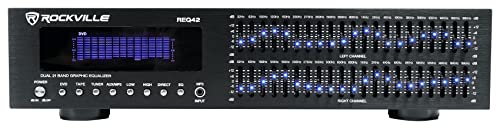
The Rockville REQ42-B offers dual 21-band graphic equalizers in a 19″ rack-ready chassis. It supports a wide 20 Hz–20 kHz range with front-panel access and RCA input/output options for seamless integration into studio rigs or live setups. This model is best for users who need two independent EQ paths and a sturdy rack-mount form factor for professional use.
RCA connectivity and a simple front-panel selector enable quick routing changes. A potential limitation is the absence of built-in Bluetooth or USB audio playback, which means it relies on external sources for wireless or digital inputs. Choose this if your workflow centers on fixed RF-free analog signal processing in rack setups.
MICNAUX 31-Band Graphic Equalizer

The MICNAUX 31-Band Graphic Equalizer combines a DSP-based 31-band system with an LED spectrum display and 10 customizable presets. It includes Bluetooth 5.2 and USB playback, enabling wireless streaming and easy file-based listening. This makes it suitable for home theaters, studios, and multi-device setups that require flexible connectivity and recallable tone profiles.
Best for: users who want a modern all-in-one EQ with wireless streaming and USB playback options. Limitation: Bluetooth performance can vary by environment, and DSP-based processing may introduce latency in certain live situations. Choose this for a connected, versatile home audio hub.
NELLN Equalizer Home Audio 31 Bands

This 31-band graphic equalizer emphasizes real-time monitoring with a spectrum display and 12 preset modes. It supports independent band tuning and noise reduction, making it suitable for both home and studio environments. It also emphasizes broad connectivity through optical/coaxial inputs and USB playback, which helps unify multiple devices in a single system.
Best for: those seeking precise control with noise-reduction features and flexible input options. Limitation: Some users may prefer more compact form factors for desktop setups. Consider this when you need robust multi-input processing in a relatively larger unit.
[Upgraded] VFD Audio Spectrum Analyzer (Douk Audio)

The Douk Audio VFD spectrum analyzer combines a green 25×15 high-resolution VFD display with Bluetooth 5.0 receiver and a dual 3.5 mm AUX input arrangement. It uses a precise RX8025T crystal oscillator for clock accuracy and includes an AGC algorithm and customized output curve to maintain readable visuals across input ranges. Best for compact setups needing a clear spectrum readout plus wireless connectivity.
Best for: users who want a tidy, Bluetooth-enabled spectrum tool with a robust VFD display. Limitation: It emphasizes visualization over a broad feature set, so it may not replace a full professional EQ in critical tone shaping. Choose this for an affordable, space-saving spectrum analyzer with wireless input options.
Buying Guide
What should I look for in a graphic equalizer spectrum analyzer?
- Frequency range and resolution: Ensure the unit covers the audible spectrum (typically 20 Hz–20 kHz) with a sufficient number of bands for your needs (e.g., 31 or 21 bands).
- Display type and readability: VFD/LED displays offer different visibility in various lighting. Decide which surface readout best suits your environment and workflow.
- Connectivity: Consider whether you need Bluetooth, USB playback, optical/coaxial, or traditional RCA inputs. Matching your existing gear matters for minimal setup friction.
- Presets and intuitive controls: Look for presets and easy-to-use interfaces, especially if you work across genres or live and studio contexts.
- Rack compatibility: If you have a studio rack, ensure the unit fits standard 19″ rack space and includes rack ears or a compatible mounting system.
- AGC and display modes: Automatic gain control and multiple display modes can help tailor visualization to different input signals and use cases.
Practical comparisons
- Best for visual precision: Nobsound AK2515 with high-resolution VFD and multiple display modes.
- Best for presets and ease of use: FULODE’s 10 presets and BYPASS feature.
- Best for professional rack setups: Rockville REQ42-B with dual channels and rack-mount readiness.
- Best for modern connectivity: MICNAUX with Bluetooth and USB playback beyond traditional EQ functions.
- Best compact option with wireless input: Douk Audio VFD spectrum analyzer with Bluetooth 5.0.
Choosing by scenario
- Home studio owner needing precise sound shaping and a visible spectrum: consider Nobsound AK2515 or MICNAUX.
- Live sound or DJ rig requiring reliable rack integration: Rockville REQ42-B is a strong fit.
- Multimedia setup with streaming: MICNAUX or FULODE provide convenient presets and playback options.
FAQ
- What is the main difference between a graphic equalizer and a spectrum analyzer?
– A graphic equalizer adjusts specific frequency bands in real time, while a spectrum analyzer visualizes the signal’s frequency content, which can guide adjustments. - Do these units require calibration?
– Some models include precise clock oscillators and AGC algorithms to stabilize visuals, but routine calibration may not be necessary for typical home use. - Is Bluetooth necessary for all these devices?
– No. Bluetooth adds wireless input or streaming options; some models focus on wired connections or rack-based processing. - Can I use these with a computer or DAW?
– Yes, many support USB playback or line-level inputs suitable for integration with PCs and DAWs, depending on the model. - Which one is best for beginners?
– Models with BYPASS, presets, and straightforward front-panel controls are often easiest for new users to learn and apply. - Do these units affect audio quality?
– They alter the signal path to shape tonal balance, so quality depends on the design quality and how you apply the EQ settings.