Best Guitar Interface for PC: Clear Picks for Recording, Live Streaming, and Practice
Looking for a reliable guitar interface for PC that delivers pro-sounding recordings and smooth latency? This guide highlights five top USB audio interfaces that suit guitarists, vocalists, podcasters, and home producers. They range from compact solo units to versatile two-channel models, all designed to plug into a Windows or Mac computer. Best for solo guitar tracks, podcasting, and small home studios, these interfaces balance clean sound with user-friendly features like direct monitoring and instrument inputs. The table below compares the key options at a glance to help you choose quickly.
| Product | Best For | Main Strength |
|---|---|---|
| Focusrite Scarlett Solo 3rd Gen | Guitarists and vocalists seeking pro preamps | Air mode, high-headroom instrument inputs, 24-bit/192kHz |
| Focusrite Scarlett Solo 4th Gen | Songwriters and solo performers needing studio-grade conversion | Improved Air mode, huge dynamic range |
| M-AUDIO M-Track Solo | Budget-conscious home studios and beginners | USB 2-in/2-out versatility with basic monitoring |
| M-AUDIO M-Track Duo | Podcasters and streamers needing dual input options | Dual XLR/Line/Instrument inputs with easy monitoring |
| MAONO PS22 Lite | Artists needing 24-bit/192kHz fidelity on a budget | High-resolution recording, loopback, USB-C convenience |
Buyer note: The top picks are selected for compatibility with PCs, ease of use, and reliable performance for guitar and vocal work. If you plan heavy multi-track projects, prioritize higher dynamic range and better converters. If you need simple practice and streaming setups, a compact unit with solid zero-latency monitoring can be ideal.
Focusrite Scarlett Solo 3rd Gen Review

Best for solo guitar and vocal work, this interface emphasizes pro pre-amps and an Air mode that adds brightness to acoustic instruments. It features two high-headroom instrument inputs to ensure your guitar or bass shines through, along with gain halos to prevent clipping. The 24-bit/192kHz converters deliver studio-quality recording and mixing capabilities. This edition is suited for players who want a compact, reliable solution that preserves sonic nuance in both guitar and vocal takes.
Who it’s for: guitarists and vocalists seeking a portable, high-fidelity interface with studio-grade conversion. Why selected: the combo of Air mode, strong preamps, and robust converters makes it a strong all-around choice for home studios. Caution: Limited to two inputs; not ideal for multi-muitar setups without additional expansion.
Focusrite Scarlett Solo 4th Gen Review

The 4th Gen builds on its predecessor with an expanded dynamic range and the same acclaimed Air mode for vocal and guitar presence. This interface is best for solo performers who want studio-grade sound in a compact desktop unit, with reliable low-latency monitoring and easy setup. It’s well-suited for indie singers, songwriter-guitarists, and podcasters who record demos at home.
Who it’s for: songwriters and solo performers needing top-tier conversion and front-end clarity. Why selected: the improved dynamics and Air mode help vocals and guitars cut through a mix more naturally. Caution: Slightly pricier than basic two-input models, but the value is in the sound quality and future-proof conversion.
M-AUDIO M-Track Solo Review
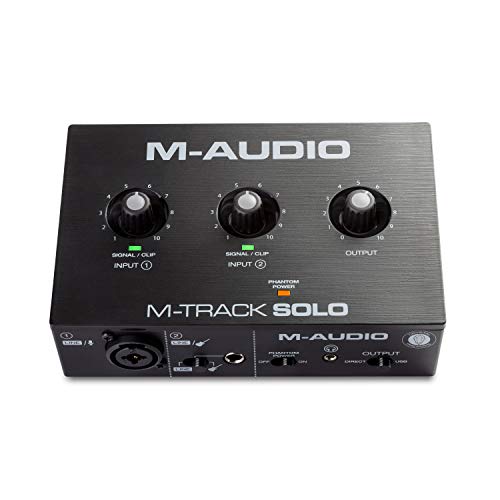
Best for beginners and budget-minded players, the M-Track Solo offers a straightforward two-input setup with XLR and instrument connections. It provides 48kHz recording resolution and simple monitoring options. This model is a solid starting point for practice rooms, home studios, and basic guitar/vocal demos without extra fuss.
Who it’s for: new producers and hobbyists needing an uncomplicated workflow. Why selected: its simplicity, reliability, and included software suite help new users get up and running quickly. Caution: Fewer advanced features than higher-end models; may feel limiting for complex projects.
PIYONE 2×2 USB Interface Review

Best for versatile PC or Mac setups needing reliable two-channel input with USB-C power. The PIYONE interface delivers 24-bit/192kHz fidelity with a modern look and fixed LED gain indicators. It’s designed to be plug-and-play without drivers, making it suitable for writers who want quick, clean guitar and vocal recordings.
Who it’s for: users needing USB-C, driver-free operation, and solid fidelity. Why selected: the driverless setup and stylish, illuminated controls make it a practical choice for quick sessions. Caution: Limited to two inputs, which may require a second unit for multi-instrument setups.
Buying Guide: Key Purchase Considerations
What should you consider when choosing a guitar interface for PC?
- Number of inputs: Do you need two inputs for guitar and microphone at once, or more for multi-instrument presets?
- Latency and monitoring: Look for zero-latency monitoring and direct monitoring features to avoid tracking delays.
- Converter quality: 24-bit/192kHz performance is a common benchmark for clear, studio-like sound.
- Preamp quality and gain range: Higher headroom reduces clipping and preserves dynamics when you crank your guitar amp tone or mic a loud guitar amplifier.
- Compatibility: Ensure USB-C or USB-A compatibility with your computer, plus driver-free operation if possible.
- Portability and build: Compact units are ideal for laptops and small studios; durable builds suit mobile recording workflows.
- Software bundle: A solid software suite can help you get started with recording, mixing, and monitoring.
Which interface should you pick for a home guitar rig?
For solo guitar and vocal work in a small studio, Focusrite Scarlett Solo 3rd Gen or 4th Gen provides strong preamps and clear converters. If you’re budget-conscious or new to recording, M-AUDIO M-Track Solo or Duo offers dependable basics with easy monitoring. For those who want high fidelity with a stylish setup, MAONO PS22 Lite is a strong value, especially if you prefer USB-C power and 192kHz recording. Consider your need for input count, latency, and software when deciding.
FAQ
- Q: Do I need a separate microphone for my guitar interface?
A: Not necessarily; you can record direct guitar or microphone input via the instrument or XLR inputs, depending on your setup. - Q: What is “Air” mode in Focusrite interfaces?
A: Air mode enhances high-end presence, giving vocals and guitars a brighter, more open feel in the mix. - Q: Is latency a concern with basic USB interfaces?
A: Some latency is expected, but many models offer zero-latency monitoring or very low monitoring latency for real-time playing. - Q: Can these interfaces power studio mics with phantom power?
A: Several models include phantom power (48V) for condenser mics; check each model’s specs to confirm. - Q: Do these interfaces work with Mac and PC equally?
A: Most listed units are compatible with both, with driver-free operation often available for convenience. - Q: Do I need an external audio interface if I only record guitar?
A: For high-fidelity guitar tracing with minimal setup, a two-input interface is typically sufficient.