
Best Guitar Pedal Rack Mount Solutions for Ready-to-Go Rig Setup
Answer: For a compact, durable, and portable pedal setup, these five pedal rack options cover different needs—from ultra-light boards for travel to sturdy brackets for modular rigs. The SOLUTEK 14/16-Inch pedalboard is ideal for gigging players who need a hard-anodized, weather-resistant board. The GOKKO Small Pedal Board suits players who want a lightweight, compact board with a tilt angle for easier stomping. The On-Stage SR5 Synth Rack works well for organizers who need integrated cable management and transportable racks. The GOGHOST 20×8 board is best for multiple pedals with a portable, durable build. The DYVBXS two-piece tilt brackets fit modular setups and custom configurations.
Summary table of chosen products:
- SOLUTEK 14/16-Inch Guitar Pedalboard — Best for: Gigging players needing a rugged, travel-ready board.
- GOKKO Small Guitar Pedal Board — Best for: Budget-conscious players seeking a compact, tilted board.
- On-Stage SR5 Synth Rack — Best for: Small rig with integrated cable management and transport bag.
- GOGHOST Medium Guitar Pedal Board — Best for: 5–6 mini pedals with solid aluminum construction.
- DYVBXS Mini Tilt Brackets — Best for: Custom or modular pedal setups with secure mounting.
SOLUTEK 14/16-Inch Guitar Pedalboard

Best for: Gigging players who need a robust, compact, and road-ready pedalboard. Why selected: It features a professional-grade tubular aluminum frame, a military-spec hard-anodized finish, and a compact size to hold 3–5 standard pedals. The combination of strength, scratch resistance, and portability makes it a strong all-around option for frequent performers.
Top considerations: This board emphasizes durability over ultra-lightweight; it is designed to withstand nightly gigs with minimal flex. A potential limitation is that it holds a fixed number of pedals, so very large pedal arrays may require a larger board.
GOKKO Small Guitar Pedal Board
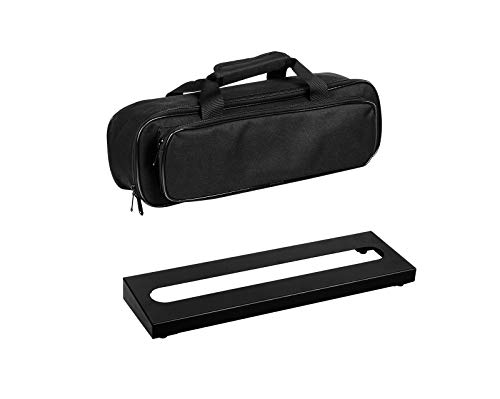
Best for: Players seeking a lightweight, affordable board with a shallow footprint. Why selected: It measures 15.7″ x 4.9″ and holds 4–5 pedals in most cases, and uses solid steel for durability. The 8-degree tilt makes stomping easier, which is crucial for performers who switch presets mid-song.
Caution: Slightly smaller boards may limit larger or newer pedal footprints; verify pedal dimensions before purchase.
GOGHOST Medium Guitar Pedal Board

Best for: Musicians needing a mid-size board with ample space for 5–6 mini pedals. Why selected: Aluminum alloy construction offers a durable, lightweight frame, with a size of 20x8x1.2 inches and included carrying bag. It also mentions multiple channels for routing cables, supporting a tidy signal chain.
Limitation: While portable, the board may still be heavier than ultra-light options, and pedal layouts can require planning to maximize space.
DYVBXS Mini Tilt Brackets (2-Piece Set)

Best for: Customizing smaller setups or adding tilt functionality to existing boards. Why selected: Each set includes a pair of tilt options (30° and 60°) to improve pedal visibility and access. They include hook-and-loop straps to secure pedals, promoting stability during performances.
Limitation: Requires a compatible base or board; brackets alone do not provide a full enclosure or case for transport.
TUOREN Guitar Effects Pedal Mounting Kit

Best for: Builders who want a complete mounting solution for a custom pedal board. Why selected: This kit includes 16 pieces of mounting brackets and screws designed to fit most guitar effects pedals. It’s durable and designed for long-term use, making it a practical addition to a modular setup.
Caution: Mounting hardware compatibility varies by pedal size and chassis; planning layout in advance helps avoid misfit screws or brackets.
Buying Guide: Key Considerations For Your Pedal Rack Setup
- Pedal count and footprint: Measure your current pedals and consider future additions. Choose boards with extra room if you plan to grow your rig.
- Material and durability: Aluminum frames offer rigidity and lightness. Hard-anodized finishes resist scratches and wear, keeping gear looking professional.
- Portability: If you travel often, prioritize lighter boards with carrying bags or integrated handles. Check weight limits and bag compatibility.
- Stability and tilt: A slight tilt aids foot access. Brackets and non-slip feet reduce pedal movement during performances.
- Cabling and organization: Look for built-in cable management or included accessories to maintain a clean, reliable signal path.
- Modularity: For evolving rigs, consider brackets or modular boards that let you reconfigure layouts without replacing the entire system.
- Protection during transport: Carrying bags, rack cases, and protective finishes extend the life of boards under gig conditions.
Frequently Asked Questions
- What is a guitar pedal rack mount and why do I need one?
A pedal rack mount provides a stable platform to hold multiple pedals in a single, organized unit, improving durability, transportability, and cable management for live or studio setups.
- How many pedals can a typical 14–16 inch board hold?
Most compact boards hold 3–5 standard pedals, depending on pedal size and layout. If you expand to larger footprints, consider a bigger board.
- Should I choose a finished aluminum board over a steel one?
Aluminum boards are lighter and rigid, with strong resistance to flex. Steel boards are heavier but can be exceptionally sturdy; your choice depends on portability needs.
- Are tilt boards worth it for live use?
Yes, tilting can improve pedal accessibility and visibility during performance, especially for stomp-heavy setups.
- Do I need mounting hardware with a pedal board?
Some boards include hardware; others require separate brackets or mounting kits. Check compatibility with your pedal models and the board’s mounting points.
- What should I consider for travel and storage?
Look for boards with protective finishes, included carrying bags, compact dimensions, and a layout that minimizes set-up time at gigs or rehearsals.