
Best Guitars for 12 Year Olds: Easy Play, Fun Beginnings and Lasting Versatility
Answering the top buyer question: which guitars are best for 12-year-olds just starting or advancing their skills? This guide highlights five suitable options that balance playability, size, and tone for growing players. Each pick is best for a specific need—starter learners, progressing players, or those seeking a compact, travel-friendly option. Below is a quick summary table to compare essentials at a glance.
| Product | Best For | Why Pick |
|---|---|---|
| Winzz Electro-Acoustic Guitar | Beginner to Early Intermediate | Full-size comfort with beginner-friendly features |
| Fender Squier 3/4-Size Mini Strat | Young players needing smaller body | Compact, kid-friendly, versatile tone |
| Loog Mini Acoustic (3 strings) | Absolute beginners (young ages) | Three strings simplify chord learning and confidence |
| GEWA E-Acoustic Classical 3/4 | Classical style learners | Nylon-like feel with smaller neck and 3/4 size |
| Raimy 21in Kids Ukulele Guitar | First instrument for tiny hands | Very small, approachable, good starter sound |
The following sections describe each pick in detail. Each product section indicates who it’s best for, why it fits a 12-year-old learner, and a practical caveat to consider.
Winzz Electro-Acoustic Guitar For Beginners
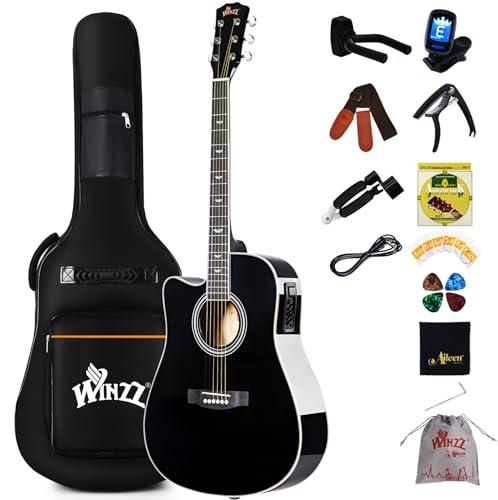
Best for: beginners who want a full-size instrument with built-in electronics. This 4/4 guitar supports later transition to standard 6-string play while offering acoustic-electric versatility for practice and jam sessions.
Why selected: It includes a comprehensive accessories bundle—bag, wall mount, strap, 3-in-1 winder, tuner, capo, spare strings, picks, cloth, wrench, and bag. The design adds a playful peach-shaped top pattern and the exclusive “W” fret markers to aid beginners locating notes faster.
Consideration: This is a full-size instrument. If your 12-year-old has shorter reach or prefers a smaller body, another 3/4-size option may be more comfortable initially.
Fender Squier 3/4-Size Mini Strat Bundle

Best for: kids aged 6–12 who need a smaller, comfortable instrument without sacrificing versatility. The 22.75″ scale length and 3/4-size body are friendly to developing hands.
Why selected: The C-shaped neck and 20-fret board support easy chord shapes and scales, with three single-coil pickups offering a broad tonal palette for various styles. It’s a practical, all-in-one starter kit including an amplifier and accessories.
Limitations: Smaller body may feel cramped for taller tweens who are transitioning to full-size guitars; plan for a future upgrade when they outgrow 3/4 size.
Loog Mini Acoustic Kids Guitar

Best for: absolute beginners aged 3+ who want a real guitar experience with minimal setup friction. Although marketed for younger kids, the Loog size can work for smaller hands in early stages.
Why selected: Three-string design accelerates chord familiarity and simple song-play. It includes a learning app and lessons, facilitating a structured path from day one and transferability to standard six-string guitars later on.
Caution: Some players prefer standard six-string familiarity from the start; if your child progresses quickly, you may switch to a 6-string soon after mastering basics.
Raimy 21-Inch Kids Ukulele Guitar

Best for: young learners who need a tiny, affordable instrument to build confidence before tackling full-sized guitars. This size is especially approachable for smaller hands and developing coordination.
Why selected: Sympathetic design and durable construction suit beginners, providing a genuine playing experience rather than a toy. A good stepping-stone toward full-size guitar skills and rhythm fundamentals.
Limitation: It is a ukulele-style instrument; progress to a standard guitar will still require teaching and practice to carry over correctly.
GEWA 3/4 Nylon-Style E-Acoustic For Kids

Best for: children aged 9–12 who favor a classical playing feel and smaller neck dimensions. A 3/4 size helps with comfortable fretting and accurate intonation.
Why selected: The combination of pakka wood fingerboard and nylon-like playability offers easier string tension, making classical technique practice more forgiving for beginners. Nickel silver frets and chrome tuners support reliable tuning stability.
Important note: It is a hybrid design, so the feel resembles a classical yet can yield a brighter acoustic response depending on strings and playing style.
Buying Guide: How To Choose The Right Guitar For A 12-Year-Old
What size is best for a growing young guitarist? Start with 3/4-size instruments for kids under 12 who struggle with reach, then transition to full-size as skill and reach expand. Consider the child’s height, hand size, and whether they prefer a steel-string feel or nylon/classical softness for easier learning.
What playing style will guide the choice? If the child loves rock and modern pop, a versatile electric or electro-acoustic is helpful. For classical practice or formal lessons, a nylon-string or classical-style guitar can be a better fit. For quick chord learning, a simplified three-string design might accelerate confidence.
What about the learning path? Bundled kits with tuners, straps, and cases reduce setup friction and encourage regular practice. If a product includes a learning app or structured lessons, it can support independent practice and progression.
Durability and safety matter: choose instruments with child-safe materials, comfortable necks, and manageable string tension. A lighter guitar reduces fatigue during longer practice sessions.
Maintenance considerations: plan for restringing, simple adjustments, and occasional setup checks. A guitar with accessible tuning pegs and easy intonation is ideal for beginners.
FAQ
- What size is best for a 12-year-old starting guitar?
Typically 3/4-size is ideal for younger players, with full-size options available for those with longer reach or preference for a standard playing experience. - Should I choose a steel-string or nylon-string guitar for beginners?
Nylon-string (classical) guitars require less tension and are gentler on fingers, making them good for early beginners; steel strings are common for rock and pop styles but can be tougher initially. - Are bundled accessories worth it?
Yes. Bundles reduce extra purchases and help establish consistent practice habits with a ready-to-play setup. - Is a three-string beginner guitar better for younger kids?
Three-string designs simplify chords and build confidence quickly, but plan to move to a standard six-string to maintain long-term progression. - What should I look for in a beginner guitar’s neck and frets?
Look for a comfortable neck profile (C-shaped is common), easy-to-press strings, and smooth fretwork to prevent snagging fingers during early lessons. - How important is weight for a child?
A lighter instrument reduces fatigue and encourages longer practice sessions, especially for younger players.