
Best Half Rack Audio Interface Options for Compact Studio Setups
Looking for a compact, half-rack friendly audio interface or compatible rack-mounted gear? This guide highlights five suitable choices that fit slim rack spaces while delivering solid recording and live performance capabilities. The selections emphasize rack-mountable interfaces and related gear ideal for small studios, podcast setups, or on-the-go live rigs. Each product includes who it’s best for, key benefits, and a practical caveat to help you compare quickly. A quick summary table follows to help you scan options at a glance.
| Product | Type | Best For | Key Benefit | Note |
|---|---|---|---|---|
| Tascam US-16×08 Rackmount USB Audio/MIDI Interface | 8×8 USB Audio Interface | Home studios and project setups needing 16 inputs | Eight ultra-HDDA mic preamps with up to 56dB gain; rackmountable | Direct monitoring and ample IO |
| Samson Media Track Rackmount 4 Channel Mixer/Interface | 4-Channel Rackmount Mixer/Interface | Portable rack rigs with USB connectivity | USB interface integrated with a small mixer for quick routing | Limited channels vs. larger interfaces |
| Behringer X32 RACK 40-Input Digital Rack Mixer | Digital rack mixer with USB interface | Live sound and installations needing many inputs | 16 programmable MIDAS preamps; multiple outputs; remote control | 3U rack height, not a true half-rack unit |
| RME RM-19 Rackmount Kit (for Half-rack RME Devices) | Rack ears/kit | Expanding half-rack RME gear in a rack | Adds rack capability to compatible RME units | Requires compatible RME devices |
| VEVOR 12U AV Rack Stand | Rack cabinet for gear | Organized gear for portable studios | Open design with wheels for mobility; sturdy steel | Not an interface itself |
Tascam US-16×08 Rackmount USB Audio/MIDI Interface
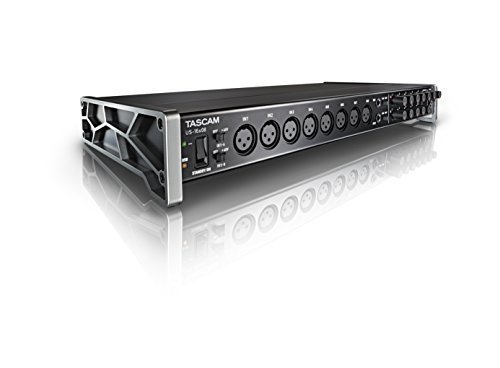
- Best for: Home studios and project setups that need 16 inputs in a rackable form factor.
- Why selected: 16 inputs with eight premium mic preamps provide clean gain and versatile routing. Rack-mount design suits compact spaces.
- What to know: Maintains a balance between portability and IO; consider your need for MIDI and line inputs beyond XLR first.
- Caution: Rico input gain requires careful gain staging to avoid noise in dense sessions.
Samson Media Track Rackmount 4 Channel Mixer/Interface

- Best for: Small setups needing a simple 4-channel mixer plus USB interface in a single 19″ chassis.
- Why selected: Combines a basic mixer with USB connectivity, enabling quick routing for podcasts or small ensembles.
- What to know: Fewer channels than larger interfaces; ideal for lightweight mobile rigs.
- Caution: Integrated mic preamps are adequate but not top-tier for demanding studio tasks.
Behringer X32 RACK 40-Input Digital Rack Mixer

- Best for: Live setups or installations needing extensive input routing and on-board effects within a rack unit.
- Why selected: 16 MIDAS preamps and 40 inputs across a compact 3U chassis offer substantial flexibility and direct USB audio interface functionality.
- What to know: Not a native half-rack unit; may require adequate rack space and power planning.
- Caution: Complex enough that it benefits from a dedicated setup and labeling to avoid misrouting during gigs.
RME RM-19 Rackmount Kit

- Best for: Users with compatible half-rack RME devices looking to rack-mount them elegantly.
- Why selected: Adds sturdy rack ears enabling clean rack integration alongside other gear.
- What to know: Requires compatible RME devices to maximize benefits.
- Caution: Not a standalone interface; it’s a mounting accessory.
Pyle Rack Mount Studio Pre-Amplifier – PPRE70BT

- Best for: In-room setups needing a pre-amplifier with built-in Bluetooth and recording options in a rack-friendly format.
- Why selected: Combines pre-amp functionality with Bluetooth streaming and media features in a compact chassis.
- What to know: Not a dedicated audio interface; suitable for combining with a separate USB/audio interface.
- Caution: Bluetooth features may introduce latency for live monitoring unless managed properly.
Buying Guide: Half Rack Audio Interface Essentials
- What counts as half-rack: Look for 1U or compact 2U designs that fit standard 19″ racks with reduced height. If a device is 3U or deeper, plan space accordingly or consider a dedicated rack drawer or stand.
- Interface vs. mixer: Decide if you need pure audio interface inputs or integrated mixing and routing options. A rack-mount mixer/interface can simplify live setups but may be bulkier than a dedicated interface.
- Preamplifier quality: Mic preamps impact noise and headroom. For vocal work or critical recordings, prioritize gear with clean gain stages and low self-noise.
- IO configuration: Ensure the number and type of inputs/outputs align with your workflow (XLR, line, instrument, MIDI, USB, etc.).
- Compatibility: Confirm compatibility with your computer, DAW, and any required drivers. Some devices offer native macOS/Windows support and class-compliant USB operation.
- Expansion and future needs: If you anticipate growing your rig, prefer devices with scalable I/O, robust USB interfaces, and reliable driver updates.
- Cabling and organization: Plan cable management within the rack—labeling and proper routing help reduce signal interference and setup time.
Frequently Asked Questions
- What is a half-rack audio interface? A half-rack refers to equipment sized to occupy about half the height of a standard 19″ rack, typically 1U or a compact 2U, designed for space-saving audio interfaces or related gear.
- Can I use a non-rack-mount interface in a rack? Yes, with a rackmount kit or tray, provided the unit fits your rack and has compatible mounting points.
- Are digital rack mixers suitable as interfaces? They can be, if they provide USB or USB-C audio interface capabilities in addition to mixing functions.
- Which is better for podcasts: small rack mixer or dedicated USB interface? A small rack mixer/interface can simplify monitoring and routing for podcasts, but a dedicated interface may offer cleaner preamps and higher channel counts for future expansion.
- Do I need powered racks for these devices? Many rack units are self-powered, but ensure you have adequate power distribution in your rack to support all devices safely.
- Is latency a concern with rack-mounted interfaces? Latency depends on the device, driver, and buffer settings. Modern interfaces aim to minimize latency, but monitor for system-specific delays.