
Best Headphone Amps With Multiple Inputs for Studio Sessions
Find the right headphone amplifier when you need multiple independent listening mixes. This guide highlights five top options, explains who each is best for, and clarifies the key trade-offs. Ideal buyers include recording engineers, bands practicing together, and educators needing reliable multi-output monitoring.
The table below summarizes the selected products to help you compare at a glance.
| Product | Best For | Inputs/Outputs | Key Benefit |
|---|---|---|---|
| Mackie HM-4 Headphone Amplifier | Small studios or classrooms needing four independent outputs | 4 x 1/4″ and 1/8″ outputs | Each listener has own volume control |
| TONALUXE 8-Channel Headphone Mixing | Professional studios requiring many simultaneous mixes | 8 channels, 16 outputs, mono/stereo modes | High-power, low distortion with dedicated rear inputs |
| Bolanle PH800 8-Channel | Bands and studios needing versatile 16-output setup | 16 outputs (8× 3.5mm, 8× 6.35mm) | Mono/Stereo per channel, strong headphone drive |
| ELZONYX 4 Channel | Compact setups requiring four independent channels | 4 x 1/4″ outputs | Low-noise, clean stereo with independent level controls |
| FIFINE N6 4 Channels | Budget-conscious studios or stage setups | 4 x 1/4″ outputs, input via 1/4″ TRS | Compact, rugged, good isolation between channels |
Mackie HM-4 Headphone Amplifier (4-Channel)

The Mackie HM-4 provides four independent outputs with dedicated level control for each listener. It accepts sources via 1/4″ or 1/8″ connections, making it suitable for compact studios, rehearsal spaces, or classrooms where multiple musicians or students monitor a single mix. Best for those who need simple four-way distribution without complex routing.
Best for: small studios, educators, and session musicians who want individual volume control per listener. Caution: with four outputs, space and cable management can become a consideration in tighter setups.
TONALUXE 8-Channel Headphone Mixing

The TONALUXE system offers eight independent channels with 16 outputs and dual input modes (Mono/Stereo). It’s designed for professional monitoring, allowing eight discrete mixes and flexible routing. Built for high-end studios and live contexts, the unit uses premium components to support low distortion and a strong signal-to-noise ratio. Best for: advanced studios and live monitoring with many performers.
Best for: professional environments needing flexible routing and high headroom. Caution: a larger footprint and more complex setup than smaller multi-headphone units.
Bolanle PH800 8-Channel

The Bolanle PH800 drives up to 16 outputs across eight 3.5mm and eight 6.35mm jacks. It supports high-impedance headphones up to 250Ω, making it suitable for studio-grade headphones. Each channel has independent level control, and the unit offers mono/stereo options for flexible monitoring. Best for: bands and studios needing many independently controlled outputs.
Best for: multi-monitor setups where musicians require clean, loud individual feeds. Caution: configuration can be more complex due to the larger number of outputs.
ELZONYX 4 Channel Headphone Amplifier

The ELZONYX offers four independent headphone outputs with one 1/4″ input and four 1/4″ outputs. It uses a low-noise JRC4580 operational amplifier to maintain clean sound, ideal for studio monitoring, group listening, and rehearsal spaces. Best for: compact setups requiring quiet operation and reliable per-channel control. Caution: performance depends on source impedance and cable quality.
FIFINE N6 4 Channels
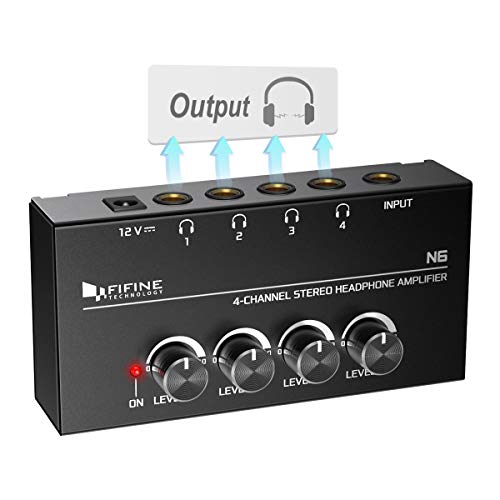
The FIFINE N6 provides four independent headphone outputs with individual volume controls. It’s compact and rugged, making it a solid choice for travel, small studios, or stage setups. Best for: budget-minded users who still need reliable multi-channel monitoring. Caution: input/output cabling requires TRS connections, and some users may want additional front-panel controls for quick tweaks.
Buying Guide: Key Considerations For Your Multi-Input Headphone Amp
What should you consider when choosing a headphone amp with multiple inputs? Start with your intended use, number of listeners, and whether you need front- or rear-panel access for routing. Consider these essential questions:
- How many independent headphone outputs are required, and do you need mono or stereo per channel?
- What impedance are your headphones, and is the amplifier capable of driving those loads cleanly?
- Do you require built-in routing options, or are independent volume controls sufficient?
- Will you connect multiple devices as inputs, and do you need rear-panel input jacks for clean routing?
- Is compact size or portability a priority, or is a larger, feature-rich model acceptable?
Audience and Scenarios
Small studios and classrooms benefit from four-channel options like the Mackie HM-4 for straightforward monitoring. For larger recording or live setups, the TONALUXE and Bolanle PH800 provide more channels and flexible routing to accommodate many performers. Space considerations and budget will influence whether the ELZONYX or FIFINE N6 is the best fit, with ELZONYX offering a neat middle ground and FIFINE delivering value for smaller budgets.
Setup Tips and Best Practices
- Label each headphone channel clearly to reduce monitor mix mistakes.
- Test each output individually before full sessions to confirm level and balance.
- Use balanced connections where possible to minimize noise in longer runs.
- Plan for future expansion by choosing models with more outputs than you currently need.
FAQ
- What is a headphone amplifier with multiple inputs best used for?
It enables several people to monitor the same or multiple audio sources with individual volume control, suitable for studios, rehearsals, or classrooms.
- Do these amps support mono or stereo monitoring per channel?
Many models support both modes, with some channels offering mono per channel and others providing stereo pathways depending on routing.
- Can a headphone amp handle high-impedance headphones?
Yes, several models are designed to drive high-impedance headphones (often up to 250Ω or more) with adequate headroom.
- Are rear inputs important for monitoring setups?
Rear inputs help with clean cable management and flexible routing, particularly in larger setups with multiple source devices.
- Is there a noticeable difference between four-output and eight/output models?
Eight-output models offer more solo monitoring options and routing flexibility but require more space and a larger setup.
- What should I consider if I plan to expand later?
Choose a model with more outputs or scalable routing options to avoid early upgrades.