Best Headphones for Electric Piano: Clear Monitoring for Practice, Recording and Performance
Choosing the right headphones for electric piano helps you hear every nuance—from delicate keyboard whispers to dynamic chord blends. This guide highlights five solid options that balance comfort, sound accuracy, and compatibility with keyboards, amps, and recording gear. Whether you’re a casual player, a home studio producer, or a live performer, these picks aim to match common needs like detailed mids, solid bass, and long-session comfort. The table below compares key attributes to help you decide at a glance.
| Product | Best For | Notable Strength |
|---|---|---|
| OneOdio Wired Over Ear Headphones | Home studio and podcasting | Strong bass and comfortable fit |
| PHILIPS Over Ear Wired Headphones | All-around studio monitoring | Versatile adapters for multiple devices |
| Sony ZX Series MDR-ZX110 | Travel and casual listening | Lightweight with portable design |
| Yamaha HPH-50B | Compact and on-the-go practice | 90-degree swivel and sturdy plug |
| PUPGSIS Wired Over Ear | Mixing, podcasting, and multi-user setups | High-resolution sound with share port |
OneOdio Studio Monitor Headphones for Music Production

Best for: Home studio makers, DJs, and podcasters who need reliable bass response and long-wear comfort. The 50mm drivers deliver powerful bass and clear highs for balanced stereo sound, aiding precise piano monitoring during practice and production sessions.
- Large 50mm drivers with neodymium magnets for robust bass and clear highs
- Soft, padded ear cushions and adjustable headband for extended use
- 90° swiveling ear cups support single-ear monitoring, useful for mixing
Limitation: Heavy, wired design may be less portable for on-the-go use. Best used in a fixed setup like a home studio or control room.
PHILIPS Over Ear Wired Stereo Headphones – Studio Monitoring
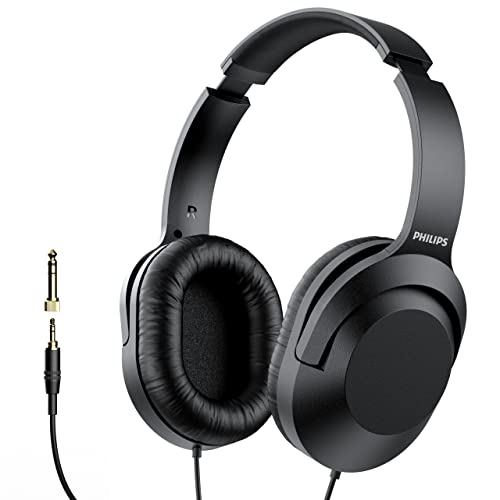
Best for: All-around listening and home studio use when you need a versatile pair that can connect to PCs, keyboards, and guitars with simple adapters.
- 40mm drivers for crisp, clear sound with good low-end
- Over-ear design with passive noise isolation
- Includes 1/8″ (3.5mm) jack and 1/4″ (6.3mm) adapter for broad compatibility
Limitation: May not offer studio-grade isolation for loud environments; ideal for quiet rooms or desk setups.
Sony ZX Series MDR-ZX110

Best for: Travelers and casual listeners who want a light, portable pair that still delivers engaging sound for practice sessions or quick keyboard jams.
- Lightweight, compact design with a portable swivel for easy storage
- Neodymium drivers deliver punchy sound suitable for practice
- Closed-back design to help keep sound contained in a small space
Limitation: On-ear design can become uncomfortable after long sessions; best for shorter practice periods or on-the-go use.
Yamaha HPH-50B Compact Closed-Back Headphones

Best for: Keyboard players seeking a compact, comfortable pair for daily practice or quick studio runs. The 90-degree swivel aids fitting around instrument settings.
- 90-degree swivel for ear angle flexibility
- Gold-plated stereo plug and 2-meter cable for easy connections
- Compact styling designed to match instruments in a portable setup
Caution: The compact design may feel less plush for long sessions compared to larger studio models.
PUPGSIS Wired Over Ear Headphones – Studio Monitoring

Best for: Professionals and semi-professionals who need wide frequency response and a shared monitoring option for multi-user setups in a studio or rehearsal space.
- 50mm drivers with wide frequency range 20Hz–20kHz
- Share Port allows two headphones to monitor without external splitters
- Designed for monitoring, recording, podcasting, and live performances
Limitation: The shared-monitor feature is beneficial for co-hosts, but may introduce slight interference if not used with high-quality cabling or adapters.
OneOdio A71 Hi-Res Studio Headphones

Best for: Players and producers who want high-resolution sound with a comfortable, foldable design for portable practice and studio work.
- Hi-Res 40mm drivers for precise detail across the spectrum
- SharePort and long coiled cord for versatile connections
- Adjustable headband and soft cushions for extended wear
Limitation: While foldable, these cans are still wired and may be less ideal for completely wireless setups.
Buying Guide: How To Choose The Right Headphones For Electric Piano
Key questions to help you decide:
- What will you use them for most—practice, recording, or live performance? If monitoring accuracy matters most, prioritize neutral frequency response and comfortable long-wear design.
- Do you need single-ear monitoring or sharing capabilities? If you often track with others, models with swiveling cups and shared ports can be valuable.
- How portable should they be? If you travel or gig, look for lighter builds and foldable designs without sacrificing sound quality.
- What devices will you pair them with? Look for compatible jacks (3.5mm, 6.35mm) and adapters to ensure easy connection to keyboards, amps, and PCs.
- What is your balance preference—bass-forward or flat monitoring? For electric piano, a balanced response helps you hear subtle touch dynamics and pedal effects clearly.
Practical tips
- For critical piano monitoring, avoid overly colored headphones that boost bass and mask midrange details.
- Consider closed-back designs to minimize room spill during recording or practice in shared spaces.
- Try to choose a pair with a comfortable headband and soft earpads to reduce fatigue during long sessions.
FAQ
- What headphone type is best for electric piano practice? Closed-back over-ear headphones are commonly preferred for accurate monitoring and minimal sound leakage.
- Should I buy headphones with a 1/4″ adapter? If your keyboard, audio interface, or amplifier uses 1/4″ jacks, an adapter helps avoid swapping cables.
- Is wireless a better option for piano playing? Wireless can reduce cable clutter, but may introduce latency; wired headphones are typically more reliable for precise timing.
- Can I use studio headphones for live performances? Some models are road-ready, but check build quality and durability; choose foldable or durable designs if you travel often.
- How important is frequency response for piano monitoring? A balanced response around the midrange helps you hear articulation and pedaling clearly, aiding expressive playing.