
Best Hi End Speaker Cable for Clean, Accurate Audio
Answering the search for high-end speaker cables, this guide identifies top options that emphasize low distortion, solid shielding, and reliable terminations. Best for audiophiles, home theater enthusiasts, and professionals seeking clear, detailed sound without noise or interference. The featured cables vary in gauge, conductor material, and plug styles, helping you match to your system and room. Below, five carefully chosen cables are compared on build quality, polarity clarity, and suitability for different setups. A quick buying table follows to summarize the key details.
| Product | Gauge | Special Feature | Best For |
|---|---|---|---|
| GEARit 12 Gauge Speaker Wire with Banana Plugs | 12 AWG | OFC copper, braided jacket | High-power AV systems |
| GEARit 14 Gauge In-Wall Speaker Wire | 14 AWG | In-wall CL2 rated, braided jacket | In-wall installations |
| TODN 6.5 ft OCC Copper Speaker Cable | 20 mm diameter, 16.77 mm² | OCC copper, banana and spade plugs | Audiophile setups with multiple terminations |
| Micca 14-Gauge Pure Copper Speaker Cable | 14 AWG | Gold-plated banana plugs | Balanced stereo systems |
| YYTCG 13 AWG HiFi Speaker Cable | 13 AWG | 6N OCC copper, multi-shielding | Detail-focused listenings |
GEARit 12 Gauge Speaker Wire With Banana Plugs

This 12 AWG cable uses oxygen-free copper and a dual conductor design to deliver solid current and low resistance. Its banana plug terminations simplify connection to A/V receivers or amps, making setup faster without cutting wires. The braided jacket adds a premium look and extra protection for speaker finishes. Best for high-power, home-theater systems where secure, low-loss connections are critical. Caution: Not ideal if you need a flexibly small profile for tight AV racks.
Who it’s best for and why selected
- Best for high-power receivers and subwoofers due to thicker gauge reducing resistance.
- Ideal for users who value a premium braided jacket that protects finishes.
GEARit 14 Gauge In-Wall Speaker Wire

This 14 AWG OFC cable is CL2-rated for in-wall use, reducing fire risk while maintaining audio integrity. A braided jacket provides durability and a tidy finish in wall cavities. Polarity is clear with color-coded banana plug terminations, supporting straightforward setup for stereo pairs. Best for permanent room installations where clean aesthetics and compliance with building codes matter. Limitation: In-wall rated cables may be less flexible for frequent reconfigurations.
Who it’s best for and why selected
- Choose this for in-wall installations in living rooms or media rooms.
- Better for fixed setups where code compliance and concealment are priorities.
TODN 6.5ft OCC Speaker Cable With Banana & Spade Plugs

Featuring 99.9999% OCC copper, this six-and-a-half-foot cable includes banana and spade plugs, with carbon fiber ferrite bead shielding and dual OCC braided shielding to suppress EMI/RFI. The 20 mm diameter and 16.77 mm² cross-section support strong bass and clear highs. Best for audiophiles seeking multi-termination flexibility and enhanced signal integrity. Caution: The listed length is not a fixed pair; order length needs careful measurement to ensure slack between components.
Who it’s best for and why selected
- Best for multi-connector needs including banana and spade styles.
- Better for those who want shielding to minimize external interference.
Micca 14-Gauge Pure Copper Speaker Cable
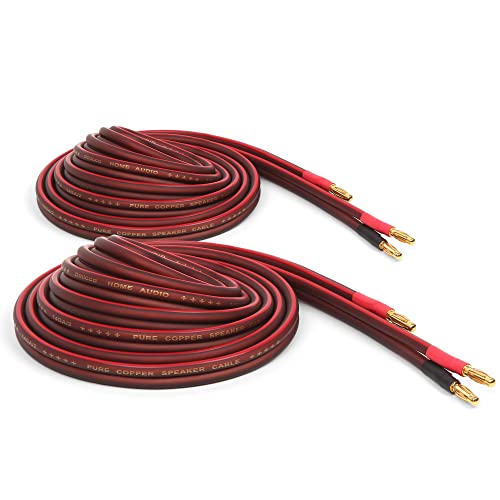
Two 6.6-foot runs of premium 14 AWG pure copper with gold-plated banana plugs. The all-metal banana plugs are designed for high-current, low-loss connections, providing a firm grip and reduced contact resistance. Ultra-slim connectors minimize bulk for clean installations. Best for balanced stereo setups where small aural artifacts must be avoided. Limitation: May be less flexible than some braided-jacket options, requiring careful routing in tight spaces.
YYTCG 13 AWG HiFi Speaker Cable
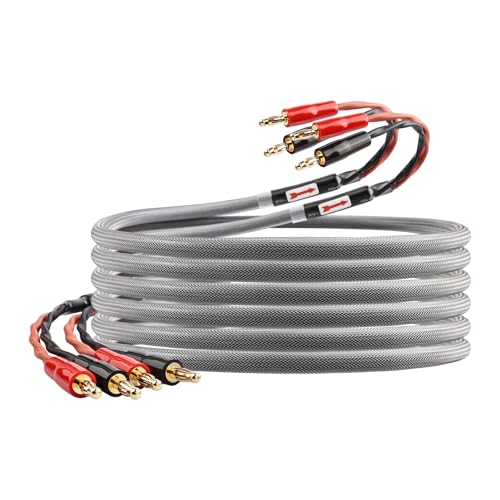
YYTCG uses 6N OCC copper conductors for a balanced sound across bass, mids, and highs. The 13 AWG size aims at a middle ground between flexibility and low resistance. The 24K gold-plated connectors improve corrosion resistance and long-term connect-satibility. Multi-shielding reduces EMI/RFI, delivering quieter background and clearer detail. Best for detail-forward listening and smaller to mid-size systems. Caution: OCC copper demands careful handling to avoid micro-cracks during bending.
Buying Guide: Key Considerations For Hi End Speaker Cables
- Conductor material and gauge: Higher-purity copper (OCC) and larger gauges reduce resistance and preserve signal strength, especially in longer runs.
- Terminations and connectors: Gold-plated banana plugs resist corrosion; ensure compatibility with your amp/speaker terminals.
- Shielding and construction: Multi-shielding and braided jackets protect against EMI and RFI and prevent connector wear on finishes.
- In-wall vs. freestanding: In-wall cables require CL2/CL3 ratings and fire-safe jackets; consider your installation path and building codes.
- Flexibility vs. stiffness: Heavier gauge cables are less flexible; plan cable routing to avoid excessive bending radii.
- Load, frequency, and room: Choose a cable designed to preserve dynamic range for your room size and speaker impedance.
FAQ
- What gauge should I choose for a home theater system?
For most home theaters, 14–12 AWG is a good balance of resistance and ease of use; higher-power setups may benefit from 12 AWG or thicker. - Are OCC copper cables better than standard copper?
OCC copper offers lower resistance and improved signal integrity, particularly in longer runs and high-resolution setups. - Do in-wall cables degrade audio quality?
Quality in-wall cables with proper ratings (CL2/CL3) are designed to meet safety codes and minimize interference when installed correctly. - Is shielding important for speaker wires?
Shielding helps minimize EMI/RFI, especially in rooms with multiple electronics or long cable runs. - Can I mix different cable brands in a system?
It’s generally fine to mix, but for best coherence, try to match gauge and conductor quality on the main runs to preserve tonal balance. - What’s the advantage of banana plugs vs bare wire?
Banana plugs provide quick, repeatable connections and reduce the risk of stray strands or shorts, especially in active setups.