
Choosing The Right High End Audio Speaker depends on use case: near-field studio monitors, bookshelf speakers for home theater, outdoor all-weather speakers, marine/vehicle coaxials, or quality cables and accessories. Below is a quick comparison of the selected products to help you jump to detailed sections.
| Product | Type | Primary Strength |
|---|---|---|
| PreSonus Eris 3.5 Studio Monitors | Powered Studio Monitors | Accurate Near-Field Reference Sound |
| Polk Audio T15 Bookshelf Speakers | Bookshelf / Home Theater | Balanced Home Theater Performance |
| Polk Audio Atrium 8 SDI | Outdoor Speaker | Weather-Resistant Outdoor Coverage |
| DS18 HYDRO NXL-6 Coaxial Speakers | Marine / Vehicle Coaxial | Waterproof, UV-Stable With RGB Lighting |
| HiFind 12/2 Gauge Speaker Wire | Speaker Cable | High-Conductivity, Outdoor/In-Wall Rated |
PreSonus Eris 3.5 Studio Monitors

The PreSonus Eris 3.5 are powered near-field monitors aimed at accurate reference listening for music production and hi-fi desktop setups. Each monitor uses a woven-composite woofer and delivers combined Class AB amplification (50W total). Features emphasize accurate tonal balance, tight low end, and compact form factor suitable for small studios or desktop listening.
- Use Case: Near-field mixing, multimedia reference, small-room hi-fi.
- Key Specs: Powered/active monitors, 50W class AB amplification, woven-composite woofers.
- Considerations: Requires placement close to listener for best imaging; powered design removes need for external amp.
Polk Audio T15 Bookshelf Speakers

The Polk Audio T15 pair are passive bookshelf speakers designed for home theater and stereo systems. They feature a 5.25″ Dynamic Balance driver and a 0.75″ tweeter to provide balanced midrange and clear highs. Wall-mountable design supports flexible placement as front or surround channels in a 5.1 setup.
- Use Case: Home theater front/rear channels, stereo bookshelf setups.
- Key Specs: Dynamic Balance driver, wall-mountable, designed for integration with subwoofers and center channels.
- Considerations: Passive speakers require an amplifier or receiver; speaker placement and room acoustics influence performance.
Polk Audio Atrium 8 SDI Flagship Outdoor Speaker

The Polk Audio Atrium 8 SDI is a robust outdoor speaker with a 6.5″ polypropylene woofer and two 1″ anodized aluminum dome tweeters. It’s designed for high output and low-frequency extension to fill large outdoor areas, and it includes a single/dual input switch for flexible wiring and stereo pairing.
- Use Case: Poolside, patio, sunroom or commercial outdoor zones.
- Key Specs: 6.5″ woofer, dual tweeters, high power handling, Polk Power Port for enhanced bass.
- Considerations: Outdoor placement benefits from weather-resistant materials and correct mounting for coverage.
DS18 HYDRO NXL-6 High End Coaxial Speaker Pair

The DS18 HYDRO NXL-6 are two-way coaxial speakers rated for marine and off-road environments. With IP65 water resistance, UV-stable grills, and 100W RMS (300W max) power handling, they are built to maintain performance in saltwater and sun exposure. Integrated RGB lighting adds an aesthetic feature when used in custom installations.
- Use Case: Boats, UTVs, marine applications, custom vehicle audio where environmental durability matters.
- Key Specs: IP65 waterproof, 100W RMS per pair, UV-coated grills, RGB LED integration (controller sold separately).
- Considerations: Verify enclosure and mounting compatibility for marine installations; wiring and marine-grade connectors recommended.
HiFind 12/2 Gauge Speaker Wire Cable
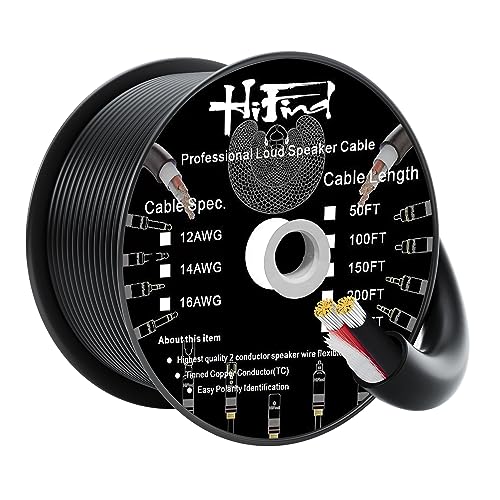
The HiFind 12/2 speaker wire is a pro-series cable using tinned oxygen-free copper (OFC) conductors, UL CL3 rating, and a UV-resistant PVC jacket. Designed for indoor, outdoor, and in-wall installations, it aims to deliver low-loss signal transfer and long-term durability in harsh conditions.
- Use Case: In-wall home theater installs, outdoor runs, buried or conduit applications.
- Key Specs: 12 AWG tinned OFC conductors, UL CL3 rated, anti-tear cotton filler, UV PVC jacket.
- Considerations: Thicker gauge improves low-frequency delivery for long runs; confirm compatibility with terminals and amplifier outputs.
Buying Guide: How To Choose High End Audio Speakers And Accessories
This guide covers key factors to compare high end audio speakers and supporting accessories to match your intended use and listening goals.
Intended Use And Placement
Studio vs. Home Theater vs. Outdoor: Choose powered near-field monitors (like PreSonus Eris) for mixing and accurate reference. For home theater or living-room listening, passive bookshelf or tower speakers (like Polk T15 combined with a receiver) provide immersive sound. For patios, pool areas or marine use, prioritize weather-resistant designs (Polk Atrium, DS18 HYDRO).
Power And Amplification
Active vs. Passive: Active/powered speakers include amplifiers and simplify setups. Passive speakers require an external amplifier or AV receiver; match speaker sensitivity and impedance with amplifier power for optimal performance.
Frequency Response And Bass Delivery
Low-Frequency Needs: Larger woofers and ported designs deliver deeper bass. For small speakers, plan for a subwoofer to achieve full low-end extension. Consider room size and speaker placement—walls and corners increase perceived bass.
Weather Resistance And Build Quality
Outdoor/Marine Durability: Look for UV-stable materials, IP or marine ratings, corrosion-resistant terminals, and UV-coated grills. Proper mounting and wiring with marine-grade connectors extend longevity.
Wiring And Connectivity
Cable Gauge And Quality: For long runs or high-power setups, use thicker gauge wire (12–14 AWG) to reduce resistance. Tinned OFC or copper conductors improve conductivity and corrosion resistance for outdoor or marine runs. Use properly shielded RCA cables for line-level runs to reduce hum and interference.
Room Acoustics And Placement
Room Size And Treatment: Speaker performance depends on room acoustics. Place monitors at ear height for near-field listening, keep bookshelf speakers off the floor or use stands, and allow clearance for ported speakers. Acoustic treatment or rugs and curtains can reduce reflections and improve clarity.
Aesthetics And Integration
Visual And Mounting Options: Consider wall-mountable speakers or compact monitors for tight spaces. Outdoor speakers should visually blend with architecture while permitting secure mounts for directional coverage.
Compatibility And Expansion
System Growth: Select speakers that integrate with existing systems (impedance, sensitivity, and power handling). For surround setups, choose matching tonal characteristics across front, center, and surround speakers to maintain coherent imaging.
Comparison Perspectives
Performance vs. Durability: Studio monitors prioritize accuracy; outdoor/marine options prioritize environmental durability. Compare intended listening results versus installation environment when selecting.
Wired vs. Wireless: Wired systems generally provide lower latency and more consistent audio fidelity. Wireless solutions add convenience but may introduce compression or latency—evaluate codec and network robustness if choosing wireless options.
Value Considerations: Evaluate total system cost: speakers, amplification, cables, mounts, and any environmental protection to ensure realistic performance expectations.