
Best High End DJ Mixer Options for Serious Pros and Ambitious Beginners
Looking for a high-end DJ mixer that blends professional features with beginner-friendly usability? This guide highlights five top choices that balance robust performance, portability, and value. The selections cater to party DJs, mobile performers, home studios, and club-ready setups. Each product section includes who it’s best for, why it’s chosen, and practical tradeoffs to consider.
Buyer’s quick-reference table:
| Product | Best For | Key Feature Highlight |
|---|---|---|
| Pyle PMXU46BT | Beginners to intermediate users seeking USB recording and Bluetooth streaming | 4 channels with USB audio interface |
| Numark Party Mix III | Casual DJs and small gatherings needing built-in lights | 2-deck controller with built-in light show |
| Denon PRIME GO+ | Pro DJs on the move needing standalone operation | Standalone, battery-powered with Wi‑Fi streaming |
| Numark M2 | Budget-conscious scratch DJs and learners | Two-channel scratch-focused with versatile I/O |
| Aveek 5 Channel | Home studios and streaming with USB recording | Built-in USB recording and multiple inputs |
Pyle 4-Channel Bluetooth Studio Mixer PMXU46BT

The Pyle PMXU46BT is a four-channel mixer with a built-in USB soundcard and audio interface, making it suitable for PC or Mac recording. It supports Bluetooth streaming, allowing wireless input when mixing with other channels. This unit is well-suited for beginners who want simple setup plus the option to record directly to a computer, and for small home studios that need versatile connectivity.
Best for: Beginners and semi-pros who want USB recording and wireless streaming in one compact package. Why selected: It combines an accessible workflow with essential recording and input options, reducing gear clutter. Caution: Bluetooth can introduce minor latency depending on the source; use wired inputs for critical monitoring when necessary.
Numark Party Mix III Bluetooth DJ Controller

The Party Mix III is designed for entry to mid-level performers who want built-in lighting and USB-C connectivity. It’s a two-deck controller that emphasizes simplicity and party-ready features, pairing beginner-friendly software access with a ready-to-play hardware setup. The included light show helps energize venues from bedrooms to small venues.
Best for: Casual DJs or hosts seeking a compact, all-in-one showpiece with lights. Why selected: The integrated lighting and straightforward workflow make it ideal for quick setups. Caution: Not the most feature-rich for advanced beat-matching or large setups; upgrade if you need deeper performance controls.
Denon DJ PRIME GO+ Standalone Portable Controller
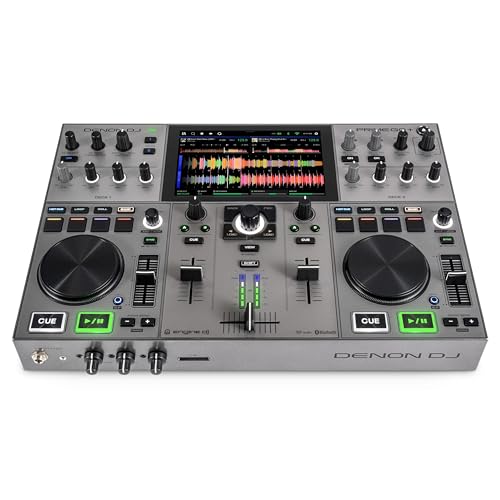
The PRIME GO+ is a high-end choice for performers who need true stand-alone capability with battery power and streaming flexibility. It runs Engine DJ OS, supports onboard sampling and advanced effects, and includes built-in Wi‑Fi for access to streaming services. This makes it compelling for pro DJs who perform without a laptop or who travel between venues.
Best for: Pro DJs on the move who need standalone operation and streaming. Why selected: It combines professional features with portability and Wi‑Fi access to large music libraries. Caution: Battery life and feature availability may vary with use; plan a workflow that accounts for offline playback if needed.
Numark M2 2-Channel Scratch DJ Mixer

The M2 is a straightforward two-channel mixer with scratch-friendly features and multiple input options. It’s suited for beginners learning the craft or scratch enthusiasts who need a compact, reliable device with versatile connectivity for different DJ setups. It’s also a strong starter option for clubs and small events where a simple, robust mixer is appropriate.
Best for: Scratch-focused beginners and small venues needing a dependable two-channel setup. Why selected: Its emphasis on essential scratch controls and flexible inputs makes it a practical entry point without overcomplication. Caution: Limited channels mean less room for complex mixes in larger venues; consider a multi-channel model for expanding gigs.
Aveek 5 Channel Audio Mixer

The Aveek 5 Channel mixer offers multiple inputs, a built-in USB recording interface, and USB drive playback. It’s designed for home studios, streaming setups, and light-performance environments where you need straightforward recording and playback capabilities alongside mic and line inputs. It provides a practical bridge between beginner and intermediate needs.
Best for: Home studios or live-streaming setups needing USB recording and USB drive playback. Why selected: The integrated recording and USB drive features simplify workflows for content creators. Caution: It’s not a heavy-duty club mixer; for frequent professional gigs you might want a more rugged, higher-channel unit.
Buying Guide
What should you consider before buying a high-end DJ mixer?
- Channels and layout: Decide how many channels you need. More channels allow complex blends, while 2–4 channels suit smaller gigs and practice spaces.
- Connectivity: Look for USB recording interfaces, Bluetooth streaming, line/mic inputs, and output options to connect to speakers or interfaces.
- Standalone vs. controller: Standalone units eliminate the laptop, but may be heavier and pricier. Controllers rely on software but can be cheaper and highly portable.
- Portability and power: If you travel, choose battery-powered options or light-weight builds with compact footprints.
- Software compatibility: If you plan to use software like Serato, DJay, or VirtualDJ, verify bundled licenses and compatibility with your devices.
- Upgrade path: Consider future needs. A modular system or a mixer with software integration can grow with you.
What scenario fits which product?
- Best for USB recording and Bluetooth: Pyle PMXU46BT offers strong connectivity and recording features for home studios and beginners.
- Better for built-in lighting and casual parties: Numark Party Mix III provides an all-in-one party setup with lights for quick deployments.
- Best for standalone performance on the go: Denon PRIME GO+ enables laptop-free performances with streaming options.
- Choose this if you want a compact, scratch-friendly start: Numark M2 is an affordable two-channel option focused on essential mixing and scratching.
- A good all-round studio and streaming mixer: Aveek 5 Channel covers mic/line inputs with USB recording and USB drive playback for content creators.
How to compare these options quickly
- Channel count and routing: Match to your typical gigs (e.g., two-deck setups vs. multi-channel performances).
- Portability vs. power: Balance travel needs with required features and durability.
- Latency and input quality: Wired connections tend to offer lower latency than Bluetooth; use Bluetooth for convenience where latency is not critical.
- Software ecosystem: Consider which DJ software you use most often and whether bundled licenses are included.
FAQ
- What is a standalone DJ mixer? A standalone mixer operates without a computer and can run its own effects and sampling, using built-in hardware and onboard features.
- Do I need Bluetooth on a DJ mixer? Bluetooth is convenient for wireless input but may introduce latency, so wired connections are preferred for critical performance tasks.
- Which mixer is best for beginners? A mixer with USB recording, simple layout, and clear inputs—such as models in the Pyle or Aveek lines—helps new users learn quickly.
- Is a 2-channel mixer sufficient for events? Yes, for small venues, practice sessions, or private parties; larger venues often benefit from 4–5 channels for more complex mixes.
- Should I buy a mixer with built-in software? Many beginner-friendly units include software and licenses to ease setup, but potential upgrades may require separate purchases or subscriptions.
- What kind of inputs should I look for? At minimum, mic in, line in, and a main output; RCA, XLR, and 1/4-inch connections cover most setups.