
Best High-Quality External Sound Cards for PC Audio
Answering your search for reliable, high-quality external sound cards, this guide compares top options for different needs—from gaming and streaming to general multimedia enhancement. Best for audiophiles, gamers, or professionals requiring clean, low-noise audio, these picks focus on drivers, supported sample rates, and ease of use. Each product section explains who it’s best for, plus practical limitations to consider before you buy.
| Product | Best For | Key Benefit |
|---|---|---|
| StarTech ICUSBAUDIO7D | Desktop users needing 7.1 surround | Multiple outputs with SPDIF passthrough |
| ANDREA USB-SA-1 | Low-noise, high-fidelity audio | Built-in noise reduction tech |
| SABRENT AU-MMSA | Plug-and-play simplicity | Driverless setup on most systems |
| SMSL Nano ONE Pro | Streamers and creators | Four modes and DSP for clear, immersive sound |
| MOSWAG USB to 3.5mm Jack | Budget-conscious users | Stable 16-bit/48kHz output |
StarTech 7.1 USB Audio Adapter
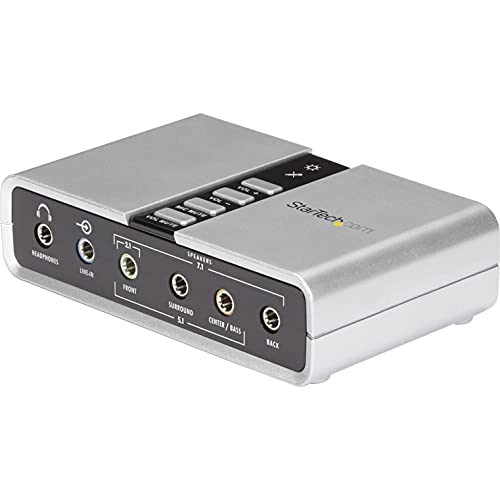
The StarTech ICUSBAUDIO7D is a bus-powered external sound card that delivers up to 7.1-channel audio via USB. It supports 7.1, 5.1, and stereo outputs through three 3.5mm jacks, plus a headphone port, line-in, and a stereo microphone input. This makes it suitable for desktop or laptop users who want to upgrade integrated audio without internal changes. It also provides 44.1 kHz and 48 kHz sampling for analog playback and recording, with SPDIF digital output at 48 kHz. Best for users who need robust surround options on a single USB connection. A potential limitation is SPDIF input passthrough being limited to 2-channel audio at 48 kHz, which may affect some high-end digital workflows.
Who it’s best for: PC users seeking high-quality multi-channel output for gaming, home theater, or professional applications that require separate mic, line-in, and headphone paths. It’s particularly useful when upgrading legacy systems without internal sound cards.
Why choose this
- 7.1, 5.1, and stereo output support
- Dedicated mic and line-in inputs
- USB-powered, portable for desktops and laptops
Caution/limitation
SPDIF input passthrough supports only two-channel 48 kHz audio, which may limit some surround sound setups that rely on higher-resolution digital input.
Andrea Electronics USB-SA-1 High Fidelity External Digital Sound Card

The Andrea USB-SA-1 emphasizes high-fidelity digital audio. It’s designed to upgrade built-in PC audio with CD-quality digital sample rates and noise-reducing technology. The device is compact—roughly the size of a thumb drive—making portability easy for users who need better audio on the go. It’s compliant with USB 2.0 Full Speed for broad compatibility and supports a standard digital audio device platform, which helps drivers align with common PC configurations. A key limitation is that some users may experience variability in driver support across older operating systems.
Who it’s best for: Users who want a small, portable external card with improved noise performance and CD-quality audio for music, calls, and media playback.
Why choose this
- Noise reduction technology for cleaner sound
- Small form factor for portability
- CD-quality digital sampling
Caution/limitation
Driver compatibility can vary on older systems; verify OS support before purchase.
SABRENT USB External Stereo Sound Card Adapter

The SABRENT AU-MMSA is a driverless, plug-and-play USB external sound card that works across Windows, Mac, and Linux. It provides two jacks: a green stereo output and a pink mono microphone input. It’s a straightforward option for users who want a simple, reliable external audio device without software installation. This model adheres to USB Audio Device Class 1.0 and is recognized as a standard USB audio device, making compatibility broad. However, it does not support 4-pole headsets on a single combined plug, nor does it add surround sound capabilities.
Who it’s best for: Users who want a quick, driverless setup for basic stereo audio and microphone input on multiple operating systems.
Why choose this
- Driverless on most systems
- Two independent jacks for output and input
- USB-powered, no extra software required
Caution/limitation
Does not support surround sound or 4-pole headsets; intended for stereo use only.
SMSL Nano ONE Pro External Sound Card

The SMSL Nano ONE Pro delivers a hi-fi DSP-based solution with virtual 7.1 surround sound and four modes: Music, Game, 7.1 Virtual Cinema, and Voice Enhancement. It connects via USB-C and supports a 16-bit/48 kHz DAC with up to 20 mW output at 600 ohms, aiming for clean, powerful sound across platforms. The four-mode approach lets users tailor audio for work, streaming, gaming, or calls. A potential limitation is that some users may require optimization for specific games or apps to achieve optimal virtual surround performance.
Who it’s best for: Streamers, gamers, and multimedia creators seeking flexible DSP-based sound with easy plug-and-play use.
Why choose this
- Four mode presets for versatile use
- USB-C, driverless on many platforms
- High-quality DAC with clear output
Caution/limitation
Virtual surround performance may vary by software and content; experimentation may be needed to achieve preferred positioning.
MOSWAG USB To 3.5mm Jack External Sound Card

The MOSWAG external sound card offers a straightforward USB-to-3.5mm solution designed for broad compatibility. It supports 16-bit/48 kHz audio output with effective noise reduction, delivering solid sound without complex setup. It is suitable for devices needing a simple audio upgrade for music, calls, or gaming. A limitation is that the unit provides a single stereo output and may not support advanced features like surround sound or multi-input configurations.
Who it’s best for: Budget-conscious users who want a reliable, easy-to-use USB audio adapter for basic stereo listening and voice input.
Buying Guide: External Sound Card Essentials
What should you look for when choosing an external sound card? Focus on compatibility, sample rates, channel support, and ease of use. If you game or watch movies with surround sound, prioritize models offering 7.1 or virtual surround and SPDIF options. For portability, a compact, driverless option reduces setup friction. If you need professional-quality audio for streaming or recording, consider models with noise reduction, DSP modes, and higher DAC bit depth.
Key questions to guide your decision
- Do you need true multi-channel surround or is stereo output enough?
- Is driverless setup important for your systems (Windows, macOS, Linux, or mobile)?
- What sample rate and bit depth do you require for your content?
- Will you use a mic, line-in, or both, and do you need SPDIF output?
- Is portability a priority, or is a desktop setup acceptable?
Comparison at a glance
- Best for multi-channel audio: StarTech ICUSBAUDIO7D
- Best for noise-sensitive listening: Andrea USB-SA-1
- Best for plug-and-play simplicity: SABRENT AU-MMSA
- Best for customizable sound profiles: SMSL Nano ONE Pro
- Best budget stereo option: MOSWAG USB to 3.5mm
Quick tips
- Check compatibility with your operating system before purchasing.
- Consider whether you need a separate microphone input or only headphone output.
- If you require surround sound, verify supported channels and sampling rates.
FAQ
- What is an external sound card? It’s a USB-powered device that converts digital audio from your computer to analog audio or enhances analog signals for better sound quality.
- Do these devices require drivers? Some are driverless; others may require drivers for full functionality on certain systems.
- Can I use these with both Windows and macOS? Most listed models support Windows; many also support macOS and some Linux or mobile platforms.
- Will they improve gaming audio? Yes, especially models with 7.1 or virtual surround and DSP modes tailored for gaming.
- Is SPDIF output common? SPDIF is supported on select models for digital audio; check the product’s specs for compatibility.
- Do these devices support high-resolution audio? Several models support up to 48 kHz or higher, depending on the DAC and input/output capabilities.