
Best High Quality Home Theater Speakers for Immersive TV Sound
The right home theater speakers deliver clear dialogue, dynamic effects, and room-filling bass without overwhelming the room. This guide highlights five high-quality options suited for different buyers—from newcomers building a starter system to enthusiasts upgrading for cinematic realism. Use this quick table to compare key strengths and who each product best serves.
| Product | Best For | Why It Stands Out |
|---|---|---|
| Polk Audio T15 100 Watt Bookshelf Speakers | Entry-level, compact setups | Cost-effective, clear vocal clarity, flexible placement |
| ULTIMEA Poseidon M60 5.1CH System | Simple, all-in-one 5.1 surround | Dolby Atmos-ready feel with built-in drivers and easy setup |
| Bobtot 5.1 Surround System | Budget-conscious home theater with strong bass | High wattage and included subwoofer for big sound |
| Polk Audio Monitor XT90 Height Speakers | Dolby Atmos or height-channel upgrades | Compact, designed for elevation effects and wide dispersion |
| Fluance Elite SXBP2 Bipolar Surround Pair | Immersive surround without rear speakers | Wide dispersion for natural imaging and theater-like sounds |
Polk Audio T15 100 Watt Bookshelf Speakers

Polk Audio T15 speakers pair a 0.75″ tweeter with a 5.25″ Dynamic Balance driver to deliver clear vocals and balanced sound with solid bass, even at lower volumes. They’re wall-mountable and versatile for use as front, left, or rear channels in a surround system. Best for first-time home theater buyers and space-conscious setups seeking reliable performance without a high price tag. Caution: As passive bookshelf speakers, they require a suitable receiver or amplifier to power them.
ULTIMEA Poseidon M60 5.1CH System

This 5.1-channel system offers a self-contained Dolby Atmos-like experience with five built-in drivers and a wired wooden subwoofer. It emphasizes a broad frequency range (45 Hz–18 kHz) and a maximum SPL capable of filling a medium room. Best for buyers who want a straightforward, compact setup that still delivers immersive surround effects. Caution: The claimed latency advantages rely on advanced DSP and proper room calibration; outcomes may vary by room acoustics.
Bobtot Home Theater Systems Surround Sound Speakers
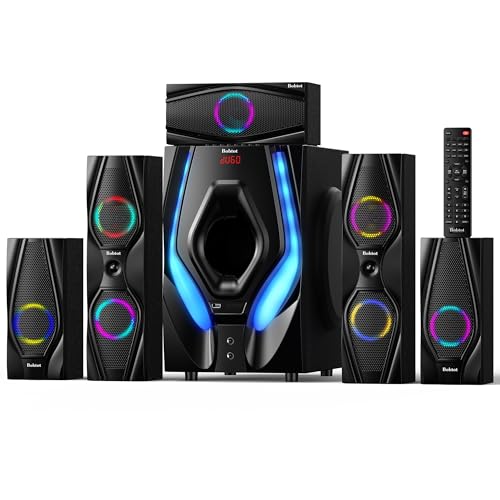
Bobtot’s 5.1-channel system delivers up to 1200 watts peak with a 10-inch subwoofer and seven-channel versatility, including two channel modes (5.1/2.1) accessible via remote or front panel. It includes LED ambient lighting for added ambiance. Best for buyers who want loud, impactful bass and flexible mode options in a budget-friendly package. Caution: Built-in receiver and wiring are mid-tier; premium clarity may require careful speaker placement and calibration.
Fluance Elite SXBP2 Bipolar Surround Speakers

These high-definition bipolar surround speakers deliver wide-dispersion ambience for immersive rear sound, designed to pair with Fluance SX Series and other high-quality systems. They’re best for homeowners seeking expansive surround imaging without deploying traditional rear wall speakers. Limitation: Bipolar designs can require careful balancing with front-channel speakers to avoid overpowering the main dialogue.
Buying Guide
What should I consider when choosing home theater speakers?
- Room size and layout: Smaller rooms benefit from bookshelf or compact speakers; larger rooms may require floor-standing models and additional subwoofers.
- Power and compatibility: Ensure your receiver matches the speaker impedance and power handling; passive speakers need an amplifier or receiver.
- Speaker type and placement: Bookshelf, tower, and bipole/dipole surrounds each offer different imaging and diffusion. Height channels add dimensionality but require proper placement.
- Subwoofer integration: A dedicated subwoofer enhances bass depth and consistency across listening levels; check crossover settings and phase alignment with mains.
- Dolby Atmos or virtualization: Height channels can be real or virtual; choose a system that aligns with your content and room acoustics.
- Aesthetics and build: Material quality, cabinet construction, and finish should complement your room decor and durability expectations.
Frequently Asked Questions
- What is the difference between bookshelf and floor-standing speakers?
Bookshelf speakers are more compact and versatile for smaller rooms, while floor-standing models offer higher bass output and broader coverage. - Do I need a separate subwoofer with all these systems?
Not always, but a subwoofer typically improves low-frequency performance for movies and music with strong bass. - Can I use these speakers without a dedicated home theater receiver?
Passive speakers require an amplifier or receiver; active speakers have built-in amplification. - What is Dolby Atmos, and do I need height speakers?
Dolby Atmos adds vertical sound effects; height speakers or upfiring modules are needed for true Atmos playback. - How do I position surround speakers for the best experience?
Surrounds are typically placed slightly behind and to the sides, angled toward the listening position; bipolar surrounds can diffuse sound more broadly. - Are the listed brands reliable for long-term use?
These brands are well-known in consumer audio and offer varied price tiers; long-term performance depends on room treatment, setup, and maintenance.