
Best High Quality Lapel Microphones for Clear, Reliable Audio
Find top-tier lapel mics that deliver crisp, noise-free sound for interviews, vlogs, podcasts, and live streams. This guide highlights five strong options and explains who each is best for. If you need discreet wearability, robust wireless performance, or plug-and-play simplicity, you’ll find a match here. The table below summarizes key traits to help you compare quickly.
| Product | Best For | Wireless Range | Power Life |
|---|---|---|---|
| DJI Mic Mini | Outdoors & on-the-go interviews | Up to 300 m | 11.5 hours |
| MAYBESTA Wireless Mini Mic | Smartphone creators | Wireless, stable | All-day with usage |
| Mini Mic Pro | Studio-like mobile recordings | Plug-and-play across devices | All-day depending on usage |
| NPTCL Wireless Lavalier | Budget-friendly multi-device use | Wireless with USB-C | 6 hours per mic; 24h with case |
| Sony Compact Stereo Lavalier ECMLV1 | Simple stereo capture | Wireless range typical | All-day use |
DJI Mic Mini (2 TX + 1 Mobile RX)

The DJI Mic Mini is a compact, ultralight transmitter system designed for comfortable all-day wear. It features active noise cancelling capabilities to help reduce ambient noise in busy environments and a long 300-meter max transmission range for stable recordings outdoors. With two transmitters and a mobile receiver, it supports extended shooting sessions up to 11.5 hours, making it a strong choice for interviews, reporting, and on-location shoots. Best for professionals needing discreet, high-quality audio in dynamic settings.
Best for: field reporters, documentary crews, and on-camera interviewers who need reliable wireless performance in varied environments. Caution: ensure the transmitter units are charged for long shoots to avoid mid-session power loss.
MAYBESTA Wireless Mini Microphone (2 Pack)

This two-pack Maybesta mic system is designed for broad smartphone compatibility. It supports Android and iPhone (including newer USB-C devices) without requiring adapters or apps for connection. The receiver interface has been extended for easier phone connections, and the kit emphasizes compatibility with phone cases so you won’t need to remove cases during filming. Best for creators who shoot primarily with smartphones and want quick, automatic pairing.
Best for: YouTubers, TikTok creators, and vloggers who need easy plug-and-play use with multiple devices. Caution: performance may vary with certain phone cases or platform updates; verify compatibility with your device before purchasing.
Mini Mic Pro (Latest Model)

The Mini Mic Pro is a lightweight wireless microphone popular for iPhone and Android users. It emphasizes a plug-and-play approach with USB-C and Lightning adapters included, so it can connect instantly to most devices without apps or Bluetooth pairing. Its design focuses on delivering clear voice pickup and effective wind protection for outdoor use. Best for creators who want studio-like sound in a small, portable package.
Best for: solo content creators who want reliable setup across devices with minimal fuss. Caution: no external mic controls on some variants; check kit contents to confirm included adapters meet your device needs.
NPTCL Wireless Lavalier Microphone (USB-C)
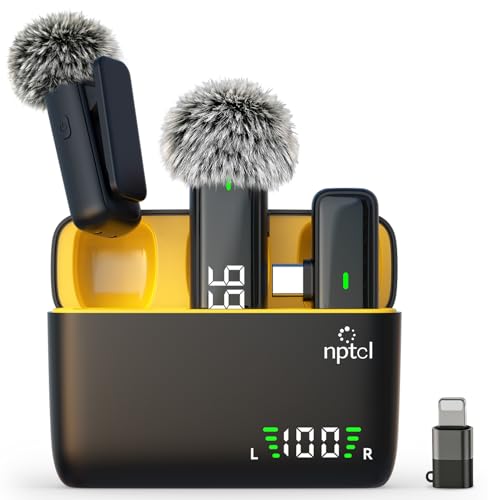
The NPTCL wireless lavalier uses USB-C and offers a compact, easy-to-use option for iPhone, iPad, Android, and other USB-C devices. It emphasizes noise reduction, a windscreen to minimize plosives, and a long usage window of up to 24 hours with the charging case. Best for budget-conscious creators who still want credible audio and convenient auto-pairing without apps. Caution: some users may prefer longer range or additional mic features not listed here.
Wireless Mini Lavalier Microphone for iPhone, Android (Bulatry)

The Bulatry wireless mini lavalier offers a two-pack with USB-C and Lightning adapters for broad device compatibility, plus a built-in noise reduction approach to improve voice clarity in busy environments. It emphasizes a quick pairing process and a plug-and-play experience suitable for podcasts, vlogs, and live streams. Best for creators who value portability and straightforward setup. Caution: slightly busier feature set may require careful placement to avoid cable clashes with certain phone cases.
Sony Compact Stereo Lavalier ECMLV1

The Sony ECMLV1 is a compact stereo lavalier microphone featuring omni-directional capture and a windscreen to minimize wind noise. It offers freedom of movement with a 360-degree rotation clip, making it versatile for various wearing angles. Best for straightforward, reliable stereo capture in travel or on-location shoots. Caution: may not include advanced wireless features found in pricier kits.
Buying Guide
What should you look for when choosing a high quality lapel mic?
- Voice quality and noise handling: Prioritize mics with noise reduction, wind protection, and clear voice pickup for your typical shooting environments.
- Connectivity: Decide between wired vs wireless and check device compatibility (iPhone, Android, USB-C, Lightning, laptops).
- Power and battery life: For field work, longer battery life or a charging case reduces interruptions.
- Clip design and discreetness: A compact, comfortable clip improves wearability during long sessions.
- Water and wind conditions: Wind screens and robust construction matter for outdoor use.
- Setup simplicity: Some kits offer automatic pairing and no-app operation, which can save time.
Practical comparison tips
- Best for field reporting: DJI Mic Mini or NPTCL for battery life and range.
- Best for smartphones: MAYBESTA and Bulatry kits with USB-C/Lightning adapters.
- Best plug-and-play across devices: Mini Mic Pro with included adapters.
- Economy pick with stereo capture: Sony ECMLV1 for simple, reliable voice pickup.
FAQ
- What is the main difference between wireless lavalier mics and wired lavalier mics?
- Can these mics work with both iPhone and Android devices?
- Is wind protection necessary for indoor use?
- How do I know which mic is best for on-camera interviews?
- Do these kits require any apps to operate?
- What should I consider for long recording sessions outdoors?