
Best I2s Class D Amplifier for DIY Audio Projects
If you’re building a compact, efficient audio project, an i2s Class D amplifier is a strong choice. These boards decode I2S digital audio and amplify it directly to a speaker, saving space and power. They suit hobbyists, makers, and portable projects where battery life matters. Top products here are ideal for Raspberry Pi, ESP32, and Arduino setups. The table below compares five solid options to help you decide which module fits your needs for compact DIY speakers, smart assistants, or experimental audio devices.
| Product | Key Strength | Best For |
|---|---|---|
| GODIYMODULES 2PCS MAX98357 | Two-breakout I2S DAC + Amp combo | Compact dual-channel builds |
| AITRIP 3 PCS MAX98357 | Plug-and-play with many clocks/data formats | Budget multi-project kits |
| Usdrwam 6PCS MAX98357A | Multiple modules, durable for multi-channel DIY | Multi-speaker prototypes |
| AKEYSRC 2PCS MAX98357A | Adjustable gain, all-in-one DAC + amp | Portable, battery-powered projects |
| SATUY 4Pcs MAX98357A | Flexible I2S compatibility, modest heat | Small multi-channel arrays |
GODIYMODULES MAX98357 2Pcs I2S Class D Amplifier

This package combines two MAX98357 I2S DACs with Class D amplification in a compact breakout. It accepts standard I2S input and drives a speaker directly, making it well suited for small Raspberry Pi or ESP32 projects that need quick, integrated audio. The board runs on 2.7V–5.5V and includes built-in protection features for thermal and over-current conditions. Best for: dual-channel audio projects needing space efficiency and straightforward wiring. Limitation: some users may require external filtering depending on speaker impedance and enclosure design.
AITRIP 3 PCS MAX98357 I2S Audio Power Amplifier Module

The AITRIP set includes three MAX98357 modules designed for easy expansion in Arduino, Raspberry Pi, or ESP32 projects. The breakout supports many I2S clock and data formats, enabling quick integration with minimal setup. Best for: makers building multiple small speakers or a classroom project. Limitation: lower-end variants may require gain tuning to minimize noise in some environments.
Usdrwam 6PCS MAX98357A I2S 3W Class D DAC Modules
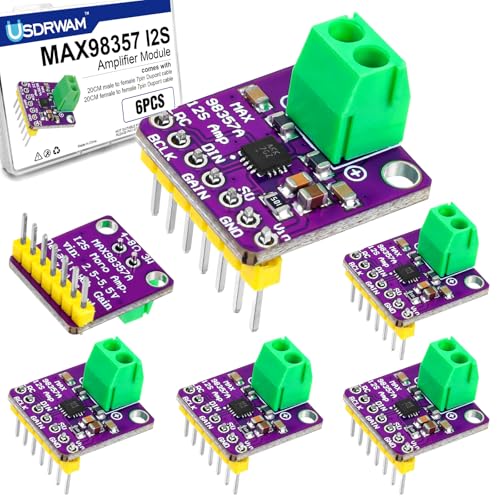
This 6-pack offers an economical route for multi-channel prototypes or classroom demonstrations. Each module provides roughly 3W into 4 Ω and ~1.8W into 8 Ω, with bridge-tied PWM outputs designed to drive speakers directly. Best for: large speaker arrays or projects that require several independent audio channels. Caution: ensure good ventilation and a stable supply to maintain low noise during continuous operation.
AKEYSRC 2PCS MAX98357A I2S Class D Amplifier
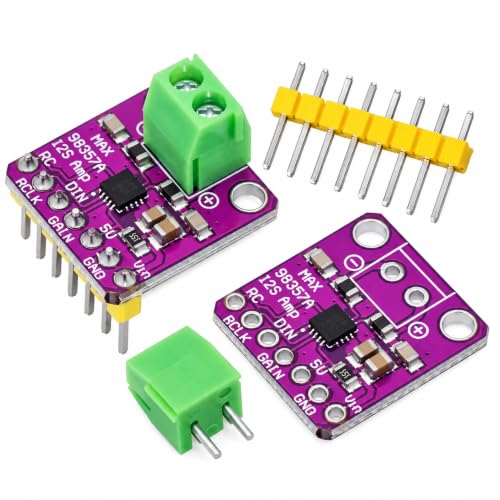
This all-in-one breakout combines an I2S DAC and a Class D amplifier in one compact board. It runs on 2.7V–5.5V and can deliver up to 3W into a 4-ohm speaker. Best for: portable projects where space and power efficiency matter. Limitation: gain is adjustable via wiring, which may require careful setup to avoid clipping with sensitive speakers.
SATUY MAX98357A 4Pcs I2S 3W Breakout Board

Having four breakout modules, SATUY enables flexible I2S/LJ/TDM audio compatibility with 8kHz–96kHz sampling and no external MCLK, delivering up to roughly 3.2W at 4Ω. Best for: multi-speaker experiments or small arrays in DIY audio projects. Limitation: outputs are bridge-tied PWM and should not be connected to ground or cascaded into another amplifier without proper design.
Buying Guide: i2s Class D Amplifier Selection
What to consider when choosing an i2s Class D amplifier?
- Power output and speaker impedance: Aim for modules that specify watts into the intended speaker (e.g., 3W into 4 Ω). If you use 8 Ω speakers, pick devices with published performance at 8 Ω or plan for a lower output.
- Input compatibility: Look for I2S DACs that support common formats and clocks. Some boards advertise “no external MCLK,” which simplifies wiring for battery-powered projects.
- Gain and control: Adjustable gain helps prevent clipping and matches speaker sensitivity. Check how gain is set (pins, resistors) and how to configure channel mode (stereo, mono, or L+R).
- Thermal and power integrity: Class D designs stay cooler than traditional Class A/B, but high-power use benefits from ventilation or a heatsink. Ensure your power supply remains stable under load.
- Physical footprint: For compact enclosures, prefer breakout boards with integrated DAC and amp to minimize wiring and stacking height.
- Protection features: Over-current and thermal protections help safeguard both the board and your speaker, especially in portable setups.
Frequently Asked Questions
- What is an I2S Class D amplifier used for?
It decodes I2S digital audio and amplifies it directly to a speaker, ideal for compact, efficient DIY audio projects.
- Can I drive 4 Ω and 8 Ω speakers with these modules?
Yes, many modules specify performance for both 4 Ω and 8 Ω loads; check the listed power at each impedance.
- Do I need external DACs with these boards?
Most boards include the DAC as part of an all-in-one breakout; some products are dual-board kits with separate DAC and amp modules.
- Which module is best for a portable project?
Modules with a wide input voltage range (2.7V–5.5V) and adjustable gain are typically best for battery-powered builds.
- Are there any precautions when wiring these boards?
Avoid tying outputs to ground and ensure correct BCK/LRCK/DIN connections; improper wiring can cause noise or damage.