
Find the Best In-Wall Bass Speaker options to add deep low end without visible floor-standing drivers. Below is a quick comparison table of the most relevant in-wall models covered in this guide to help you scan features and uses before reading each product section.
| Model | Brand | Key Feature |
|---|---|---|
| Pyle PDIW87 | Pyle | 8″ Long-Throw Woofer, 50Hz–20kHz |
| Polk 265-RT | Polk Audio | 3-Way Design With Power Port, Dual 6.5″ Woofers |
| Micca M-6S | Micca | 6.5″ Woofer, Paintable Grill, Easy Install |
| Polk 255c-RT | Polk Audio | Dual 5.25″ Drivers, Center Channel In-Wall |
| Polk 65-RT | Polk Audio | Compact 6.5″ Driver, Power Port Bass |
Pyle Ceiling Wall Mount Enclosed Speaker – PDIW87
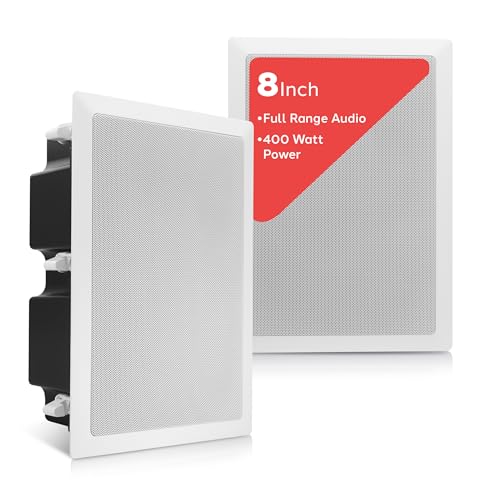
This Pyle in-wall/in-ceiling speaker emphasizes deep bass with an 8″ long-throw woofer and a vented design. It lists a 50Hz–20kHz frequency response, a 1″ high-temperature voice coil tweeter, and 4–8 ohm impedance for compatibility with common receivers and amps.
- Power Handling: 400 watts peak, intended for higher output in home theater or music systems.
- Application: Can be used as surround or main speakers in a larger setup; designed for flush mount installation.
- Considerations: Peak wattage vs. RMS not stated in listing; confirm amplifier pairing for sustained power delivery.
Polk Audio 265-RT 3-Way In-Wall Speaker

The Polk 265-RT is a 3-way in-wall speaker built for front or surround channels. It uses two 6.5″ mid/woofers and a 1″ swivel silk-dome tweeter, plus Polk’s Power Port technology to increase low-frequency output without larger enclosures.
- Design Strength: Dynamic Balance drivers reduce distortion for clearer mids and deeper bass.
- Installation: Includes templates and pre-construction brackets with a rotating cam mounting system for secure fit.
- Use Cases: Suited for left/right mains or surround placement in multi-channel home theater arrays.
Micca M-6S 2-Way In-Wall Speaker

The Micca M-6S is a compact 2-way in-wall speaker with a 6.5″ woofer and 1″ tweeter, designed for whole-house audio or home theater. The grill is paintable for a low-visibility installation and the built-in mounting tabs reduce the need for external brackets.
- Sonic Profile: Smooth, natural sound signature with emphasis on balanced bass for small to medium rooms.
- Installation Ease: Built-in tabs allow direct mounting to drywall or wood panels; cutout dimensions provided.
- Versatility: Suitable for background music, bedrooms, kitchens, or covered outdoor porches.
Polk Audio 255c-RT In-Wall Center Channel

The 255c-RT is a dedicated center channel in-wall speaker built to improve dialogue clarity and center imaging. It pairs two 5.25″ mid/woofers with a swivel silk dome tweeter and incorporates Polk’s Power Port to bolster low-end response.
- Purpose: Optimized for center channel duties in 3.1, 5.1, or larger systems—improves vocal intelligibility.
- Mounting: Includes templates and a rotating cam system to ensure vibration-free installation.
- Acoustic Focus: Designed to compensate for wall reflections to minimize distortion and preserve clarity.
Polk Audio 65-RT In-Wall Speaker

The Polk 65-RT is a compact single 6.5″ driver in-wall loudspeaker with a 1″ dome tweeter and Power Port bass venting. It’s intended where space is limited but you still want premium bass and integration into a multi-channel system.
- Best Fit: Stealth side or rear surrounds, or left/right in smaller rooms.
- Construction: Precision flange and paintable grille for near-invisible installation.
- Performance: Dynamic Balance driver tech aims to deliver clear mids and controlled low frequencies.
Buying Guide: How To Choose An In-Wall Bass Speaker
Selecting an in-wall bass-capable speaker involves matching room, amplifier, and listening goals. Below are key factors to compare across models.
Speaker Size And Low-Frequency Extension
Larger woofers (8″ in the Pyle PDIW87, dual 6.5″ in Polk 265-RT) generally produce more low-frequency output. Consider room size: small rooms often perform well with 5.25″–6.5″ drivers, while larger spaces benefit from 8″ or multi-driver designs.
Power Handling And Amplifier Matching
Check both peak and RMS ratings where available. Ensure your AVR or amp can drive the speaker’s impedance (common 4–8 ohms) and provide sufficient continuous power for clean bass without clipping.
Enclosure, Porting, And Built-In Bass Enhancements
Some in-wall models include Power Port or vented designs to extend bass. Ported designs can increase perceived bass output but may need proper wall cavity depth and damping to avoid resonance.
Installation And Fit
Review cutout dimensions, pre-construction brackets, and mounting systems. Polk’s rotating cam system and included templates simplify secure, vibration-free installs. Built-in mounting tabs (Micca) reduce extra hardware needs.
Placement And Role In System
Decide speaker role—center, front, surround or whole-house. Center channel speakers prioritize midrange clarity, while multi-driver front speakers or larger woofers focus on impactful low end. Match voicing across set if buying multiple units from the same series.
Room Acoustics And Installation Cavity
Wall cavity depth, insulation, and nearby reflective surfaces affect bass. Use acoustic insulation behind the speaker or add damping material if boomy resonances appear. Some designs compensate for reflective surfaces with specific driver and crossover tuning.
Aesthetics And Stealth
Paintable grilles and minimal flanges maintain a near-invisible look. If visual integration is important, choose models with low-profile grilles or Sheer-Grille options to minimize protrusion.
Durability And Environment
For covered outdoor or moisture-prone areas, verify manufacturer guidance. Many indoor in-wall speakers are fine in covered porches but not direct-exposure environments.
Comparing Multiple Perspectives
- Value vs. Performance: Budget models (compact 2-way designs) can offer good balance for whole-house audio, while multi-driver Polk models target higher fidelity in home theater roles.
- Impact vs. Clarity: Larger woofers provide stronger bass impact; 3-way and center-channel designs prioritize tonal clarity and imaging.
- Ease of Install vs. Custom Integration: Pre-construction brackets and rotating cam systems speed installs; models with built-in tabs reduce accessory needs but may have limitations in dense wall builds.