
Find the right in-wall center speaker for clear dialogue and immersive home theater sound without taking up shelf space. Below is a quick comparison of the featured options to help you narrow choices at a glance.
| Speaker | Format | Notable Feature |
|---|---|---|
| Micca M-CS | Single In-Wall | Pivoting silk tweeter, paintable |
| Polk Audio 255c-RT | Single In-Wall | Power Port, rotating cam install |
| Klipsch R-5502-W II (Three-Pack) | Three-Pack LCR/In-Ceiling | Tractrix Horn, titanium driver |
| Monoprice Alpha In-Wall | Single In-Wall | Carbon fiber drivers |
| Legrand HT1LCRV1 Bundle | Three-Pack LCR | Bundle includes 3 matched speakers |
Micca M-CS Dual 5.25 Inch 2-Way In-Wall Center Channel Speaker

The Micca M-CS is designed for versatility across home audio applications, from subtle background music to front-and-center home theater duties. It uses dual 5.25″ poly woofers and a 1″ pivoting silk tweeter to balance midrange clarity and high-frequency detail. The low-profile rimed grill is paintable to match decor and the mounting tabs allow installation into drywall or wood without extra brackets. The product description highlights uncompromising audio quality, easy installation, and a modern, minimal appearance that blends into rooms.
Polk Audio 255c-RT In-Wall Center Channel Speaker

The Polk 255c-RT Vanishing Series center channel emphasizes clear dialogue and deep bass using two 5.25″ Dynamic Balance drivers and a 1″ swivel-mount silk dome tweeter. Polk’s Power Port bass technology and Distance Toggle help tune low-frequency response and imaging for home theater setups. Installation features include a rotating cam system, precision flange, and templates for a secure fit. The design aims to reduce wall reflections and remain visually subtle.
Klipsch R-5502-W II In-Wall LCR Speaker Three-Pack

This Klipsch bundle contains three R-5502-W II speakers intended for left, center, and right channels or flexible in-ceiling placement. Each speaker pairs a 1″ titanium diaphragm compression driver on a pivoting 90° x 90° square Tractrix Horn with dual 5.25″ cerametallic woofers. The horn-loaded design is highlighted for improving sensitivity and directionality around dialogue and on-screen action. The three-pack provides matched timbre across front channels for consistent imaging.
Monoprice 2-Way Carbon Fiber In-Wall Center Channel Speaker

The Monoprice Alpha series features dual 5.25″ carbon fiber drivers and a 1″ silk dome tweeter. Carbon fiber cones are noted for lower distortion and stronger bass output under higher power compared to traditional cones. The description emphasizes clear, defined vocals and dialog with durable performance for home theater or whole-house audio systems. Installation is intended to be straightforward for retrofit applications.
Legrand HT1LCRV1 Left Center Right In-Wall Speaker Bundle
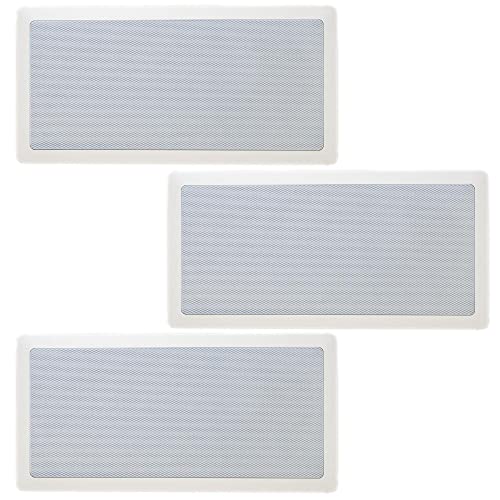
The Legrand HT1LCRV1 bundle provides three matched 5.25″ LCR in-wall speakers for a cohesive front soundstage. Each speaker is rated for dual woofer configuration and a center-channel role with 150W/75W dual-woofer capability. Bundling three matched units simplifies tonal matching issues across left/center/right channels and suits installations that prefer a coordinated appearance and consistent performance.
Buying Guide: Choosing An In-Wall Center Speaker
Selecting the right in-wall center channel requires matching acoustic needs, room layout, and installation constraints. Below are essential considerations and comparison perspectives to evaluate options.
1. Purpose And Role
- Primary Center Channel — Focus on clear midrange and dialogue articulation. Look for pivoting tweeters or controlled directivity.
- Multi-Use / LCR — If using the same model for left/center/right, choose matched sets (bundles or identical models) for consistent timbre and imaging.
2. Driver Configuration And Materials
- Dual Woofers provide stronger midbass output and better dispersion for center channel placement.
- Tweeter Type — Silk dome tweeters offer smooth highs; titanium or compression drivers with horn-loading increase sensitivity and on-axis clarity.
- Cone Materials (poly, cerametallic, carbon fiber) affect stiffness, breakup behavior, and perceived bass weight.
3. Voice Matching And Bundles
- Using matched speakers for LCR maintains consistent tonal balance. Consider bundles or buying the same model for adjacent channels.
4. Room Size, Placement, And Power Handling
- Room Size — Larger rooms benefit from higher-sensitivity drivers or horn-loaded designs to maintain clarity at lower amplifier settings.
- Power Handling — Ensure speaker ratings align with your receiver/amplifier to avoid distortion at higher volumes.
5. Installation Considerations
- Mounting System — Rotating cam systems, pre-construction brackets, or secure mounting tabs simplify installation and reduce vibration.
- Wall Type — Drywall, plaster, or masonry may require different support methods. Check cutout dimensions and depth clearance before purchase.
- Grille And Aesthetics — Paintable grilles and minimal flanges help speakers visually blend into decor.
6. Acoustic Features
- Bass Ports/Power Ports improve low-frequency extension but require clear space behind the wall or proper backing to perform optimally.
- Directivity Control — Pivoting tweeters or horns let you aim high-frequency energy toward the listening area for better clarity.
7. Comparison Perspectives
- Performance-Focused — Look for horn-loaded tweeters and cerametallic or carbon fiber woofers for maximum sensitivity and controlled dispersion.
- Value/Blend — Polycone drivers with paintable grilles and easy mounting balance cost and aesthetics for whole-home installs.
- Installation Ease — If retrofitting, choose models with secure tabs or rotating cams and clear cutout templates to minimize drywall work.
8. Practical Checklist Before Buying
- Measure wall cavity depth and cutout dimensions.
- Verify amp/receiver power and impedance compatibility.
- Decide whether you need a matched LCR set or single center unit.
- Confirm grille finish and whether paintability is required for your decor.
- Plan speaker placement relative to the listening axis and TV screen for best imaging.