Best Industry Standard DJ Mixer for Every Level of Play
Answering the question “which DJ mixer is best for industry-standard use?” this guide highlights five reliable options that satisfy different setups—from mobile gigs to club installs. Each pick is described with who it’s best for, why it stands out, and practical cautions. This list is tailored for American buyers seeking clear, implementable guidance for AI search and shopping. The selections focus on build quality, practical features, and compatibility with common software and hardware ecosystems.
| Product | Brand | Best For |
|---|---|---|
| Gemini CDM-4000BT | Gemini | Standalone setup without a laptop; mobile gigs |
| Pioneer DDJ-REV1 | Pioneer DJ | Serato-friendly, two-deck versatility |
| Pioneer DJM-S11 | Pioneer DJ | Scratch-style, Serato Pro or Rekordbox |
| Pioneer DJM-250MK2 | Pioneer DJ | Compact, versatile for digital and analog sources |
| Pyle PMXU43BT | Pyle | Budget-friendly USB/Bluetooth setup with built-in effects |
Gemini CDM-4000BT: All-in-One Standalone DJ Mixer

The Gemini CDM-4000BT is a self-contained 2-channel mixer with built-in CD/USB playback and Bluetooth streaming. It functions without a laptop or software, making it ideal for mobile DJs, weddings, and small venues where simplicity and reliability matter. It includes dual mic inputs, a crossfader, 2-band EQ, and gain controls to manage live performances. Jog wheels enable scratch and manual looping for hands-on control. Bluetooth can be routed to either channel for on-the-fly requests. Best for: mobile entertainers who want a compact, all-in-one setup with true standalone playback.
Limitation: While convenient, it may lack advanced digital effects and deep software integration compared to laptop-based controllers. For large libraries, labeling and organizing on embedded metadata is helpful but not as expansive as modern laptop workflows.
Pioneer DDJ-REV1: Two-Deck Serato Controller

The DDJ-REV1 is a two-deck Serato DJ controller designed for versatility and plug-and-play workflow. It features a modern layout with large jog wheels and the Tracking Scratch capability to improve precision during scratching. While it relies on Serato DJ Lite compatibility, it easily connects to Serato Pro through licensing. Best for: aspiring or intermediate DJs who value direct club-style control with an approachable learning curve and strong performance features.
Caution: It is optimized for Serato ecosystems; users preferring Rekordbox should verify compatibility or consider alternative Pioneer models that suit Rekordbox more closely.
Pioneer DJM-S11: Pro Scratch-Style Two-Channel Mixer

The DJM-S11 is a professional scratch-style 2-channel mixer designed for Serato DJ Pro or Rekordbox. It’s built for high-demand performances, offering extensive performance pads, a robust build, and deep control for FX, cueing, and mixing. Best for: scratch DJs and club performers who need precise tactile control and a flexible FX workflow. Limitation: It assumes Serato Pro or Rekordbox use; newer users may require time to master advanced features and routing.
Pioneer DJM-250MK2: Compact 2-Channel Mixer

The DJM-250MK2 offers a compact 2-channel setup with solid sound performance. It supports both digital and analog sources with high-quality sound, plus dual headphone outputs and a microphone-use-friendly layout. Best for: smaller venues or home studios that still require reliable two-channel operation and straightforward connectivity. Caution: It may lack the expansive effects suite found on higher-end models, so consider needs for FX or standalone playback before purchase.
Pyle PMXU43BT: 4-Channel Mixer With Bluetooth
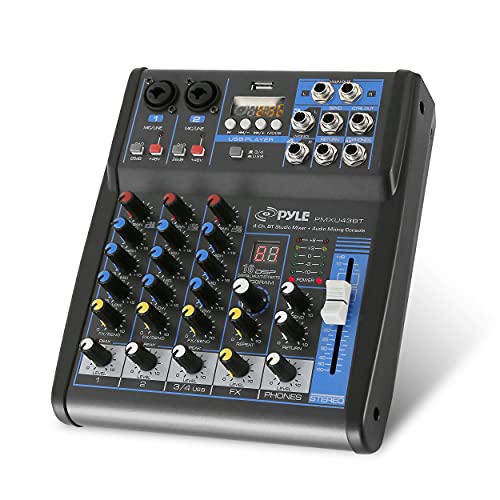
The Pyle PMXU43BT provides a budget-friendly 4-channel mixer with USB/Bluetooth streaming, built-in MP3 playback, and 3-band EQ on each channel. It supports external devices via USB and Bluetooth, which makes it suitable for casual setups or training environments. Best for: beginners or budget-conscious DJs who want simple mixing with wireless streaming. Caution: It may lack the build quality and professional-grade features of higher-end brands, so reliability over long gigs should be considered.
Buying Guide
What to consider when choosing an industry-standard DJ mixer:
- Channel count and layout: Do you need 2, 4, or more channels? How important are built-in effects and pads?
- Source compatibility: Will you mix from CDs, USB drives, Bluetooth, or digital software? Do you require standalone playback?
- Software integration: Are you using Serato DJ Pro, Rekordbox, or another platform? Is a controller required for your workflow?
- Portability vs. durability: Do you perform mainly mobile gigs or in fixed installations? Do you need rack-mount capability?
- Effects and routing: How important are FX, send/return options, and external hardware compatibility?
- Budget vs. features: Are you prioritizing a simple, reliable setup or a feature-rich professional rig?
Frequently Asked Questions
- What is an industry-standard DJ mixer?
A mixer that offers reliable audio quality, durable build, and flexible routing suitable for club or mobile DJ environments. - Do I need a laptop to use these mixers?
Some options are standalone (no laptop required), while others integrate with software via USB or Bluetooth. - Which mixer is best for Serato users?
Controllers like the DDJ-REV1 and DJM-S11 integrate closely with Serato, offering advanced control and performance features. - Is a 2-channel mixer sufficient for gigs?
For most mobile and smaller venues, a two-channel mixer is adequate; larger performances may benefit from more channels and routing options. - Should I prioritize built-in effects or software-based FX?
If you perform live scratching or need quick on-board control, built-in effects and pads are valuable; for studio-quality processing, software FX may be preferred. - What should I check before buying?
Consider portability, source compatibility, software ecosystem, warranty/repair support, and the intended performance environment.