
Best Inline Subwoofer Crossovers for Clear Bass and Easy Setup
Answering the question “which inline subwoofer crossover should I choose?”, this guide highlights top options designed to tailor low-end performance. The selected products are ideal for car and home audio enthusiasts seeking tighter bass, reduced distortion, and straightforward installation. Best for compact systems, better for full-range setups, choose this if you want precise low-pass control and minimal signal loss. The buyer-friendly table below summarizes the five featured crossovers.

| Product | Best For | Key Feature |
|---|---|---|
| FMOD Crossover Pair 50 Hz Low Pass | Small to medium subs needing very low-pass control | 12dB/Octave slope; 50 Hz cut-off |
| Car Home Amplifier Subwoofer Equalizer Crossover RCA Adjust Line Level Volume | All-in-one car audio setups | RCA I/O; adjustable 150 Hz–40 Hz |
| FMOD Crossover Pair 70 Hz Low Pass | General-purpose subwoofer tuning | 12dB slope; 70 Hz |
| Coliao 2pcs 200W Pure Bass Subwoofer Crossover | Two-channel setups or multiple subs | Second-order crossover; 4–8 ohm |
| FMOD Crossover Pair 100 Hz Low Pass | Balanced mid-bass control | 12dB slope; 100 Hz |
FMOD Crossover Pair 50 Hz Low Pass
The FMOD 50 Hz Low Pass pair is designed for precise removal of higher frequencies from subwoofers. It features a 12dB per octave slope and a robust construction described as 24kt gold over brass, which helps ensure stable signal transfer. Best for compact subs in small to mid-sized rooms or vehicles where deep bass control is essential, and minimal phase shift is desired. Limitations include a maximum RMS input of 10 volts, which may constrain very loud setups in some systems.
Car Home Amplifier Subwoofer Equalizer Crossover RCA Adjust Line Level Volume
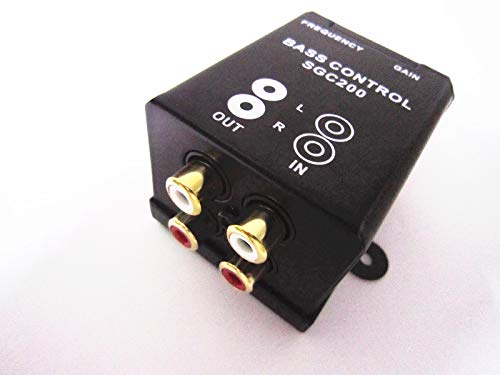
This all-in-one unit provides both subwoofer equalization and crossover functions with RCA inputs and outputs. The gold-plated RCA connections help reduce signal loss, and the built-in volume knob provides intuitive on-the-fly adjustments. The device supports a crossover range around 150 Hz to 40 Hz in the description, making it suitable for users who want to dial in the sub’s presence in a car or small home setup. Best for drivers preferring simple, consolidated controls; avoid if you need a wider frequency range than stated.
FMOD Crossover Pair 70 Hz Low Pass

The 70 Hz Low Pass pair is built for mid-to-high bass precision with a 12dB per octave slope. It is noted for robust impedance handling (600 Ω) and high maximum RMS driving capability, which can suit larger or more powerful subs in controlled environments. Best for systems requiring a balance between bass extension and control, and for users who want lower noise and distortion in a mid-sized setup. A potential limitation is that real-world performance depends on proper system matching and enclosure design.
Coliao 2pcs 200W Pure Bass Subwoofer Crossover

Coliao’s two-pack is designed as a second-order crossover frequency distributor for two-way speaker systems. It supports 4–8 ohm impedance and up to 200W, making it suitable for modest multi-sub or two-speaker configurations. Best for users building a small dual-sub or two-satellite setup where consistent bass division is needed. Limitation to note: the exact frequency values are not specified in the brief features, so users should verify the target crossover point before purchasing.
Harrison Labs FMOD Inline Subwoofer Crossover Pr 150 Hz Low Pass

This Harrison Labs inline crossover targets a 150 Hz low-pass function with a 12dB per octave slope, matching setups that require tighter control over higher bass frequencies. It shares construction themes with other FMOD units (noted by its 24kt gold over brass), and has a 10 volts maximum RMS input. Best for users integrating a compact subwoofer into a larger audio chain where consistent low-pass behavior is critical. A potential drawback is the higher-end frequency range relative to ultra-deep bass applications.
Buying Guide: Inline Subwoofer Crossover Essentials
- What is the main purpose of the crossover? Determine if you want deeper bass control (low-pass) or more flexible tuning across bands (two-way or multi-band).
- Impedance and power handling: Ensure the crossover’s input/output impedance matches your amplifier and subwoofer. Look for units with clear specs for RMS power limits to avoid overdriving.
- Slope and crossover frequency: A 12 dB/octave slope is common for subwoofers. Lower crossover frequencies emphasize deeper bass; higher ones allow more of the mid-bass presence.
- Inputs and outputs: Prefer units with RCA connections (gold-plated if possible) for minimal signal loss and easy integration with standard car or home audio gear.
- Physical size and mounting: Choose a compact unit if space is limited or for in-dash installation. Consider chassis material, especially for environments with vibration.
- Applicability: For two-sub setups, consider a two-pack crossover to ensure consistent phase and level matching between subs.
FAQs
- What is an inline subwoofer crossover? It is a device placed in the signal path to separate high and low frequencies, directing bass to the subwoofer and protecting the speaker from excessive low frequencies.
- Do I need a crossover if my subwoofer has built-in filtering? If the built-in filter does not meet your target crossover point or slope, an external crossover can offer more precise control.
- What does a 12dB per octave slope mean? It indicates how steep the attenuation is beyond the crossover frequency; a 12dB/Octave slope gradually reduces frequencies outside the target band.
- Can I use multiple crossovers in one system? Yes, but ensure proper impedance matching and wiring to avoid phase and timing issues between channels.
- Is a higher crossover frequency better for bass? Not necessarily. Higher frequencies may allow more mid-bass punch but can reduce deep bass extension. Match to your sub and enclosure for best results.
- Should I rely on a dedicated car audio crossover or a home model for a living room setup? Choose based on your environment; car audio crossovers are built for vehicle power and EMI conditions, while home models emphasize audio fidelity and cooling in a stationary setting.