
Inline fuses protect subwoofer amplifiers and vehicle electrical systems from short circuits and overloads. Below is a quick comparison of five inline fuse options selected for car audio subwoofer use, highlighting fuse type, amperage range, and compatible gauge sizes.
| Product | Fuse Type / Amps | Wire Gauge Compatibility |
|---|---|---|
| BOJACK 100A AGU Fuse Holder | AGU / 100A | 4–8 AWG |
| NuIth 60A Mini ANL Fuse Holder | Mini ANL / 60A | 4/6/8 AWG |
| Skar Audio ANL Fuse Holder | ANL / 150A | 1/0 or 4 AWG |
| BOJACK 300A ANL Fuse Holder | ANL / 300A | 0/2/4 AWG |
| Petutu 100A AGU In-Line Kit | AGU / 100A | 4–8 AWG |
BOJACK 4-8 Gauge In-Line 100A AGU Fuse Holder

This AGU-style inline fuse holder supports 10×38 mm AGU fuses and is specified for 4–8 AWG wiring. The holder features gold-plated metal contacts and a transparent polycarbonate (PC) shell for visual fuse inspection. Listed attributes include corrosion resistance, flame retardance, high-temperature tolerance, and water-resistant properties. The compact, cylindrical design includes a mounting hole and is intended for car audio, alarms, amplifiers, and compressors. Use this style when you require a visible fuse element and compatibility with standard AGU fuses.
NuIth 60A Inline Mini ANL Fuse Holder

The NuIth inline mini-ANL fuse holder comes preloaded with a 60A fuse and fits 4/6/8 AWG cables. The transparent housing allows quick fuse checks, and the unit can be mounted to a panel or firewall. The housing is serviceable so you can replace the included fuse with different amperages as needed. The package includes mounting hardware and a small wrench to secure connections. This model targets installations where a compact ANL-style protection device is desired for moderate current subwoofer amplifiers.
Skar Audio In-Line ANL Fuse Holder With 150A Fuse
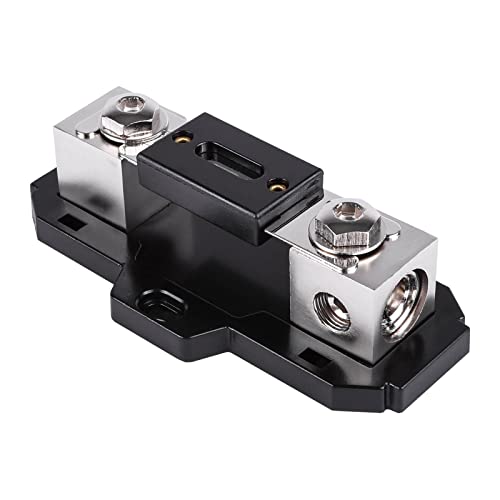
This high-performance inline ANL holder is supplied with a 150A fuse and supports 1/0 or 4 AWG input/output via included reducer shims. The design emphasizes a solid zinc core for maximal current flow and low-resistance connections. It is suitable for higher-power subwoofer amplifiers or systems with larger battery/alternator demands. Use this option when your amplifier’s recommended fuse rating and wire gauge align with 150A protection and larger conductors.
BOJACK 0/2/4 Gauge In-Line ANL Fuse Holder With 300A Fuse

This BOJACK ANL holder arrives with a 300A fuse and supports heavy-gauge wiring (0/2/4 AWG). The product listing emphasizes straightforward connections without terminal blocks required. It’s designed for very high-current systems such as multi-amp setups or vehicles with upgraded charging capacity. Choose this holder when your amplifier and power distribution call for high-amperage protection and large conductors for minimal voltage drop.
Petutu 100A AGU In-Line Car Amp Fuse Block Kit

This kit includes a single AGU-style inline fuse holder and two 100A AGU fuses. The holder uses gold-plated terminals and a clear polycarbonate body to aid conductivity and visual inspection. Dimensions match standard 10×38 mm AGU fuses and the device targets 4–8 AWG installations. The kit approach is useful when replacing existing AGU protection or adding a straightforward inline protective element to a subwoofer amplifier power line.
Buying Guide: Choosing The Right Inline Fuse For Your Subwoofer
Selecting the appropriate inline fuse involves matching the fuse type, amperage, and holder to your amplifier, wire gauge, and installation environment. Below are the key considerations and comparison perspectives.
1. Fuse Type: AGU vs ANL vs MAXI
- AGU (glass tube, 10×38 mm): Visible element, common for medium amperage like 60–150A, fits 4–8 AWG depending on holder.
- ANL (blade-style cartridge): Designed for higher currents and heavy-gauge wiring (4 AWG to 0 AWG); common for high-power subwoofer amplifiers.
- MAXI: Compact automotive fuses for lower- to mid-range currents; some waterproof holders support MAXI types.
2. Amperage Rating And Matching To Amplifier
- Use the amplifier manufacturer’s recommended fuse value or calculate expected current draw. The fuse should protect wiring and the amp from faults without nuisance blowing during normal surge currents.
- Choose a holder that accepts the desired fuse amperage range (e.g., 60A, 100A, 150A, 300A).
3. Wire Gauge Compatibility
- Inline holders list compatible AWG ranges. Ensure your power and ground cables match the holder’s input/output capacity to avoid overheating and voltage drop.
- For example, small amps may use 4–8 AWG; high-power systems often require 1/0–0 AWG and ANL holders.
4. Installation And Mounting
- Consider whether the holder is mountable (mounting hole or bracket) and if it includes hardware. Some holders include screws or wrenches for installation.
- Check whether the holder provides a sealed or water-resistant housing if install location is exposed to moisture.
5. Electrical Conductivity And Materials
- Gold-plated or tin-plated contacts reduce resistance and corrosion. Transparent polycarbonate housings enable quick fuse inspection.
- Solid metal cores (e.g., zinc) are mentioned in high-current models for improved current flow.
6. Serviceability And Fuse Replacement
- Serviceable designs allow fuse replacement without splicing. Some mini ANL or AGU holders let you swap amperage easily.
- Kits that include spare fuses simplify initial setup and testing.
7. Environmental Resistance
- If routing near firewalls, engine bays, or exposed areas, choose holders with water-resistant, damp-proof, and high-temperature tolerant construction.
8. Multiple Perspectives For Comparison
- Power Level Perspective: Match ANL holders to high-power systems (150A–300A); AGU holders suit mid-range amps (60A–100A).
- Space & Aesthetics Perspective: Compact mini ANL or AGU holders occupy less space and may mount easily in tight locations.
- Service Perspective: Transparent, serviceable holders make troubleshooting easier than sealed, non-serviceable blocks.
- Cost & Convenience Perspective: Kits with included fuses and mounting hardware reduce parts sourcing complexity.
Use these considerations to align fuse type, amp rating, wire gauge, and installation needs for reliable subwoofer protection and safe car audio operation.