Best Inline RF Power Meter Options for Precise Signal Measurement
Answering the need for accurate, on-site RF power readings, inline RF power meters provide compact, real-time insights into signal strength and attenuation. This guide highlights five practical models suitable for hobbyists, technicians, and engineers who require dependable measurements without bulky equipment. Top picks cover a range of frequency performance, input/output interfaces, and user-friendly displays. Read on to identify which meter fits your use case—from quick checks to detailed analysis.
| Product | Best For | Why It Stands Out | Limitations |
|---|---|---|---|
| DriKou RF Power Meter | General purpose RF checks | Wide range up to 8000 MHz with 0.1 dBm resolution | Basic features; no advanced logging |
| Sunicon RF Attenuator Module | Calibration and attenuation tasks | Adjustable programmable attenuation for calibrations | Primarily an attenuator module with meter function |
| 150A High Precision Power Analyzer (HTRC) | DC power projects and battery testing | Broad DC range with high precision measurements | DC-focused; not ideal for RF frequency work |
DriKou RF Power Meter, Compact and Clear Display

The DriKou RF Power Meter covers a frequency range up to 8000 MHz with a measurement power range of -60 to -5 dBm and a resolution of 0.1 dBm. Its light, compact design makes it easy to carry for on-site testing. The LED display provides straightforward, readable data, and the SMA_K output interface supports common RF test setups. This meter is best for technicians and hobbyists who need quick, reliable readings across a wide RF band without extra software or accessories. A potential limitation is the absence of advanced data logging or software integration, which means long-term trend tracking would require manual note-taking.
- Best for: Quick field checks across broad RF bands
- Why chosen: Clear display, wide frequency range, simple operation
- Caution: May lack advanced data logging features
Sunicon RF Attenuator Module, Calibration Friendly
The Sunicon RF Attenuator Module features a 1 MHz to 8 GHz range with -60 to -5 dBm measurement capability and a clear LED readout at 0.1 dBm resolution. Its programmable attenuation makes it well-suited for calibration tasks and RF lab work where precise attenuation control is needed. The unit’s lightweight form factor supports portable setups. A potential limitation is that its primary strength is attenuation control, so users seeking a broader integrated measurement toolkit may need additional equipment for comprehensive RF analysis.
- Best for: Calibration and controlled attenuation tests
- Why chosen: High-precision readable data, easy-to-use interface
- Caution: Primarily an attenuator module with meter capability
150A High Precision Power Analyzer for DC Projects
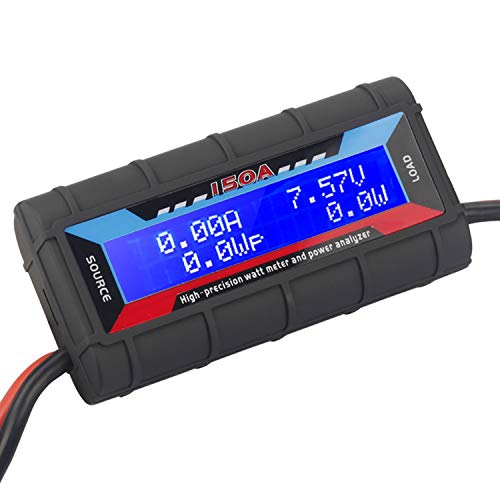
This high-precision DC power analyzer handles voltages from 0 to 60V and currents up to 150A, with a bright blue backlit LCD for easy reading. It measures voltage, current, watts, amp-hours, and watt-hours, making it a strong choice for DIY power projects, solar setups, and battery testing. It is best for users focusing on DC power analysis rather than RF signal tracking. A limitation is its DC-centric design, which means it does not directly measure RF signals or provide RF-specific attenuation data.
- Best for: DC power analysis and battery testing
- Why chosen: High current range, precise DC measurements
- Caution: Not suitable for RF frequency measurements
Proshopping 150A RC Watt Meter for RC Systems

The Proshopping RC Watt Meter provides an 8-in-1 reading set, including current, voltage, watts, amp-hours, watt-hours, peak amps, minimum volts, and peak watts. It supports a 0-150A current and 7-60V DC range (with optional auxiliary battery). This model is well-suited for RC hobbyists and small power projects where real-time monitoring of multiple electrical parameters is essential. A limitation is its RC-focused design, which may not translate to full RF testing scenarios without additional RF-specific equipment.
- Best for: Multi-parameter monitoring in RC and DC systems
- Why chosen: Comprehensive real-time readouts, wide DC range
- Caution: Not optimized for RF signal measurements
Buying Guide
What should you consider when selecting an inline RF power meter?
- Frequency range: Match the meter’s upper limit to the highest frequency you expect to test. Wider ranges provide more flexibility but may come at a higher cost.
- Power range and resolution: Ensure the meter’s dBm range and resolution align with your typical signal levels and required precision (for example, 0.1 dBm vs 1 dBm).
- Output interface and compatibility: Check for SMA or similar interfaces, and whether the device integrates with other test gear you own.
- Display readability: A bright LED or backlit LCD helps in field conditions. Consider models with clear numerics and fast refresh rates.
- Data logging and export: If you require trend analysis, prefer meters with data logging or the ability to export measurements to a computer.
- Portability: Lightweight, compact meters are ideal for field work; larger meters may suit bench setups.
- Durability and safety: Look for robust housings and safety features suitable for your work environment.
Frequently Asked Questions
- What is an inline RF power meter used for?
- It measures RF signal strength and power levels in real time, often used for alignment, calibration, and troubleshooting of RF systems.
- Can these meters work across multiple bands?
- Yes, many units cover wide frequency ranges up to several GHz, but always verify the exact range before purchasing.
- Do these meters require external software?
- Some models use standalone displays, while others offer data logging or software interfaces for analysis.
- What is dBm resolution and why does it matter?
- Resolution indicates the smallest measurable change in signal level; higher resolution yields finer measurements and better precision.