
Best Car Inverters With Cigarette Lighter Plugs for Travel
Answering the common buyer question: these inverters convert your car’s 12V DC power into 110V AC, with a cigarette lighter plug ensuring easy compatibility in most vehicles. The top picks here are best for travelers, commuters, and families who need reliable power for laptops, phones, and small appliances on the go. This guide highlights five solid options and explains who each is best for, plus practical buying tips you can use right away.
| Product | Best For | Key Feature |
|---|---|---|
| BESTEK Power Inverter DC 12-17V to AC 110V – 300W | Heavy-duty use, multiple outlets | 2 AC outlets, 2 USB ports, 300W continuous |
| PiSFAU 200W Car Power Inverter | Compact trips, basic charging | 2 AC outlets, 4 USB ports |
| Vansoet 400W Car Power Inverter | Higher wattage, fast USB charging | 3 USB ports including PD Type-C, 2 AC outlets |
| YSOLX 300W Portable Car Inverter | Balanced power, camping use | 4 USB-C/A ports, 2 AC outlets |
| MOVFFGGRM 500W Peak 1000W Inverter | More devices, higher load | 3 AC outlets, 4 USB ports, robust cooling |
BESTEK Power Inverter DC 12-17V to AC 110V – 300W Car Plug Adapter Outlet
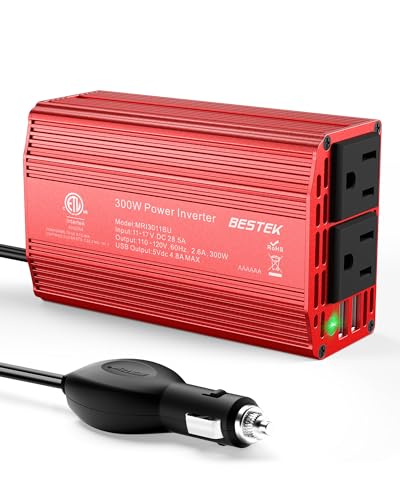
The BESTEK inverter is designed for travelers who need reliable continuous power in and out of the car. It supports 300 watts of continuous DC-to-AC power and 700 watts peak, with two AC outlets and two USB ports. Its compact, iPhone-sized form makes it easy to store in a glove box or cup holder. It is best for users who frequently run laptops, small kitchen appliances, or multiple USB devices at once on road trips or camping adventures. A potential limitation is the fixed cigarette lighter plug length; ensure your vehicle has space for a longer run. This unit targets travelers who prioritize multiple outlets and USB charging for mixed device types.
PiSFAU 200W Car Power Inverter – DC 12V to 110V AC Car Plug Adapter Outlet

This PiSFAU model emphasizes portability with enough power for everyday devices. It provides 2 AC outlets and 4 USB ports, making it suitable for charging smartphones, tablets, and small electronics during short trips. It’s a good choice when you need a compact solution that still offers multiple charging options. A caution: 200W continuous power may limit use with power-hungry devices like large laptops for extended periods.
Vansoet 400W Car Power Inverter for Vehicles DC 12V to 110V

The Vansoet unit offers a higher 400W capacity with a robust USB-C PD port. It includes one 30W PD fast-charging Type-C and one 15W Type-C plus two 15W USB-A ports, enabling simultaneous fast charging for multiple devices, including laptops and phones. It features a dedicated AC control switch and an intelligent cooling fan for quiet operation. This is best for users who need faster charging and better heat management on longer trips. A limitation is that the higher power draw may require careful device selection when driving with limited alternator capacity.
300W Portable Charger Car Power Inverters for Vehicle

This YSOLX inverter emphasizes a balanced approach with 300W output and four USB ports, including both USB-C and USB-A. It’s paired with two 110V outlets, making it practical for families or groups traveling with several devices. The model is suitable for camping or road trips where multiple small electronics need charging. A caution is that higher loads may reduce running time if the vehicle’s battery is already low.
MOVFFGGRM 500W Peak 1000W Inverter
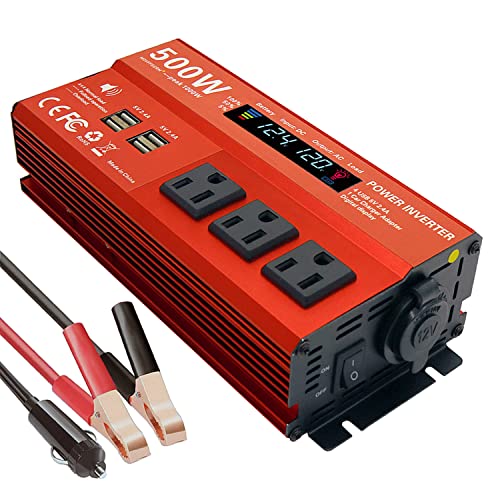
The MOVFFGGRM unit provides a higher load capacity with 500W continuous and 1000W peak, plus three AC outlets and four USB ports. It also includes a robust aluminum body and an assistive cooling fan for sustained use. Best for travelers who run multiple devices or slightly heavier loads, such as tablets, gaming devices, or small appliances. Use caution with extended high-load usage, as prolonged operation at peak can generate more heat than lighter models.
Buying Guide
Power needs: Match wattage to your devices. If you frequently run laptops or small appliances, choose models in the 300W–500W range. For only phone and tablet charging, 150W–200W options may suffice.
Outlets and ports: Consider the mix of AC outlets and USB ports. USB-C with Power Delivery (PD) is ideal for modern devices; multiple USB-A ports help with older gear.
Heat management: Look for built-in cooling fans or heat sinks for extended use. Quiet operation helps in shared spaces like campers or hotel rooms on wheels.
Safety features: Double protection, over-voltage and short-circuit safeguards, and automatic shutoffs add reliability when driving in diverse conditions. A dedicated AC switch on some models helps conserve energy.
Portability vs. power: A lighter, compact inverter is easier to carry but often offers lower wattage. Heavier models provide more outlets and higher peak power for demanding loads.
Vehicle compatibility: Ensure your car’s cigarette lighter socket can handle continuous use of the inverter and that the plug length fits in your dash area without obstruction.
FAQ
- What wattage inverter do I need for laptops? Answer: A minimum of 150–300W is typical for many laptops, but check your specific power draw and consider 300–500W for frequent laptop use or extra devices.
- Can I use an inverter while the car is off? Answer: Some inverters can operate with the engine off if connected to the car battery, but this may drain the battery. Use caution and monitor battery levels.
- Is Pure Sine Wave better than Modified? Answer: Pure sine wave inverters provide cleaner power for sensitive electronics, but many standard devices run fine on modified sine wave models. Consider sensitivity of your equipment.
- Do inverters have built-in safety features? Answer: Yes, most include overload protection, short-circuit protection, high/low voltage shutoffs, and overheat protection.
- Will an inverter affect car electrical systems? Answer: When correctly rated and used within the car’s electrical limits, inverters are generally safe. Avoid exceeding vehicle alternator capacity or battery limitations.
- What is the advantage of USB-C PD on car inverters? Answer: PD provides faster charging for compatible phones, tablets, and laptops, reducing downtime during travel.