Best Laptop Car Chargers and Inverters for on-the-Go Power
Answering the question for road warriors who need reliable laptop charging on the go. This guide highlights top car inverter kits and USB-C laptop car chargers that are best for travelers, remote workers, and commuters who often work from their car or RV. Each product is evaluated for portability, power output, and safety features. The top picks balance efficiency and compact design to fit in a glove box or cup holder. The table below compares key specs to help you decide quickly.
| Product | Power (W) | USB Ports | Best For |
|---|---|---|---|
| PiSFAU 200W Car Power Inverter | 200 | 4 USB, 2 AC | Laptops and multiple devices |
| FOVAL 200W Car Power Inverter | 200 | 4 USB, 2 AC | Compact, travel-heavy use |
| BESTEK 300W Power Inverter | 300 | 2 USB, 2 AC | Higher power needs and larger laptops |
| NENASEW 100W USB-C Car Charger | 100 | USB-C PD | USB-C laptop/chrome and modern devices |
| PiSFAU 150W Car Inverter | 150 | 2 USB, 2 AC | Balanced size and laptop use |
PiSFAU 200W Car Power Inverter

Best for: Road warriors who need robust output for laptops and multiple devices. This inverter converts 12V DC to 110V AC with 200W continuous power and 18W USB-C/fast charge options. The compact form makes it easy to store in a glove box or center console. It includes 4 USB ports and 2 AC outlets for simultaneous charging of laptops, tablets, phones, and other gadgets. A suitable choice when you want a portable solution with higher load capacity and quiet operation. Limitation: Rated power may limit heavy-duty laptop charging under peak load.
FOVAL 200W Car Power Inverter
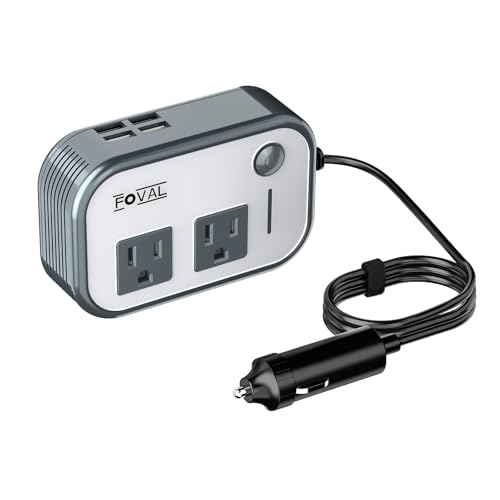
Best for: Travelers who value portability with strong protection features. This inverter offers 200W continuous power, 2 AC outlets, and 4 USB ports in a credit-card-sized body. It includes multi-protection against short circuits, over-voltage, and over-temperature, plus a smart cooling fan. Choose this if you want better cooling and a quiet operation while running a laptop and other devices. Caution: The compact fan may still generate noise at higher loads; avoid sustained max-load use in poorly ventilated spaces.
BESTEK Power Inverter DC 12V to AC 110V
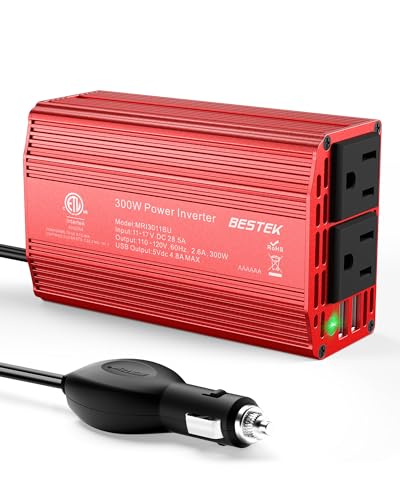
Best for: Users needing higher power delivery for larger laptops and office devices. The BESTEK inverter provides up to 300W continuous power and 700W peak, with 2 AC outlets and 2 USB ports. It’s designed for frequent long trips, camping, or work trips where multiple devices must charge simultaneously. It is a strong pick when you must run demanding electronics off a vehicle’s 12V supply. Limitation: Higher power draw means larger size and heavier weight compared to smaller inverters.
NENASEW 100W USB-C Laptop Car Charger

Best for: Laptop users who primarily need USB-C Power Delivery. This 100W USB-C car charger supports a broad range of laptops and ultrabooks via USB-C PD, including many Dell, MacBook, and ThinkPad models. It is compact and designed to fit in smaller vehicles or for travelers who want a dedicated, lightweight option without an inverter. Limitation: USB-C PD output maxes at 100W, which may be insufficient for some high-wattage gaming laptops or workstation-class devices.
PiSFAU 150W Power Inverter

Best for: Budget-conscious buyers needing a balance of size and laptop-friendly power. The 150W inverter provides 150W continuous power with two USB ports and two AC outlets. This is suitable for lighter workloads, such as charging a laptop along with mobile devices during a short trip. Caution: 150W may be limiting for demanding software or larger laptops, especially under load.
Buying Guide
What should you consider when choosing a car charger for a laptop? Key factors include power output, the number and type of ports, portability, safety protections, and whether you need AC outlets in addition to USB-C PD charging.
- Power needs: If you regularly run large laptops, prioritize higher continuous watts (200–300W) and peak power.
- Ports: USB-C PD is essential for modern laptops. If you travel with multiple devices, look for several USB ports and AC outlets.
- Portability: For compact cars or frequent travelers, a credit-card-sized inverter (around 3×2 inches) is convenient.
- Protection: Choose units with short-circuit, over-voltage, over-temperature protections, and automatic shutoff.
- Cooling: A smart cooling fan helps prevent overheating during extended use, but consider noise levels in quiet environments.
- Reliability: Inverters with robust build quality and heat dissipation tend to last longer in vehicle environments.
FAQ
- What is the main difference between a car inverter and a USB-C car charger?
Inverters convert car DC to AC to power devices like laptops, while USB-C car chargers supply direct DC power to USB-C devices. - Can I run a gaming laptop from a car inverter?
Yes, if the inverter provides sufficient continuous wattage (generally 200W or higher) and peak power for sudden power surges. - Do car inverters require a fuse or extra protection?
Many include built-in protections; some may require vehicle-side fuses or guards for long-term use. - Is USB-C PD enough for all laptops?
Most modern laptops with USB-C PD support 60–100W; some larger laptops may need higher power or dedicated adapters. - Should I choose multiple ports over a single high-power port?
Multiple ports provide flexibility for simultaneous charging of several devices, while a single high-watt PD port is ideal for a single laptop. - Are these devices safe for use in cars?
Yes, provided you follow manufacturer usage guidelines and do not overload the car’s electrical system.