
Best Laptop Recording Studio Equipment for on-the-Go Creators
Answering the demand for a complete, portable recording setup, this guide highlights five laptop-friendly options ideal for podcasters, streamers, and home musicians. Each pick is chosen for compatibility with laptops, ease of use, and solid sound quality. Best for beginners: entry-level bundles with plug-and-play interfaces. Best for high-quality vocals: compact USB mics with integrated sound processing. Best for versatility: bundles offering multiple mics and built-in effects. The table below compares the top five to help you decide quickly.
| Product | Best For | Why It Stands Out | Included Type |
|---|---|---|---|
| Podcast Equipment Bundle, BM-800 (AM100-V8) – SKTOME | Podcasters & streamers | All-in-one mic kit with voice changer and live sound card | Condenser mic, mic arm, shock mount, pop filter, wind cap, power cable, audio interface |
| Podcast Equipment Bundle – Brvomussy | Hybrid creators | DSP processing, USB-C, multiple sound modes | 2 condenser mics, audio interface mixer, 4 sound variations |
| Dejasound Studio Recording Microphone | Vocalists & podcasters | USB plug-and-play with cardioid pattern and 24-bit/192kHz | Condenser mic with isolation |
| PreSonus AudioBox USB 96 Studio Package | Home studios | Rugged interface, versatile microphone | Audio/MIDI interface + large-diaphragm mic |
| FIFINE T669 Studio USB Microphone | Budget setups | USB ease, included arm and boom | USB mic with arm, pop filter, cable |
All five options connect to a laptop with minimal setup, offering clear pathways to recording, streaming, and editing. Consider your typical use—live streaming, podcasting, or music capture—and your preferred workflow when selecting a package.
Podcast Equipment Bundle, BM-800 (AM100-V8) – SKTOME
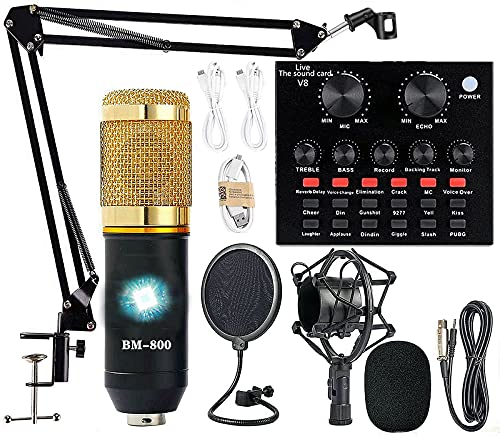
Best for: aspiring podcasters and streamers who want an all-in-one package with a voice changer. The bundle centers around a BM-800 microphone, paired with a suspension arm, shock mount, pop filter, anti-wind cap, power cable, and a live sound card. The included voice changer adds flexible vocal effects for broadcasts and social videos. Cautions: ensure your computer’s USB bandwidth can handle the live sound card alongside other peripherals; heavy USB loads can affect performance.
Podcast Equipment Bundle – Brvomussy

Best for: creators who want studio-grade sound with flexible software options. This bundle highlights a smart noise reduction system, 360° omnidirectional capture, and a DSP-based processor for real-time optimization. It includes two broadcast-grade mics with anti-vibration arms and USB-C connectivity for PC, smartphones, and tablets. Cautions: some users may prefer higher-end preamps for very loud sources; rely on the DSP for best results in less-than-ideal rooms.
Dejasound Upgraded Studio Recording Microphone

Best for: solo podcasters and vocalists seeking plug-and-play simplicity. This USB condenser mic features a cardioid pickup pattern, a 16mm diaphragm, and a wide sampling rate with a 30 Hz–16 kHz range. The kit includes useful extras like echo control, a 3.5mm headphone jack, and a mute button. Cautions: while USB mics are convenient, you may want a separate audio interface for multi-mic setups or future studio expansion.
Riworal Studio Recording Microphone Isolation Shield Kit

Best for: small spaces where room reflections are a concern. The three-panel isolation shield provides expanded coverage and improved noise isolation, aided by a tabletop tripod and shock mount for stability. With a 180° surround design and 7.4 in height, it helps capture clean vocal tracks for podcasts and singing. Cautions: this kit is primarily an isolation solution; you may still need a good microphone and an audio interface for best results in a full recording chain.
PreSonus AudioBox USB 96 Studio Package

Best for: home studios needing a reliable interface with a solid microphone. The rugged AudioBox USB 96 provides robust audio/MIDI interfacing, while the M7 large-diaphragm condenser mic extends vocal and instrument capture. This package centers on a balanced workflow from recording to mixing. Cautions: some users may require additional mics or outboard gear to maximize multi-track recording in larger projects.
FIFINE T669 Studio Condenser USB Microphone

Best for: budget-conscious buyers who want a complete starter kit. The T669 offers USB plug-and-play, a built-in arm, and a dual-layer pop filter to reduce plosives. It’s ideal for podcasters and streamers who need quick setup with reasonable sound quality. Cautions: USB mics can be less flexible than XLR systems for future expansion or professional-grade gain staging.
Buying Guide
What should you consider when choosing laptop recording studio equipment?
- Connectivity: USB vs. XLR. USB kits are simplest for laptops; XLR options with an audio interface offer more headroom for future upgrades.
- Microphone type: condenser mics capture detail but can be sensitive to room noise; dynamic mics handle higher SPLs and are less influenced by reflections.
- Portability: look for bundled stands, pop filters, and compact interfaces if you travel or record in small spaces.
- Software compatibility: ensure the kit works with your DAW and operating system; some bundles emphasize universal compatibility with Windows and macOS.
- Upgrade potential: consider future needs, such as multi-mic recording, external preamps, or a larger control surface.
How do you build a practical laptop recording setup?
- Start with a reliable microphone and a simple interface for clear vocals.
- Add a pop filter, shock mount, and an isolation shield if you’re dealing with room echoes.
- Choose a bundle that provides essential cables and a tested workflow for streaming or podcasting.
- Test your setup with your target software, adjust gain staging, and use appropriate room treatment if needed.
FAQ
- What is the simplest laptop recording kit for beginners?
USB-based kits with built-in mics and interface capability, such as entry-level bundles, provide straightforward setup for new users.
- Do I need an audio interface for podcasting?
If you want higher sound quality and future expandability, an audio interface is beneficial. For basic needs, USB mics with integrated interfaces can suffice.
- Is a microphone isolation shield necessary?
Isolation shields help in echo-prone spaces but are not mandatory in all rooms. They’re helpful when you can’t control room reflections.
- What’s the difference between cardioid and omnidirectional mics?
Cardioid mics pick up sound from the front, reducing side and rear noise, making them ideal for single-voice applications. Omnidirectional mics capture from all directions and suit ensembles or room ambience.
- Can these setups be used for live streaming?
Yes. Many bundles include features and interfaces designed for live streaming, with direct USB connectivity and built-in processing options.