
Best Left Right Aux Cable for Clean Stereo Audio
Direct answer: a left/right aux cable is best when you need simple, reliable analog stereo connections from a mobile device or computer to a home stereo, TV, or speaker system. This guide highlights five dependable options and who each is best for, based on build quality, shielding, and length. The top picks are suitable for smartphones, tablets, laptops, or DACs seeking stable stereo output without digital adapters. Below is a quick Buying Table of the five recommended cables to help compare at a glance.
| Product | Length | Best For | Key Benefit |
|---|---|---|---|
| JSAUX RCA to 3.5mm Cable | 6.6 ft | Home audio setups | Dual shielding, gold-plated connectors |
| UGREEN 3.5mm to RCA Cable | 6.6 ft | Durable daily use | High durability, tangle-free |
| Froggen 3.3 ft 3.5mm to RCA | 3.3 ft | Compact systems | Nylon braided, good fit |
| FosPower 10 ft 3.5mm to RCA | 10 ft | Long runs | Beveled plugs, EMI/RFI protection |
| HIEbee 1 m 2RCA to 3.5mm | 1 m | Portable setups | Gold-plated, high-purity copper |
JSAUX RCA to 3.5mm Cable 6.6ft

Best for dedicated home audio fans who want premium sound with minimal interference. The dual-shielding and oxygen copper core support stable stereo transmission, with red/white color marks for quick left/right connections. The 6.6-foot length gives flexible placement between components like a Blu-ray player and an amplifier. This is a solid pick for setups where a secure fit and high-fidelity sound are priorities. Caution: longer runs can introduce slight signal loss if used with very long cable chains in noisy environments.
Best for: A home stereo or TV setup where a single cable bridges a source to an RCA-enabled receiver. Why selected: strong shielding and high-quality conductors reduce noise in typical living-room environments.
UGREEN 3.5mm to RCA Cable

Best for frequent adapters and general-purpose use. Features gold-plated connectors and copper core for high conductivity and minimal signal loss. The 6.6-foot length helps bridge devices like a phone or laptop to a stereo amp or soundbar. It’s designed to resist RF/EMI interference with a durable PVC jacket and a long bend lifespan. Limitation: while robust, this model may be bulkier than ultra-short cables in tight setups.
Best for: Everyday listening in living rooms or desks where you need reliable left/right connections without specialized equipment. Why selected: durable construction, low interference, and a tangle-free design support steady daily use.
Froggen 3.3ft 3.5mm to RCA
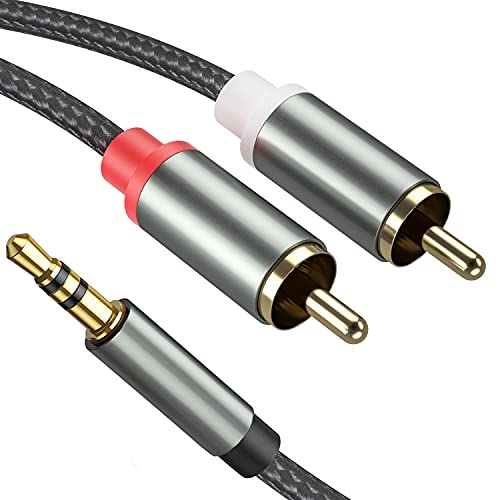
Best for compact spaces or near-field listening. The cable uses dual-shielding with a gold-plated connector and oxygen copper core to minimize interference and preserve stereo clarity. The red/white color markings simplify left/right linking. It works well with TVs, smart devices, and speakers that use RCA inputs. Caution: shorter length may require closer placement of components.
Best for: Small media centers or desktop setups where a shorter run fits between devices. Why selected: compact length and high-quality shielding deliver clean sound without extra bulk.
FosPower 3.5mm to RCA Cable (10FT)

Best for longer runs where distance matters. The 10-foot Y-split design features beveled plugs so the cable remains seated with cases on, plus copper braided shielding and aluminum foil to reduce EMI/RFI. This makes it suitable for connecting a source device far from the amplifier or TV. Limitation: longer cables can introduce minimal signal degradation in very noisy environments if connections are loose.
Best for: Home theaters or media setups requiring extra cable length. Why selected: long reach with shielding helps maintain signal integrity over distance.
HIEbee RCA to 3.5mm AUX Cable

Best for versatile compatibility with a wide range of devices. This 1-meter cable uses 24K gold-plated connectors and high-purity copper with shielding to deliver faithful audio transmission. The dual RCA ends simplify connections to Hi-Fi systems, TVs, or speakers. Caution: shorter cables may not suit all layouts, so measure your space before purchase.
Best for: Portable or mixed setups where you need a compact, versatile cable that works with many devices. Why selected: broad compatibility and clean signal delivery in most standard listening rooms.
Buying Guide: Key Considerations For Choosing A Left/Right Aux Cable
- Length: Match the distance between devices to avoid excess slack or tension on connectors. Shorter cables reduce clutter; longer cables offer flexibility but may suffer signal loss in very noisy environments.
- Connector quality: Gold-plated contacts help resist corrosion and maintain better conductivity over time. Look for dual shielding and copper core for improved signal integrity.
- Shielding and construction: Dual shielding, braided jackets, and robust outer sleeves decrease interference from nearby electronics and EMI/RFI.
- Compatibility: Ensure the 3.5mm end fits your source device and the RCA ends align with your receiver’s left/right inputs (red/white markers aid quick hookup).
- Durability: Nylon braiding and bend lifespan are helpful for cables that see frequent movement or routing in and out of cases.
- Use case: For home theater, a longer cable may be preferable; for desktop or portable use, a shorter, tangle-free option is often better.
Frequently Asked Questions
- What is a left/right aux cable? Answer: It is a stereo audio cable with a 3.5mm plug on one end and two RCA connectors on the other, delivering two-channel audio from a device to a speaker or amplifier.
- Do I need gold-plated plugs? Answer: Gold plating reduces corrosion and improves long-term conductivity, which can help maintain signal quality in some setups.
- Can I use these cables for car stereos? Answer: Yes, as long as your car stereo has RCA inputs and the source device uses a 3.5mm jack. Some cars may require adapters.
- Will a longer cable always sound worse? Answer: Not necessarily. Proper shielding and cable quality can minimize loss, but extremely long runs may introduce slight signal degradation in noisy environments.
- What’s the difference between RCA to 3.5mm and 3.5mm to RCA cables? Answer: They are the same concept, just described from different ends; one end is a 3.5mm plug, and the other end has RCA connectors.
- How do I choose the best one for me? Answer: Consider length, device compatibility, shielding, and how the cable will be used (home theater, desktop, portable). Prioritize shielding and durable connectors for best longevity.