Best Line Converter for Amp: Top Car Audio Interfaces for Clean Subwoofer Power
The best line converter for an amp will convert high-level speaker signals to a low-level RCA signal with clean, distortion-free output, while offering flexible setup for factory or aftermarket radios. This guide highlights five top options ideal for upgrading car audio with subwoofers or amplifiers. It covers who each product is best for, why it was selected, and practical limits to consider before buying.
Summary of selected products:
- KICKER 46KISLOC2 K-Series Stereo Line-Output Converter w/Remote Turn-On Output — Best for high-signal factory radios, with remote turn-on for easy amplifier control.
- Scosche LOC80 Line Output Converter — Best for broad compatibility and straightforward installation for subwoofers.
- Scosche LOC2SL Line Output Converter with Remote Control Knob — Best for driver-friendly bass control and simple integration.
- NuIth Car Audio Speaker Wire to RCA Line Output Converter — Best for adding amplifiers to stock stereos with adjustable bass.
- Skar Audio SKAR2CH-LOC 2-Channel Line-Out Converter — Best for OEM or aftermarket radios needing robust 55W input support.
KICKER 46KISLOC2 K-Series Stereo Line-Output Converter

The KISLOC2 converts factory speaker signals into both RCA signals and a 12-volt remote turn-on line. It supports up to 55 watts (16V) input, delivering true sonic accuracy at any volume. Best for vehicles with factory radios needing a clean, active amp connection, including those that require remote turn-on control for power management. The KISLOC2 is ideal for enthusiasts prioritizing signal integrity and seamless amp activation.
Best for: Car owners with factory radios who want a simple, reliable bridge to an aftermarket amp, with remote turn-on support for easy system amplification.
Note: Remote turn-on compatibility is a key feature; ensure your amp supports the DC offset remote control for best results.
Kicker 46KISLOC K-Series Interconnect

The LOC is a two-channel speaker-to-RCA converter designed to be compact yet sonically neutral. It accepts up to 55 watts of input and delivers up to 8 volts of output, making it suitable for modest to mid-sized upgrade projects. It’s a practical choice when wiring space is tight but sound quality remains a priority. The unit is especially useful for vehicles with OEM radios that include short-circuit protection.
Best for: A small-footprint upgrade where you want a neutral signal path to an aftermarket amp, especially in cars with limited mounting space.
Caution: This model emphasizes compact design; verify your vehicle’s mounting options fit the unit securely to avoid vibration noise.
Scosche LOC80 Line Output Converter

The LOC80 is designed for broad compatibility across OEM and aftermarket systems. It provides high-to-low conversion with a compact footprint, making it a versatile choice for upgrading a car’s audio performance without extensive rewiring. It’s particularly well-suited for driving a subwoofer or a dedicated amplifier with strong, consistent signal delivery.
Best for: Users seeking a flexible, installation-friendly converter that works well with many car audio configurations, including complex OEM setups.
Limitation: While versatile, it may not include advanced bass control features found on higher-end units.
Scosche LOC2SL Line Output Converter With Remote Control Knob
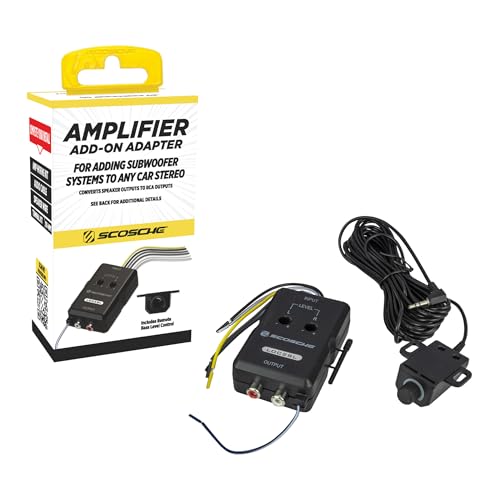
The LOC2SL provides two-channel high-to-low conversion and includes a remote control knob for driver-access bass adjustment. It’s built for easy integration with factory stereos and aftermarket amplifiers, delivering crisp sound ideal for subwoofers. The integrated remote knob adds practical control for on-the-fly bass shaping without needing to access the amp or head unit.
Best for: Drivers who want direct bass control from the cockpit and a clean, simple way to add an amplifier to a factory system.
Limitation: The knob is a nice feature, but it adds an extra control point that may require placement planning for reach and visibility.
NuIth Car Audio Speaker Wire to RCA Line Output Converter

The NuIth converter turns car speaker wires into low-voltage RCA outputs, enabling 2-channel or mono amplifier connections. It includes a bass-friendly feature set like a gain adjustment to tailor bass response while driving, minimizing the need for on-road adjustments. It’s a practical option for upgrading factory systems that lack preamp outputs.
Best for: Those adding a new amplifier or subwoofer to a factory-installed radio who want straightforward, adjustable bass performance without a full head-unit replacement.
Limitation: The product emphasizes signal conversion with bass adjustability, but it may require careful setup to avoid gain-induced distortion at higher volumes.
Skar Audio SKAR2CH-LOC 2-Channel Converter

The SKAR2CH-LOC handles up to 55 watts (16V) input and supports a flat 20Hz–20kHz frequency range at all volume levels. It claims broad compatibility with OEM and aftermarket radios, making it a robust option for integrating an amplifier with varying signal demands. It’s a solid pick for users prioritizing a wide frequency response and dependable performance across volumes.
Best for: Audiophiles and installers needing a high-performance line-out that preserves full-range sound while bridging to an amplifier.
Limitation: The unit’s capabilities depend on compatible head units and amplifiers; verify input wattage matches your system to avoid under-driving or over-driving the amp.
Buying Guide: Key Considerations For Choosing A Line Output Converter
What will you power with the converter? Consider the amplifier’s input sensitivity and the radio’s power output. Look for devices that accept up to 55 watts (16V) input as a baseline for reliable compatibility with many factory radios.
Do you need remote turn-on or bass control? Some units include a remote turn-on lead, others offer a remote bass knob. If you want driver-access bass adjustment, prioritize a model with a knob or compatible remote feature.
How important is signal integrity? For best results, choose a converter described as “sonically neutral” or with a target of minimizing distortion. A stable ground and clean wiring path reduce noise and hiss in the amplified signal.
What installation constraints exist? If space is tight, pick a compact model with straightforward mounting. If you require flexible integration with OEM or modern radios, choose a unit designed for broad compatibility across different head units.
Is future expansion planned? If you expect to add subwoofers or additional amps, ensure the converter has sufficient bandwidth and does not bottleneck signal quality when multiple amps are involved.
Frequently Asked Questions
- What is a line output converter used for? It converts high-level speaker signals to low-level RCA outputs to drive external amplifiers or subwoofers.
- Do all line output converters come with a remote turn-on? No. Some include a 12V remote wire; others focus on signal conversion with no remote output.
- Can I install a line output converter in a factory radio? Yes, many are designed for OEM integration and allow upgrading to aftermarket amplifiers without replacing the head unit.
- Is a remote bass knob necessary? Not always, but it adds convenient, driver-accessible control of bass levels, improving on-the-road adjustability.
- What wattage should I look for in a converter? A common target is up to 55 watts input; this supports most factory radios and keeps headroom for clean amplification.
- Will a line output converter affect overall sound quality? A well-made converter preserves signal integrity and minimizes distortion, contributing to clearer highs and tighter lows when paired with a quality amplifier.