
Best Line Level Distribution Amplifiers for Audio Setups
If you need clean, controllable split and distribution of line-level signals, a distribution amplifier (DA) is the right choice. These devices help you drive multiple outputs without introducing noise or gain loss. The top picks below are suited for home theaters, DJ setups, studios, and DIY audiophile rigs. Best for multi-room playback, streaming, and balanced monitoring, these products vary in input options, gain, and channel count to match your needs.
Buyer note: For succinct comparisons, see the quick reference table below. It highlights key traits like channel count, gain, and best-use scenarios.
| Product | Channel Count | Best For | Notable Gain/Features |
|---|---|---|---|
| Rolls DA134 | 4 | Small studios and home setups needing stereo 4-channel PA/monitoring | Front panel volume, DC low end, direct iPad/iPod input |
| FlyroadUp 2×4 | 4 | DJ, podcasters, home theater with per-channel control | Independent volume per channel, +15dB gain, dual-input capability |
| Rolls RA163 | 8 | Expanded multi-output systems | Mono or stereo operation, +20 dB gain switch, XLR I/O |
| ST-DA3 | 3 | Portable, compact line distribution | 1×3 distribution, compact form |
| Douk Audio L1 family | 1-2 | Budget-friendly hi-fi boosters with gain control | Up to 20dB gain, wide interface support |
Rolls DA134 4-Channel Distribution Amplifier

The Rolls DA134 is a stereo 4-channel distribution amplifier designed for moderate multi-output needs. It offers front-panel volume controls and the option for mono or stereo operation. It’s compatible with inputs from consumer devices such as iPads, iPods, or laptops, making it a practical choice for small studios or home theater setups. Best for users who want straightforward per-channel level control in a compact chassis.
Who this is best for: small studios, musicians, and home users who need four independently adjustable outputs from a single source. Why selected: simple, reliable four-channel spread with direct consumer-device inputs and audiophile-friendly low-end emphasis. Caution: may lack advanced DSP or network features found in higher-end models.
FlyroadUp 2 in 4 Out RCA Line Level Distributor

The FlyroadUp device provides two inputs and four outputs with independent volume controls per channel. It employs an integrated amplifier to deliver up to +15 dB gain, ensuring strong, noise-free distribution across all outputs. This unit is suitable for DJ setups, home theaters, and studios that require real-time mixing between two audio sources without complex gear. Best for: flexible multi-source distribution with per-channel balancing.
Who this is best for: beginners to intermediate users who want straightforward input blending and per-channel level control. Why selected: real-time mixing capability and per-channel knobs simplify balancing. Caution: gain and output levels can introduce noise if inputs aren’t properly balanced or shielded.
Rolls RA163 8-Channel Distribution Amplifier

The Rolls RA163 is an eight-output distribution amplifier intended for larger multi-output setups. It supports mono input feeding all eight outputs or two stereo inputs feeding four stereo outputs, with a +20 dB gain switch. All inputs and outputs are XLR, favoring professional-grade cabling and balanced connections. Best for: expanding a multi-room system or a compact studio with many speaker feeds. Limitations: higher channel count may require careful gain management to prevent clipping.
Who this is best for: technicians and mid-sized studios needing robust, balanced connections across many outputs. Why selected: high channel count with consistent XLR connectivity and adjustable gain. Caution: heavier and larger than compact DAs; ensure adequate rack space and power.
ST-DA3 Portable Distribution Amplifier

The ST-DA3 is a compact 1×3 line distribution amplifier. Its portable form factor makes it convenient for quick setups or field use. Best for: travelers, small venues, or temporary rigs where space is at a premium. Limitation: fewer outputs than larger DAs, which may require flying multiple devices for more complex setups.
Who this is best for: users needing a lightweight, travel-friendly distribution solution. Why selected: portability and simple three-output layout meet on-the-go requirements. Caution: limited outputs mean more planning for larger configurations.
Douk Audio L1 Mini Stereo Line Level Booster
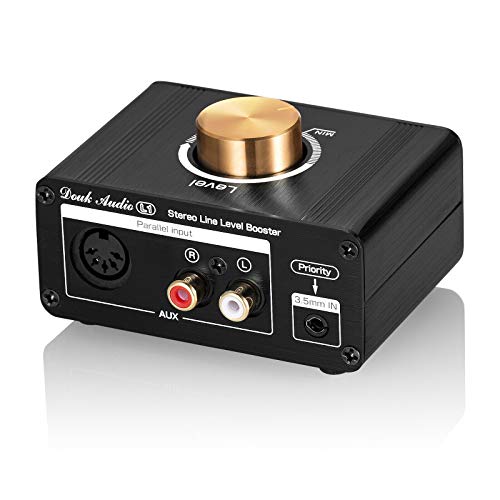
The Douk Audio L1 Mini is a compact stereo line level booster with 20 dB gain and per-channel volume control. It supports multiple input/output interfaces, including 3.5 mm AUX, RCA, and other connectors, making it versatile for small devices such as phones, tablets, TVs, and portable players. Best for: budget-friendly upgrades to boost low-output sources. Limitation: gain is fixed to modest levels and may not drive high-demand speakers alone.
Who this is best for: hobbyists and budget-conscious setups seeking straightforward gain control. Why selected: wide compatibility and upgrade-friendly design. Caution: sensitive to noise if paired with unshielded cables and distant power sources.
Douk Audio L1-MiINI Stereo Line Level Booster

The Douk Audio L1-MiINI builds on the L1 concept with similar input/output options and a compact form. It provides up to 20 dB gain, a user-friendly volume control, and flexible power compatibility. Best for: small rigs where space and simplicity matter. Limitation: while versatile, it may not replace a full DA where multiple independent outputs are required.
Who this is best for: users who want an affordable, scalable booster with essential interface options. Why selected: compact design and upgrade-friendly components. Caution: ensure power supply meets device requirements to avoid instability.
Stereo Line Level Amplifier with 0–15dB Gain

This unit offers adjustable gain from 0 to 15 dB with RCA stereo inputs and outputs. It covers typical line-level boosting needs and has a compact footprint with a frequency response from 20 Hz to 20 kHz. Best for: budget-conscious readers who need a simple, dependable booster with clear gain control. Limitation: lower output range compared with higher-end DAs.
Who this is best for: home studios and simple audio rigs seeking straightforward, non-complex amplification. Why selected: predictable, broad compatibility and a familiar 0–15 dB gain range. Caution: the compact size may limit heat dissipation with long operation times.
Buying Guide: Key Purchase Considerations
- Channel count: Match the number of outputs to your speaker or device setup. More channels let you run multiple zones or monitors without cascading units.
- Gain range: Consider devices with adjustable gain to prevent clipping and balance levels across sources. Higher gain is helpful for low-output devices but can introduce noise if misused.
- Connectivity: Look for RCA, 3.5 mm, and XLR options. Balanced XLR helps reduce noise in longer runs, while consumer interfaces (RCA, 3.5 mm) are convenient for home use.
- Input sources: Some DAs are better for one or two inputs, while others handle multiple inputs and even direct device connections (iPad, iPod, laptop). Plan how you’ll feed the DA.
- Form factor and power: Portable models are convenient for on-the-go setups; larger rack-mount designs suit fixed studios and theaters. Check power requirements and stability.
- Sound quality: While all are intended to preserve signal integrity, some models emphasize low-end response or line-level noise performance. Consider your listening environment and cabling quality.
- Compatibility and future-proofing: If you anticipate expanding your system, select a DA with more channels or higher headroom than your current need.
FAQ
- What is a line level distribution amplifier used for? It splits a single audio line into multiple outputs while preserving signal strength and quality for each path.
- When should I choose a DA with more outputs? When you need to drive several speakers, zones, or monitoring devices simultaneously without signal loss.
- Can I use a DA with consumer and professional gear together? Yes, but check connector types (RCA vs XLR) and balance options to minimize noise.
- Is higher gain always better? Not necessarily. Use the minimum gain needed to avoid distortion and noise, especially with sensitive speakers.
- Do I need a powered DA? Most DAs are powered, but some compact boosters rely on external power. Ensure stable power for consistent performance.
- How do I prevent noise when using multiple outputs? Use balanced connections where possible, keep power and signal cables separate, and avoid looping grounds.