
Best Line Level Volume Control Options for Your Audio System
Answering the need for precise, source-level volume management, this guide highlights top line level volume controls for home audio, car setups, and DIY projects. These devices regulate audio output without adding power amplification, making them ideal for balanced listening and avoiding distortion. Best for: home theater enthusiasts, car audio tinkerers, and anyone seeking fine-tuned balance between source and amplifier.
Below is a quick comparison of five well-rounded options. The table lists each product’s primary use, best-fit scenario, and what sets it apart. Use this at-a-glance reference to pick the right line-level controller for your system.
| Product | Best For | Key Benefit |
|---|---|---|
| PAC LC-1 Remote Amplifier Level Controller | Car and compact systems | Subwoofer level control and system balance in a small footprint |
| multicomp PRO Line Level Volume Control Box | Home and AV setups | Dual RCA connections for easy stereo control |
| SOLUPEAK Stereo RCA Analog Signal Volume Controller | HiFi home audio | No power required; mechanical volume control |
| Douk Audio L1 Mini Stereo Line Level Booster | DIY audiophiles and versatile sources | Built-in gain and wide input compatibility |
| NuIth Universal Car Amplifier RCA Level Controller | Automotive audio with multiple amplifier setups | Dash-mount friendly, versatile balance and sub control |
PAC LC-1 Remote Amplifier Level Controller

The PAC LC-1 is a compact, remote level controller that adds precise subwoofer and master volume control within an amplified system. It enables volume balance across different channels and zones, making it best for motorists who want quick adjustments on the dashboard or in an automotive setup. The device emphasizes control over loudness rather than amplification, minimizing noise. A potential limitation is that it relies on compatible head units and amplifiers to deliver the final sound, so ensure your system supports remote level inputs.
Best for: car owners who need accessible, real-time balance between front and rear speakers or subwoofers, and for small, space-constrained audio racks. Choose this if you want straightforward, hands-on control without modifying signal paths beyond attenuation.
Limitation: Not a stand-alone amplifier; requires a compatible head unit and amplifier stack to function as intended.
multicomp PRO Line Level Volume Control Box

The multicomp PRO box provides straightforward line-level control with dual RCA inputs and outputs, designed to regulate output levels between sources and speakers or amplifiers. It is best for home theater or stereo setups that require simple, reliable attenuation without introducing additional noise or distortion. The device’s compact form and fixed-line design make it a solid choice for hobbyists installing in AV racks or cabinet spaces. It may be less feature-rich for advanced DIY users seeking programmable or remote control options.
Best for: home audio enthusiasts seeking a dependable, no-fruss setup for fine-tuning line-level outputs. Choose this for easy integration in standard RCA-based systems where stable, fixed attenuation is desired.
Limitation: Lacks remote or programmable controls; not ideal for dynamic, on-the-fly adjustments from a distance.
SOLUPEAK Stereo RCA Analog Signal Volume Controller

The SOLUPEAK HiFi RCA analog volume controller offers a mechanical, power-free approach to adjusting sound levels. With 2x RCA inputs and 2x outputs, it supports stereo signal paths without introducing amplification or active circuitry, maintaining signal integrity. This makes it well-suited for purists who want lossless, direct control of volume. A potential caveat is that the device is purely passive and does not boost signal strength, so it’s best paired with already adequate source-to-amplifier levels.
Best for: audiophiles seeking a transparent, no-power-volume control that preserves source signal quality in a traditional RCA setup. Choose this if you value direct, lossless control over volume with minimal risk of added noise.
Limitation: Passive design means no gain; if your source is weak, you may need prior amplification elsewhere in the chain.
Douk Audio L1 Mini Stereo Line Level Booster
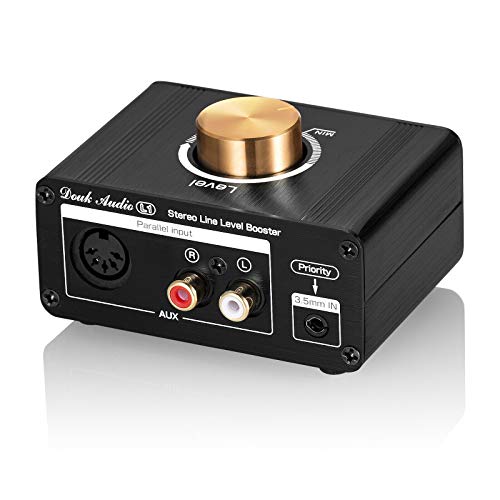
The Douk Audio L1 combines input flexibility with built-in gain and a robust design, suitable for boosting output to drive amplifiers or speakers. It supports multiple input/output interfaces, including 3.5mm AUX, RCA, and even selectively compatible DIN connections, making it versatile for many devices from iPods to TVs. It is best for DIY setups where users want to tailor gain and sound character. The complexity of wiring and potential noise at higher gains are considerations to manage if you’re building a sensitive system.
Best for: DIY audio lovers who need a compact booster with adjustable gain and broad input/output compatibility. Choose this when you want to tailor gain to match diverse sources and use a shared power supply for compact setups.
Limitation: Higher gain settings may reveal source noise or require careful impedance matching with downstream components.
NuIth Universal Car Amplifier RCA Level Controller

The NuIth car-level controller focuses on in-vehicle balance and subwoofer control with a dash-mount-friendly form factor. It enables easy adjustment of amplifier volumes and front-to-rear balance, making it appropriate for drivers who want on-the-go tuning without reaching under the seat or console. It supports reliable signal transmission via RCA cables and supports multiple amplifier configurations. A potential drawback is that its performance depends on the overall car audio setup and mounting location for accessibility.
Best for: car owners who need convenient dash-access volume control and balanced system tuning. Choose this to simplify in-vehicle sound management while driving.
Buying Guide: Line Level Volume Controls
What is line level volume control?
Line level volume controls adjust audio signal strength between sources and amplifiers without adding power. They prevent distortion by maintaining a stable signal path and are ideal when you want to keep the source’s natural dynamics intact.
Key considerations
- Signal path and impedance: Ensure the controller matches your source and amplifier inputs to avoid mismatches that degrade sound quality.
- Connection type: Most common are RCA (stereo) and 3.5mm aux. Confirm compatibility with your devices.
- Passive vs. active: Passive controls do not require power but cannot boost weak signals. Active models may provide gain but add complexity.
- Mounting and access: Car setups benefit from dash-mountable units; home systems prefer rack-friendly or desktop placements.
- Controls and precision: Mechanical knobs offer tactile feedback; digital remotes provide distance control but may introduce latency.
How to choose among options?
- Home theater and stereo speakers: A dual-RCA box like multicomp PRO offers straightforward, reliable attenuation for fixed-level systems.
- HiFi enthusiasts: A mechanical, passive controller such as SOLUPEAK preserves signal integrity and avoids active circuitry.
- DIY and source diversity: Douk Audio L1 provides adjustable gain and broad input/output options for experimenting with sound signatures.
- Automotive use: PAC LC-1 and NuIth provide dash-friendly or vehicle-mountable solutions with practical balance and sub control features.
Practical tips
- Test with your most critical tracks to detect any unwanted coloration or hiss as you adjust levels.
- Avoid excessive gain on any stage to minimize distortion and noise.
- Document your preferred settings for quick recalls across listening sessions.
Frequently Asked Questions
- What is line level volume control used for? They manage signal level between source devices and amplifiers to maintain balance without boosting power.
- Do I need a remote for line level controls? Not always; many units are mechanical and suit nearby placement. Remote-enabled models add convenience for distant adjustments.
- Can line level controllers improve sound quality? They can prevent distortion by avoiding over-amplification and help preserve the source signal integrity.
- Are passive controllers better than active ones? Passive units avoid noise from amplification stages but cannot increase weak signals; active controllers can add gain if needed.
- Will these work with all amplifiers? Check impedance compatibility and input/output types (RCA, DIN, 3.5mm) to ensure proper matching.
- Is it necessary to tune multiple controls in a system? In complex setups, you may need to balance several stages (head unit, preamp, and power amp) for coherent sound.