Best Looper With MIDI Sync for Guitarists and Home Studios
Answering the need for precise timing and seamless playback, this guide highlights top loopers that synchronize with MIDI. These devices are ideal for guitarists and producers building layered tracks, live solo loops, and backing arrangements. The top picks below vary from simple dual-loop pedals to feature-rich multi-effects processors with built-in MIDI clock and sync options. Whether you’re practicing, composing, or performing, choose a looper that matches your tempo needs, compatibility, and workflow.
Buyer snapshot: This comparison focuses on looper pedals and processors with MIDI sync capability. Best for: solo performers needing tight tempo alignment (DITTO X4, Sor an JLP-01), professionals seeking a full pedalboard alternative with expansive effects (Eventide TimeFactor, MOOER GE200 Pro), and users who want USB export and drum accompaniment for practice and songwriting (SORAN JLP-01). Summary table provides quick reference to each product’s core MIDI/sync capabilities.
| Product | Best For | Key MIDI/Sync Feature | Memory/Time |
|---|---|---|---|
| TC Electronic DITTO X4 LOOPER | Dual-track looping with easy use | Sync/tempo via DAW compatibility | Dual tracks, 7 FX |
| Eventide TimeFactor Twin Delay | Advanced delay and looper combo | Lo cking with MIDI-capable delays | 9 delays + 12s looper |
| LEKATO Guitar Looper Pedal | Compact, synced loops | SYNC & Tuner Function | 3 loops, 18 minutes |
| MOOER GE200 Pro | All-in-one guitar processor | Tempo, MIDI support via software | 286 effects/modules |
| SORAN JLP-01 Rhythm Loop Looper | Practice with drum styles | Smart Tempo Sync, USB-C export | 360s stereo, 9 drum styles |
TC Electronic DITTO X4 LOOPER

The DITTO X4 LOOPER features true bypass, analog dry-through, dual loop tracks, and seven loop effects to expand creativity. It’s best for guitarists who want easy, reliable looping with parallel ideas and live layering. The dual tracks enable evolving compositions or fully fleshed songs using separate timing or phrases. A caveat: its effects are loop-centric, so users seeking a heavy multi-effects chain may find limitations without external pedals.
Eventide TimeFactor Twin Delay Pedal

TimeFactor combines two independent delays with a built-in looper and a suite of high-fidelity effects. It’s better for guitarists who want studio-grade delay textures and a looper in a compact format, with MIDI-compatible tempo controls through external devices. Best for players who value precise tempo syncing across multiple delay voices. A limitation is its comprehensive feature set may require a steeper learning curve for new users.
LEKATO Guitar Looper Pedal
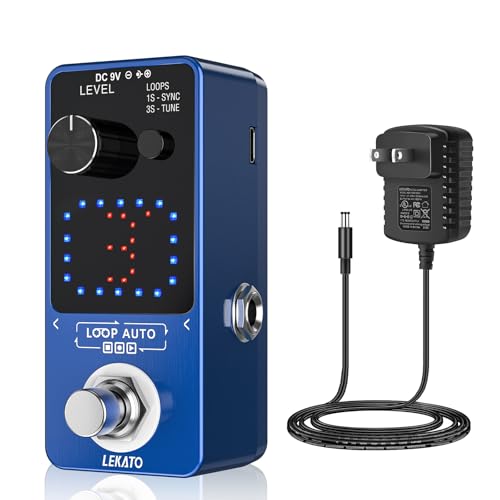
LEKATO offers three loops with 18 minutes total recording time and a visual time indicator. It supports synchronized recording and built-in tuning, with high-quality analog-dry-through design. It’s best for players who need a compact pedal with synchronized recording to minimize timing gaps. A potential drawback is the smaller memory capacity, which may require longer playback planning for complex arrangements.
MOOER GE200 Pro Gen.4.0

The GE200 Pro is a versatile all-in-one processor with 286 effects/modules and MNRS impulse responses. It supports streaming via Bluetooth, USB export, and preset sharing. Choose this if you want a single unit that handles amp modeling, effects, rhythm, and a robust looper workflow with MIDI-friendly tempo controls. It’s heavier and more complex than dedicated loopers, which can be a consideration for live pedalboards.
SORAN JLP-01 Rhythm Loop Looper

SORAN JLP-01 provides a 360-second stereo loop with eight drum styles and smart tempo sync. It’s ideal for practice and songwriting when you want a drum-backed loop without needing a separate drum machine. The USB-C export makes backing track management straightforward. A limitation is that the built-in drum engine may not meet every genre’s specific groove needs, requiring external backing for certain styles.
Buying Guide
What should I look for in a looper with MIDI sync?
Key factors include MIDI clock accuracy, tempo sync options, and whether the unit supports external MIDI devices or DAWs. Consider memory (loop duration and number of tracks), input/output options, and whether you need built-in drum machines, effects, or amp modeling.
Which features matter most for live use?
Stability of loop timing, easy-access control pedals, and clear status indicators are essential. Dual-track loops help create live, evolving arrangements, while reliable sync ensures your phrases stay in time with the band or backing tracks.
What about portability and power?
Compact pedals are easier to transport, but some all-in-one processors deliver more capability in a single unit. Check power requirements and whether a dedicated power supply is included or needed for reliable operation on stage.
Do you need USB or Bluetooth export?
USB export is useful for backing track management and archiving loops as WAV files. Bluetooth adds convenient playback of backing tracks, but can introduce latency if not well optimized.
How to choose among the top options?
- For simplicity and classic looping: TC Electronic DITTO X4 LOOPER.
- For advanced delay textures with looping: Eventide TimeFactor Twin Delay.
- For a compact, synced solution: LEKATO or SORAN JLP-01.
- For an all-in-one effects and MIDI-capable processor: MOOER GE200 Pro.
FAQ
- What is MIDI sync in a looper used for?
– It aligns loop playback with an external tempo source, ensuring phrases stay in time with other devices or DAWs. - Can I use a looper with MIDI clocks from my DAW?
– Yes, many loopers support external MIDI clock or beat sync via MIDI or USB connections. - Is a drum machine necessary if I want rhythm accompaniment?
– Not necessary, but a built-in drum machine or a companion device can simplify practice and song ideas. - Do all loopers support USB export?
– Not all do; USB export is common but verify formats and file types before purchase. - Which looper is best for live performance?
– A dual-loop pedal like DITTO X4 or a compact MIDI-sync capable processor with stable footswitches is ideal for live setups. - What’s the trade-off between a dedicated looper pedal and an all-in-one processor?
– Dedicated loopers are often simpler and lighter; all-in-one processors offer broader effects but can be more complex.