
Best Low Profile Bass Speaker Guide for Car Audio and Compact Setups
Answer: For space-saving, under-seat and slim profile bass, these low-profile subwoofers deliver solid, punchy bass without hogging interior space. They’re best for drivers who want boosted low end without sacrificing cabin room, frequent commuters, small-car owners, and renters who need easy installation. This guide compares five compact options, highlighting who each product is best for, why it was selected, and practical trade-offs.
| Product | Why It’s a Fit | Best For |
|---|---|---|
| Planet Audio P8AWK | Under-seat design, built-in amplifier, low-profile form | Compact trims and quick installs |
| Sound Storm LOPRO10 | High-level inputs; integrated amp; under-seat footprint | Factory-radio integrations |
| Rockville Slim Shaker | Ultra-slim, versatile placement, strong 600W peak | Thin-profile rooms with flexible mounting |
| TOPAUDIO Slim Subwoofer | Lightweight, space-saving, built-in amp | Budget-friendly, easy install |
| Rockville SS8P | 8″ depth-friendly, built-in amp, high-level inputs | Under-seat upgrades in small spaces |
Planet Audio P8AWK 8 Inch Under Seat Subwoofer

The P8AWK combines an 8″ driver with a built-in amplifier, offering a compact solution for drivers who want a sealed-off, low-profile sub. Best for: small cars or trucks where space is at a premium and you prefer an all-in-one unit. The MOSFET power supply supports efficient operation, while the variable low-pass filter helps keep sub-bass focused. Caution: wiring and power requirements should be matched to the vehicle’s electrical system to avoid drawing excess current.
Sound Storm LOPRO10 10 Inch Under Seat Subwoofer

The LOPRO10 integrates a built-in amplifier and features high-level inputs for factory or aftermarket radios lacking RCA outputs. It’s ideal for users upgrading an older system or those seeking a straightforward under-seat upgrade without extra amplifiers. Best for: vehicles with non-RCA head units or when a simple, all-in-one solution is preferred. Caution: the speaker-level input may require proper harnessing to avoid distortion or impedance mismatches.
Rockville Slim Shaker 10″ Under/Behind Couch Subwoofer

Rockville’s Slim Shaker delivers deep bass in a 5.7″ thick cabinet, making it suitable for under couches or behind furniture. Best for: home theater setups or living-room-style gaming rigs where space is limited but deep bass is desired. Caution: placement choice (under furniture) can affect coupling and perceived bass punch in different rooms.
TOPAUDIO Slim Subwoofer Underseat with Amp 10″

TOPAUDIO offers a slim 10″ under-seat sub with an integrated amplifier, targeting buyers who want space efficiency without sacrificing low-end impact. Best for: compact cars or trucks needing more bass without a large enclosure. Caution: as with any built-in amp design, heat management is important in hot climates or extended listening sessions.
Rockville SS8P 8″ Slim Subwoofer
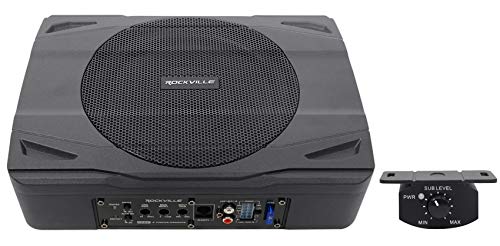
The SS8P is a compact, 8″ sub with a built-in amp and high-level inputs, designed for efficient under-seat upgrades. Best for: users who want a balanced mix of space savings and strong output in smaller vehicles. Caution: ensure the enclosure or mounting surface provides adequate ventilation to avoid thermal buildup.
Buying Guide: Choosing the Right Low-Profile Bass Speaker
- Space and mounting: Measure the available under-seat or behind-couch clearance. Slim profiles range from about 2.5″ to 5.7″ in thickness; choose a unit that fits without blocking pedals, seat adjustment, or vents.
- Power and amplification: Built-in amplifiers simplify installation but may limit headroom. Compare peak and RMS power, and confirm compatibility with your radio output and vehicle electrical system.
- Inputs and compatibility: High-level (speaker) inputs are useful for factory radios; RCA inputs are standard for aftermarket head units. If you plan to retain the factory radio, prioritize high-level input support.
- Filter and crossover controls: A variable low-pass filter helps tailor bass to your cabin acoustics. Look for adjustable phase and low-pass settings to minimize bass muddiness.
- Placement versatility: Some models allow down-firing, up-firing, side-firing, or wall-mount options. Versatile placement helps avoid interference with cargo or seating.
- Build and cooling: Slim designs benefit from ventilation, especially for longer listening sessions. Check enclosure material and any heat management features in integrated amps.
- Sound goals: Under-seat subs typically provide punchy mid-bass rather than room-filling deep bass. If you want theater-level bass, consider pairing with a front-stage speaker system or a dedicated sub in a larger enclosure.
Frequently Asked Questions
- What is a low-profile bass speaker best for? – It’s ideal for vehicles with limited space or for rooms where a traditional subwoofer would be visually intrusive.
- Do built-in amplifiers affect sound quality? – Built-in amps simplify wiring and can deliver adequate power for compact rooms, but external amps may offer higher headroom for larger installations.
- Can I install these under any seat? – Most are designed for under-seat mounting, but check width, depth, and clearance to ensure proper fitment for your specific vehicle.
- Is high-level input necessary? – Not always, but it’s useful if your radio lacks RCA outputs. High-level inputs allow compatibility with many factory radio systems.
- Should I choose 8″ or 10″ models? – 8″ subs are more compact and suitable for small cabins; 10″ models offer deeper bass and higher output potential, often with a slightly larger footprint.
- Can I use more than one sub in a car? – Yes, but ensure electrical capacity and head-unit compatibility; daisy-chaining or separate channels may be required.