
Best Mic to Line Level Preamps for Clear, Pro-Quality Signals
Looking for a mic preamp that can reliably raise a microphone’s signal to line level for easy integration with mixers, audio interfaces, and powered speakers? This guide highlights five solid options well-suited to different budgets and setups. Each pick prioritizes low noise, adequate gain, and clear output. Best for home studios, podcasters, or live-streamers, these preamps help you avoid noise and impedance issues while preserving vocal and instrument detail. The table below compares each option at a glance to help you choose quickly.
| Product | Best For | Key Benefit |
|---|---|---|
| Rodyweil RO03 | Budget setups, dynamic/condenser versatility | Low noise with -120 dB EIN; 19–66 dB gain |
| JCANOL MIC-1 | Multi-output needs, flexible routing | Up to +75 dB gain; XLR + two 3.5 mm outputs |
| XTUGA XIC1 | Dual-mic setups, live streams | +75 dB gain; dual-channel with line/mic outputs |
| Douk Audio L1-MiINI | Compact line boost for laptops/portable gear | 20 dB gain; 26V high-output capability |
| Douk Audio L1 Mini | Versatile 3.5 mm and RCA setups | Up to 20 dB gain; flexible input/output formats |
Rodyweil RO03 Mic Preamp — Low Noise, High Gain

The RO03 offers 19–66 dB gain with improved noise performance (-120 dB EIN) in the 2026 version. It supports dynamic, condenser, and even ribbon mics with a 1 MΩ instrument input option, reducing impedance-related tone loss when used as a DI box. It provides XLR, TRS, and TS line outputs and Type-C power. Best for budget-conscious studios that still demand clean, professional signals. Caution: The two input ports do not operate simultaneously, so you must select one input at a time.
JCANOL MIC-1 Mic Preamp — Flexible Multi-Output

JCANOL MIC-1 delivers up to +75 dB clean gain with -120 dB EIN for low-noise results. It uses dedicated DC analog power to minimize digital interference and features a 1 MΩ high-impedance TS instrument input for DI use. Outputs include professionally balanced XLR and separate 3.5 mm mic and line outs. It’s a strong pick when you need flexible routing for both studio and portable setups. Caution: The two input ports cannot operate simultaneously.
FOSA Mic Preamp — 48V Phantom, Clean Gain

FOSA’s mic preamp provides 20 dB gain with 48V phantom power, suitable for both dynamic and condenser mics. It emphasizes a fully balanced circuit design to deliver ultra-low noise and clean sound. Best for simple, portable use where a compact preamp with straightforward gain is needed. Caution: It is primarily a mic preamp, and some setups may require an additional line-level converter for direct line-level integration.
Douk Audio L1-MiINI Stereo Line Level Booster

The L1-MiINI boosts line level with a fixed 20 dB gain and features a built-in voltage boost circuit up to 26V for higher headroom. It uses a dual-output approach with 3.5 mm AUX and stereo RCA, making it compatible with many portable devices. Best for travelers or small setups needing a compact line-level boost rather than mic-to-line conversion. Limitation: It’s primarily a line booster; when used as a mic preamp, ensure compatibility with your mic and preamp chain.
Douk Audio L1 Mini Stereo Line Level Booster
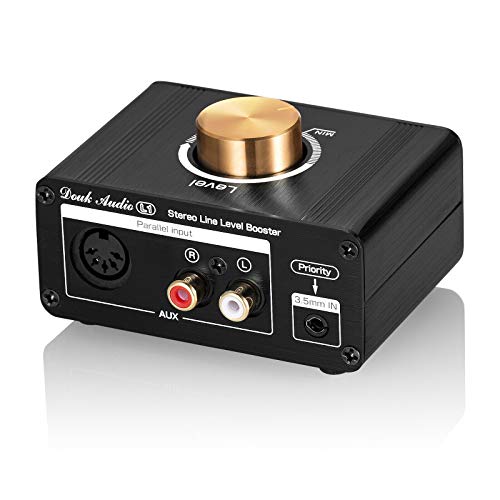
The L1 Mini provides up to 20 dB gain with multiple input/output options, including 3.5 mm AUX, RCA, and 5-DIN interfaces. It’s designed for flexible integration with various devices like phones, PCs, and small mixers. Best for those who need a compact, adaptable line-level boost in a portable form factor. Caution: Check compatibility with your signal path, as it excels at line-level boosting rather than primary mic preamplification.
Buying Guide: How to Choose the Right Mic To Line Level Preamp
Key purchase considerations help you match a preamp to your recording or streaming setup.
- Gain Range: For quiet mics, look for at least 60–75 dB of clean gain. For high-output mics or line-level boosts, 20–30 dB can be sufficient when used with other gain stages.
- Noise Floor: Seek units with low EIN (equalization of input noise). A lower EIN translates to less hum, hiss, and background noise in your recordings.
- Impedance Handling: A high-impedance input (around 1 MΩ) benefits DI use and preserves signal fidelity for instruments.
- Output Options: Prefer multiple outputs (XLR, 1/4″ TRS, 3.5 mm) to fit your interface, mixer, or audio interface.
- Power and Interference: Analog, DC-powered designs can minimize digital interference. Consider phantom power compatibility when using condenser mics.
- Portability: For mobile rigs, compact designs with simple connections are advantageous.
- Input Simultaneity: Some units limit to one input at a time. Plan your signal chain accordingly to avoid surprises.
- Intended Use: Dynamic mics and ribbons benefit from gain and noise control; condensers may require more careful power handling and impedance management.
Frequently Asked Questions
- What is “mic to line level” really doing? It increases a mic’s low-level signal to line level so it can feed mixers, audio interfaces, or powered speakers with less gain staging noise.
- Do I need phantom power for all mic preamps? Not all do. Condenser mics typically require phantom power, while many dynamic mics do not. Check each unit’s phantom power capability.
- Can I use a mic preamp as a DI box? Some preamps offer high-impedance instrument inputs suitable for DI, but verify impedance and input type before connecting guitars or keyboards.
- Is more gain always better? No. Excess gain can amplify noise. Use the minimum necessary gain and adjust downstream levels to avoid clipping.
- Should I buy a dedicated line booster or a mic preamp? If you need mic-level to line-level conversion with mic input, choose a mic preamp. If you mainly need to raise line-level signals from small devices, a dedicated line booster may suffice.
- Will these work with USB audio interfaces? Yes, as long as the interface provides compatible line-level inputs or you route outputs appropriately to avoid impedance mismatches.