Best Mic to RCA Cable for Clean, Flexible Audio Connections
Direct answer: The best mic to RCA cables provide sturdy connectors, proper shielding, and durable construction to minimize noise while delivering clear stereo sound. This guide highlights top options for musicians, streamers, and home audio users who need reliable signal transfer from mics, mixers, or devices with 3.5mm or 1/4-inch outputs to RCA-enabled speakers and receivers. Each option targets a different setup: portable rigs, home theater, studio interfaces, or live sound. Below, a quick comparison table helps you choose quickly.
Choosing at a glance
| Product | Best For | Key Strength | Drawback |
|---|---|---|---|
| UGREEN 3.5mm to RCA Cable | Mobile devices to home speakers | Durable metal shell, low loss | 2RCA only, not professional XLR |
| Amazon Basics 3.5mm to 2 RCA Cable | Budget setups | Gold-plated, straightforward | Basic shielding |
| JSAUX RCA to 3.5mm Cable | Smartphones to receivers | Bi-directional, robust braided jacket | Length limitation varies by model |
| MOSWAG 1/4″ to RCA Cable | Mixers and AV gear | 1/4″ to dual RCA, durable | Not ideal for ultra-long runs |
| JOLGOO Unbalanced RCA to XLR Y | Pro audio interconnects | Professional-grade shielding | Shorter lengths common |
UGREEN 3.5mm to RCA Cable

Best for casual setups where a 3.5mm headphone output feeds a stereo system. The 6.6-foot length provides flexible placement. Gold-plated connectors and copper conductors minimize signal loss, delivering crisp stereo sound with reduced interference. The 10,000+ bend lifespan and flexible PVC jacket boost durability for daily use. Choose this if you mainly connect a phone, tablet, or laptop to a home speaker or sound system. Caution: Not ideal for professional XLR-based mic pipelines.
Amazon Basics 3.5mm to 2 RCA Cable

Best for entry-level audio setups. This 4-foot cable offers dual shielding and gold-plated 3.5mm plugs for clearer audio with minimal signal loss. It is compatible with standard aux jacks on headphones and devices, making it suitable for connecting portable devices to an amp or speaker. Limitation: basic shielding may suffice for everyday listening but could be less robust in highly EMI-prone environments.
JSAUX RCA to 3.5mm Cable

Best for bi-directional audio transmission between smartphones and RCA-enabled devices. The JSAUX cable uses dual shielding and gold-plated connectors for reliable left-right channel transmission. The nylon braided jacket adds durability. Opt for this if you want a reliable, flexible link from mobile devices to a stereo system or a receiver. Caution: The length may be less flexible for long-distance runs in larger rooms.
MOSWAG 1/4″ to RCA Cable

Best for connecting mixers, keyboards, or audio interfaces with 1/4-inch jacks to RCA-equipped devices. This 6.35mm to dual RCA cable splits a stereo signal with two RCA outputs for left and right channels. It provides durable construction with a flexible outer jacket. Choose this when integrating professional gear into home or studio systems. Limitation: Not ideal for very short, delicate connections where micro-mobility is required.
SiYear 15FT XLR to RCA Patch Cable
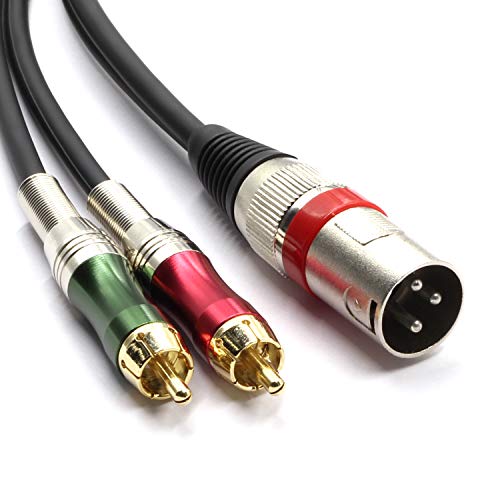
Best for integrating DJ controllers or mixers with longer reach. This XLR to RCA patch cable provides high-density shielding to prevent EMI/RFI interference and supports long-distance runs without significant signal degradation. Ideal for professional applications where balanced-to-unbalanced conversion is needed. Caution: XLR to RCA adapters may require careful level matching to avoid phase issues in some setups.
Buying Guide
Length and flexibility matter. Longer cables offer placement freedom but can introduce minor signal loss. Look for gold-plated connectors and OFC copper conductors to minimize resistance and corrosion.
Shielding and interference control are essential in busy environments. Cables with dual or triple shielding protect against EMI and RFI, preserving audio clarity.
Connector compatibility should match your gear. If you plan to go from a mic or mixer to RCA, ensure the cable supports the needed end connectors (3.5mm, 1/4″, or XLR) and matches your input/output devices.
Durability features, like braided jackets and robust housings, extend life in mobile or studio settings where cables are frequently moved or coiled.
Practical considerations include management of noise, ease of use, and whether the cable is bi-directional or unidirectional for your specific setup.
FAQ
- What is the difference between 3.5mm to RCA and 1/4″ to RCA cables? 3.5mm to RCA cables connect consumer devices with a standard headphone jack to RCA inputs, while 1/4″ to RCA cables target gear with professional line jacks or instrument outs, offering different signal levels and shielding needs.
- Do I need gold-plated connectors? Gold plating reduces corrosion and improves long-term conductivity, which helps maintain cleaner audio over time.
- Will these cables cause latency or noticeable lag? Cables themselves do not introduce latency; latency typically comes from the processing gear in the chain.
- Can I use any of these with a microphone? Some cables support mic-level signals when paired with appropriate preamps or mixers; check the end connectors and device compatibility.
- What length should I choose? Shorter cables reduce resistance and noise; longer cables offer placement flexibility but may introduce slight signal loss without high-quality shielding.
- Is bi-directional audio possible with RCA to 3.5mm? Yes, some cables are designed to carry stereo signals in both directions, depending on the wiring configuration.