Best Mics That Minimize Background Noise for Clear Voice
Finding a microphone that effectively reduces background noise helps you capture clearer voice in videos, streams, podcasts, and calls. This guide highlights five reliable options suited for different setups—from mobile recording to desktop studios. Ideal buyers include vloggers on the go, remote workers, podcasters, streamers, and students who want cleaner audio without complex software.
| Product | Best For | Key Benefit |
|---|---|---|
| Audiprosxx 2 Pack Wireless Lavalier Microphone | Mobile recording with noise reduction | Automatic pairing and dual mics for two presenters |
| ZealSound K66 PRO RGB USB Podcast Microphone | Desktop podcasting and streaming | Intelligent noise reduction and adjustable controls |
| ZealSound USB Microphone with Noise Reduction | Basic desktop setups | One-button noise reduction and easy USB plug‑and‑play |
Audiprosxx 2 Pack Wireless Lavalier Microphone

The Audiprosxx wireless lavalier microphone set is designed for mobile recording with plug-and-play simplicity. The system requires no adapters, Bluetooth, or extra apps. Its dual-microphone design is ideal for interviews or two-person vlogs. Noise reduction is built into the microphone core and processing, helping minimize ambient interference during video recording, podcasts, or livestreams. Best for on-the-go creators who need quick setup and reliable two-person capture.
- Best for: Two-person interviews, on-location shoots, and quick setup
- Why selected: Zero-setup plug-and-play with automatic pairing
- Caution: Performance may vary with extremely loud environments or distant subjects
ZealSound K66 PRO RGB USB Podcast Microphone
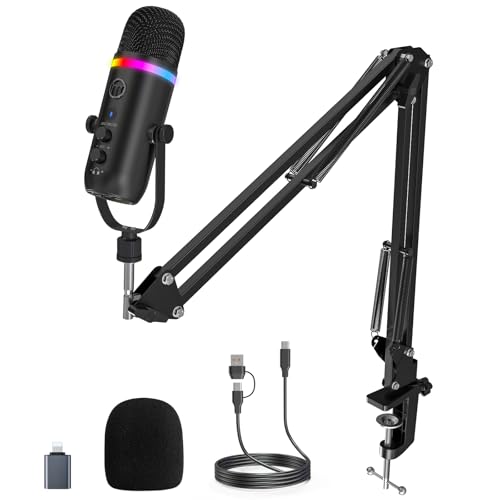
This USB studio microphone emphasizes intelligent noise reduction suitable for podcasts, gaming, streaming, ASMR, and online classes. Its cardioid capsule focuses on your voice while reducing ambient noise, with a long-press Noise Reduction Mode (green LED) to further suppress keyboard clicks, PC fan noise, and chatter. The mic includes precision knobs for mic, monitor, and echoes, helping you tailor sound in real time. Best for: creators who want a plug-and-play desktop solution with controllable noise reduction.
- Best for: Desktop podcasters and streamers seeking adjustable noise controls
- Why selected: Clear, broadcast-style sound with dedicated noise-reduction mode
- Caution: Hardware controls may require a brief setup to dial in ideal levels
ZealSound USB Microphone for iPhone, iPad, Android

This ZealSound USB microphone pares a cardioid pickup with simple plug-and-play compatibility across devices. It includes a one-button noise reduction feature designed to cut fan and AC hum, keyboard sounds, and general room noise. The setup supports iPhone, iPad, Android, PC, and laptops via USB, USB-C, Lightning adapters, and auxiliary cables. Best for: students, remote workers, and mobile creators who want a straightforward solution for cleaner voice capture on mixed devices.
- Best for: Multi-device desks and mobile creators
- Why selected: One-button noise reduction simplifies noisy environments
- Caution: May require positioning adjustments for optimal front-focused capture
ZealSound USB Podcast Microphone for iPhone, iPad, Android

This top-address, cardioid USB microphone is optimized for close-talk recording—great for podcasts, YouTube creators, ASMR, and online teaching. By directing sound from the front, it reduces side and rear noise, offering clearer vocal capture without extra software. It comes with USB cables and adapters for flexible connections to desktops, laptops, and mobile devices. Best for: creators who record at a desk and want a focused voice with minimal ambient noise.
- Best for: Desk setups needing consistent, front-focused sound
- Why selected: Effective front pickup minimizes off-axis noise
- Caution: Cardioid mics can pick up less from off-axis speakers or room reflections
Buying Guide: How to Choose a Noise-Reducing Microphone
Key factors to consider when selecting a mic for reducing background noise:
- Pickup pattern: Cardioid or supercardioid mics focus on the user’s voice and reject side noise, which helps in noisy rooms.
- Connectivity: USB mics are plug-and-play for desktops and laptops; wireless lavaliers are ideal for mobile recording and two-person setups.
- Noise reduction features: Look for built-in noise reduction modes, hats off or mute features, and adjustable gain to prevent distortion in loud environments.
- Recording context: Desktop studios benefit from mics with monitoring and echo control, while field use favors wireless lavaliers and compact mics.
- Ease of use: Preference for one-button controls or auto-pairing can save time during shoots or live streams.
Practical tips for reducing background noise with any mic
- Position the mic close to the mouth to improve signal-to-noise ratio.
- Use a pop filter or windscreen to cut plosives and breath noise.
- Record in a quieter space or with basic acoustic treatment (soft furnishings, blankets, or panels).
- Enable any built-in noise reduction modes before recording and test levels with speech-heavy content.
FAQ
- What type of microphone best reduces background noise for voice work?
Cardioid or supercardioid microphones with dedicated noise reduction modes are typically best for isolating the voice from background sounds. - Are wireless lavalier mics reliable for noisy environments?
Yes, especially those with automatic pairing and noise-reduction features, though placement and distance can affect performance. - Is USB connection necessary for noise reduction?
No. USB mics are convenient for desktops, while many mics with 3.5 mm or Lightning adapters work with mobile devices; noise reduction may be software-free. - Should I choose one mic for both recording and streaming?
Yes, a versatile USB mic with monitoring and echo control can cover both tasks efficiently. - Can noise reduction replace good room treatment?
Noise reduction helps, but basic acoustic improvements still improve overall sound quality. - Do these mics require extra software?
Most listed products offer plug-and-play operation without extra apps, though some modes may be controlled via hardware buttons.