Best Midi a/B Switches for Flexible Music Setup and Easy Switching
If you need seamless MIDI and audio switching, a robust MIDI A/B switch or a related A/B/X system can streamline your workflow. This guide highlights five solid options, suitable for producers, live performers, and keyboardists who require reliable signal routing without noise or signal loss. Each pick targets a distinct use case—from compact MIDI routing to full-featured, passive audio switching. Read on to compare what each device does best, who it’s for, and any practical limitations to consider before buying.
| Product | Best For | Why It Stands Out |
|---|---|---|
| A/B A B A+B Stereo Speaker Selector Switch | Small home studios with stereo speakers | Simple, two-way speaker switching with A/B/A+B modes |
| OUDA MIDI Audio Converter | MIDI users needing flexible A/B formats | Dual-direction MIDI TRS A/B conversion plus 3.5 mm audio switching |
| A/B A+B Switch 1 In – 2 Out | Desk setups needing one input to two outputs | Sturdy two-output, 1-in design for speakers or interfaces |
| DOREMiDi MIDI THRU-16 Box | Pro setups needing many MIDI outlets | 1 input to 16 outputs with individual filters |
| WisWinDa XLR A/B Switch Box | Balanced audio rigs with XLR | Passive, reversible operation for flexible routing |
A/B A B A+B Stereo Speaker Selector Switch Switcher Combiner

This compact two-way speaker selector is best for small home studios or desktop setups with two speaker sets. It supports A, B, or A+B configurations, enabling quick comparison of speakers or a combined sound. Note: continuous music power is limited to 10 watts per channel, so high-power monitors aren’t ideal here. Choose this if you need a simple, unobtrusive switch for studio monitors or computer speakers.
OUDA MIDI Audio Converter
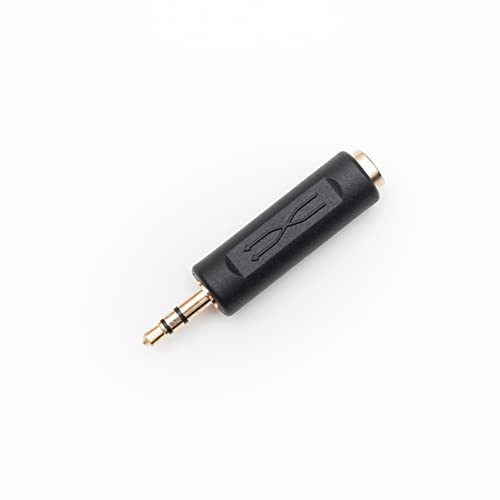
This device provides dual-direction MIDI TRS A/B conversion and 3.5 mm audio switching, making it versatile for MIDI setups and traditional AUX connections. It uses gold-plated connectors for better conductivity and durability. Best for users who need flexible MIDI routing between devices while keeping audio options open. A potential limitation is compatibility with older or non-standard MIDI gear; verify connector types before purchase.
A/B A+B Switch 1 In – 2 Out
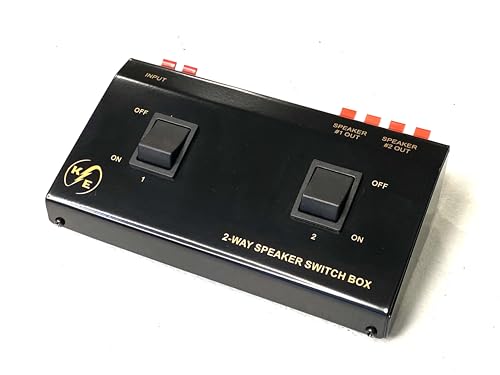
This 1 In to 2 Out switch is designed for stereo receivers or two-speaker setups. Its sturdy metal construction supports desktop use and travel-friendly setups. Best for users who need a simple, reliable way to route one audio source to two outputs. It may be less suited for high-power or multi-source configurations due to its single-input design.
EX Signal Line A/B Box Switch Mini Guitar Pedal

This compact A/B box is aimed at guitarists who need to compare amps or routes for pedals and tuners. It features true bypass and noise reduction to preserve tone, and it operates passively without power. It’s best for studio and stage use where signal integrity matters. A limitation is LED indicators that require a 9V adapter for full visual feedback; the device can still function passively without it.
DOREMiDi MIDI THRU-16 Box
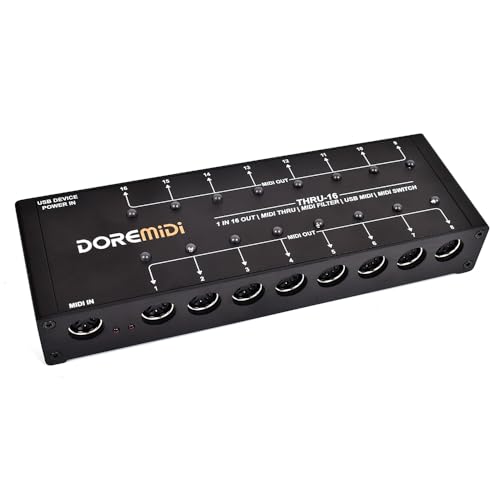
This THRU-16 MIDI hub expands one input into sixteen outputs, each with its own filter and indicator. It’s ideal for complex MIDI rigs, stage setups, or studio environments where multiple MIDI devices must be synchronized. Best for professionals who need centralized, scalable MIDI routing. A caution: power requirements are not described; confirm the power needs if your venue has limited access to outlets.
WisWinDa Pro XLR Passive A/B Switch Box

This XLR-based A/B switch supports balanced audio paths with a passive, reversible design. It suits professional audio setups needing no power consumption and full-duplex capability. Best for users who value clean, low-noise signal paths and flexible routing options for XLR and 1/4″ inputs. Limitation: the description highlights passive operation, which means it lacks built-in gain or phantom power handling if required by some gear.
Buying Guide: How to Choose the Right MIDI A/B Switch
What will you connect? Start by listing devices you plan to switch—MIDI controllers, audio interfaces, synths, or speakers. Ensure the switch accommodates the number of inputs and outputs you need, and verify if you require passive (no power) or active (powered) operation for reliable signal integrity.
What format do your signals use? For MIDI, confirm compatibility with your MIDI interface types (TRS A/B, USB-C, etc.). If you also need audio routing, check whether 3.5 mm, XLR, or RCA connections are supported and whether the switch preserves signal quality without extra noise.
Are there any power or tone considerations? Passive designs avoid power needs but may lack features like LED indicators or gain control. Active switches can offer visual feedback and, sometimes, additional buffering. Consider whether your rig benefits from true bypass, low-noise paths, or simple, straightforward switching.
Size, durability, and mounting options matter. If your setup travels or sits on a crowded desk, look for compact form factors and sturdy metal enclosures. Some products include mounting screws or rack-friendly designs for a clean installation.
Future expansion and compatibility. If you anticipate growing your gear, choose a model that scales to more outputs or supports dual-direction MIDI routing. Verify compatibility with existing devices to avoid misfits during connection, especially with legacy MIDI gear.
Frequently Asked Questions
- What is a MIDI A/B switch? It is a device that routes MIDI or audio signals from one source to two or more destinations, allowing quick A/B comparisons or combined outputs without reconnecting cables.
- Do I need a powered A/B switch? If your gear requires extra buffering or you want LED indicators and robust signal drive, a powered switch can help. Passive switches are simpler and rely on your gear’s power.
- Will using a MIDI A/B switch affect latency? Generally, a well-made switch introduces negligible latency. If you experience timing issues, check the switch’s impedance and ensure cables are short and of good quality.
- Can I use an A/B switch with speakers? Yes, many A/B switches are designed for speaker-level or line-level signals. Check wattage ratings and speaker compatibility before connecting high-power monitors.
- Is it better to choose A/B or A/B/C for more routes? If you need more than two routes, an A/B/C or multi-output switch can reduce cable clutter and simplify management, but may cost more and be bulkier.
- How do I determine compatibility with my MIDI devices? Match connector types (TRS, USB-C, etc.), confirm MIDI channel support, and ensure the device’s switching method aligns with your workflow (direct routing vs. splitter-style splitting).