Best MIDI Controlled Loop Switchers for Seamless Gigs and Studio Sessions
Looking for a reliable MIDI controlled loop switcher to organize your guitar or synth rig? This guide highlights top options that blend robust I/O, programmable presets, and real-time control. Each pick suits different buyers—from touring players needing compact control to studio designers seeking deep MIDI flexibility. Read on to compare features, best-use cases, and practical trade-offs for quick decisions on stage or in the studio.
Summary table of selected products:
| Product | Best For | Notable Strength | Limitations |
|---|---|---|---|
| JOYO PXL8 Foot Pedal Controller | Gigging players who need 8 programmable FX loops | 32 preset combinations, true bypass | Complex setup may require time to configure |
| Voodoo Lab Control Switcher MIDI Amp Commander | Studio and stage rigs with clear, isolated relays | 4 isolated relays with front-panel access | More basic MIDI routing than high-end rivals |
| HOTONE MIDI Foot Controller Pedal Ampero Control | Compact multi-bank setups with Bluetooth | 4 footswitches, 100 banks, Bluetooth | Learning curve for advanced features |
| Blackstar Live Logic 6-Button | USB MIDI integration and on-the-go control | MIDI over USB and multiple inputs | Less emphasis on elaborate loop switching |
| JOYO PXL LIVE Dual 4-Channel | Dual-loop configurations with programmable triggers | Dual 4-channel design | Limited to 4-channel per side |
JOYO PXL8 Foot Pedal Controller

The JOYO PXL8 is an eight-group FX loop pedal controller designed for performers who need reliable, programmable routing. It offers a grouping system that can save 32 effect combinations, enabling fast changes on stage without bending over for presets. This model uses a true bypass design with TAKAMISAWA miniature signal relays to minimize signal coloration. Best for players who require quick access to multiple loop configurations in live settings. A potential limitation is the setup complexity when creating large preset matrices.
Voodoo Lab Control Switcher MIDI Amp Commander
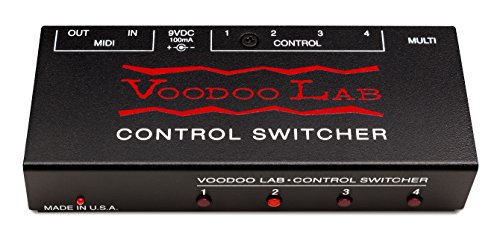
Voodoo Lab’s Control Switcher emphasizes clarity and reliability with four isolated relay controls and easy front-panel instant access buttons. It also provides separate 1/4 inch mono jacks, facilitating straightforward integration into a compact rig. This option is well-suited for studios and live rigs where clean signal routing and quick, tactile access matter most. A limitation is that it offers fewer routing options than some feature-heavy MIDI switchers, making it best for simpler, repetitive setups.
HOTONE MIDI Foot Controller Pedal Ampero Control

This compact four-footswitch controller delivers broad MIDI support, including standard, USB MIDI, and Bluetooth MIDI input/output/thru. A dedicated mobile app streamlines on-the-fly edits, and the device can send multiple MIDI messages per switch, with up to 32 messages across groups. It’s ideal for performers who want Bluetooth-enabled flexibility and quick, programmable changes between presets. A caution: learning how to manage 100 banks and various action modes can take time for newcomers.
Blackstar Live Logic 6-Button MIDI Footcontroller

Blackstar’s Live Logic offers six MIDI-enabled buttons with MIDI over USB plus two expression pedal inputs and an LED display. This setup is well-suited for players who want USB-based control for computer-based rigs or integration with other USB MIDI devices. It’s a practical choice when you need live quick access, clear visual feedback, and the ability to shape performances with lingering expression control. A potential drawback is that it focuses more on USB MIDI than extensive routing flexibility compared with larger pedalboards.
JOYO PXL LIVE Dual 4-Channel Pedal Controller

The JOYO PXL LIVE combines dual 4-channel loop control in a compact form, with two onboard programmable trigger switches. This makes it a strong fit for players who want reliable loop switching across two independent paths without adding bulk to the pedalboard. Choose this if you need a straightforward, dual-loop setup. A limitation is that it may not satisfy users needing more than two separate loop groups or advanced MIDI message routing.
Buying Guide: Key Purchase Considerations
- Number of loops and channels: Match the number of loops to your rig; more loops offer greater routing flexibility but add complexity.
- Input/output options: Consider MIDI, USB MIDI, and expression pedal inputs. Some users benefit from separate 1/4″ jacks or dual banks for quick changes.
- Presets and banks: Look for devices with multiple banks and easy recall. Banks simplify live transitions and studio recalls.
- Latency and reliability: Prioritize devices with stable wireless options or low-latency USB/MIDI to avoid performance hiccups during gigs.
- Ease of use: Front-panel access, clear displays, and intuitive layouts help reduce setup time on stage.
- Physical footprint: For small pedalboards, compact controllers or dual-channel units may be preferable; for larger rigs, multi-loop switchers shine.
Frequently Asked Questions
- What is a MIDI loop switcher used for? It routes multiple effect loops or devices via MIDI messages for organized control during performances or productions.
- Do I need Bluetooth to use a MIDI foot controller? Bluetooth can simplify wireless control, but USB MIDI and traditional 5-pin MIDI are also common and reliable.
- How many banks should I expect? Higher-end models may offer 100+ banks or 32+ presets; choose based on the breadth of your rig.
- Is a dedicated amp switcher better than a general MIDI switcher? It depends on your rig. Dedicated amp commands are excellent for amp-specific features; general switchers offer broader routing for multiple pedals.
- Can I use these controllers with DAWs? Yes, several models support DAW control via MIDI or USB MIDI, enabling transport, track, and preset commands.
- Are there any compatibility concerns? Ensure your rig’s pedals and amps support the MIDI messages and control modes your switcher uses.