Best MIDI Controllers for Drums: Top Picks for Beat Makers
Choosing the right MIDI drum controller hinges on how you create, trigger, and shape drums and samples. This guide highlights five drum-focused MIDI controllers ideal for beat makers, finger drummers, and producers working with DAWs. Each option targets a different workflow—from compact pads for laptop studios to larger pad matrices for live performance. Read on to find which controller best matches your setup and skill level.
| Product | Best For | Key Benefit |
|---|---|---|
| Akai LPD8 | Mac/PC producers seeking 8 pads and assignable knobs | Tactile control with RGB pads and 8 Q-Link knobs |
| Donner STARRYPAD | Beginners to intermediate users needing many pads | 16 pads with multiple banks and 2 faders |
| Akai MPD218 | Compact, portable beat production | 16 MPC pads with 18 assignable controls |
| M-VAVE Wireless Pad Controller | Remote or studio use with Bluetooth | 16 pads, 8 assignable encoders, rechargeable |
| Akai MPK Mini MK3 | Budget keyboard-plus-pad setup | 25 keys with 8 pads and NKS integration |
All models below connect via USB, work with common DAWs, and offer different emphasis on pads, knobs, banks, and portability. This selection focuses on drum-centric performance and sampling workflows for American music makers.
Akai LPD8 – USB MIDI Controller

The Akai LPD8 provides 8 RGB-backlit MPC-style drum pads and 8 assignable Q-Link knobs. It’s a compact solution suited for producers who want immediate tactile control over samples, loops, and DAW parameters. Best for: laptop studios and performers who need portable, hands-on triggering with quick mapping. Limitation: smaller pad count means more frequent bank switching for larger drum kits.
Donner STARRYPAD Drum Machine

The Donner STARRYPAD offers 16 backlit pads with quick bank switching across 3 banks (totaling 48 pads). It includes 2 faders and 2 knobs plus the Shift Key for layered control, plus class-compliant USB-C connectivity. Best for: learners and evolving producers who need many trigger pads and flexible control without a computer-intensive setup. Caution: in some setups, the abundance of pads may require more space and routing awareness.
Akai MPD218 – USB MIDI Controller
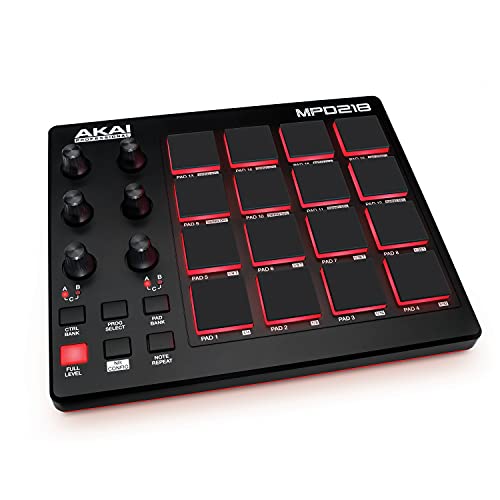
With 16 thick MPC drum pads and three banks, the AKAI MPD218 balances portability with expanded pad access. It also provides 18 assignable knobs across banks for controlling DAW parameters, effects, or virtual instruments. Best for: producers who want a portable, beat-focused controller with substantial pad real estate and flexible control. Caution: not a keyboard-equipped device, so you may need a separate MIDI keyboard for melodic parts.
M-VAVE Wireless MIDI Controller Pads

The M-VAVE model provides 16 RGB pads, 8 assignable knobs, and notes repeat along with full-level buttons, all in a rechargeable Bluetooth-enabled package. Best for: users who mix studio work with on-the-go jamming, thanks to wireless freedom and a long battery life. Limitations: wireless latency and occasional pairing quirks can affect live timing in busy sessions.
Akai MPK Mini MK3 25-Key Controller

The MPK Mini MK3 pairs 25 mini velocity-sensitive keys with 8 backlit pads and 8 assignable knobs. It also features a 4-way thumbstick for pitch/modulation and includes Native Instruments’ NKS integration for expanded instrument control. Best for: tight studio setups needing a compact keyboard-plus-pad solution. Caution: the compact keys may feel cramped for longer sessions.
Akai MPK Mini IV

The MPK Mini IV expands on compact performance with 25 mini keys, 8 MPC pads, 360-degree knobs, pitch and modulation wheels, and a full-color screen for quick navigation. Best for: creators who want a robust small-format controller with deep hands-on control. Limitation: the smaller keyboard may limit expressive range for melodic parts compared to full-sized keyboards.
Akai APC Mini MK2

The APC Mini MK2 focuses on clip launching and Live-style performance with 64 RGB pads and two modes for drum and note triggering. Best for: Ableton Live users who prioritize clip-based workflows and live remixing. Limitation: primarily designed for Ableton-style workflows, which may reduce ease of use in other DAWs without mapping.
Buying Guide: Key Purchase Considerations
- Pad count and layout: More pads are better for drum kits and finger drumming, while fewer pads can keep a compact setup tidy.
- Banking and assignable controls: Banks or multiple presets help scale up to large drum kits without clutter.
- Portability vs. feature set: Portable units suit travel and small studios; larger pads and keyboards are suited for home studios and live setups.
- DAW integration: Native integration or standard MIDI over USB ensures smoother mapping and control of software instruments.
- Power and connectivity: USB-powered units are convenient; Bluetooth models add wireless flexibility but may introduce latency.
- Latency and feel: Pad response, velocity sensitivity, and knob feel influence timing and expressiveness in drum parts.
- Compatibility: Ensure the controller works with your operating system and DAW, and supports any required software packages.
FAQ
- What is a MIDI drum pad controller good for?
- It provides tactile trigger pads for drums, samples, and loops, plus controls for virtual instruments and DAW parameters.
- Do I need a keyboard along with drum pads?
- Not always. Some users prefer a pad-focused setup; others combine pads with a small keyboard for melodic parts.
- Is wireless MIDI reliable for drums?
- Wireless MIDI offers portability, but some users notice minor latency. For critical timing, wired USB is often preferred.
- Which model is best for Ableton Live users?
- APC Mini MK2 is tailored for clip launching in Ableton Live, while other pads can map to Live parameters.
- Can I expand pad controllers with software?
- Yes. Many controllers offer multiple banks and preset slots to manage larger drum kits and effects.
- Do these controllers include software?
- Some come with bundled software or instrument packages; check each product listing for details.