
Best Midi Controller With Arpeggiator for Easy Music Production
Looking for a MIDI controller with a built-in arpeggiator? This guide highlights five solid options that pair well with common DAWs and software instruments. The top picks target beginners, beat makers, and mobile producers who want hands‑on control, expressive playability, and arpeggiated patterns ready to edit. Each product below is chosen for its arpeggiator capabilities, portability, and overall ease of use across popular setups like GarageBand, FL Studio, and Ableton Live.
Buyer-friendly table: quick comparison of selected models
| Product | Arpeggiator Type / Features | Best For | Notes |
|---|---|---|---|
| Rhymo 25-Key MIDI Keyboard | Arpeggiator with latch & modes; X-Y joystick; transpose; loop; tap tempo | Beginners to light beat makers on the go | Portable, USB-C powered |
| Akai MPK Mini MK3 | Built-in arpeggiator with adjustable resolution, range, and modes; 4-way thumbstick | Desktop producers seeking hands-on control | NKS integration for seamless Kontrol |
| Akai MPK Mini Plus | Arpeggiator and clock for creative control; 3 octaves; USB-powered | Compact studio rigs needing more keys | Includes CV/Gate I/O for modular gear |
| Akai LPK25 | Built-in arpeggiator and clock; compact 25 keys | Travel-friendly sketchpad and melody work | Very portable with essential arpeggio features |
| Arturia KeyStep MK2 | 16-step polyphonic arpeggiator; 37-note Slimkey; chord/scale modes | Hardware rigs and sequencing into DAWs | Includes CV/Gate, MIDI, and USB-C |
Rhymo 25-Key Portable MIDI Keyboard with Arpeggiator

Best for mobile producers and beginners who want a compact, USB-C powered setup. The Rhymo 25-key keyboard includes a multi‑mode arpeggiator with latch, plus an X‑Y joystick for pitch bend and modulation. It supports an extended octave range via octave buttons, delivering wide melodic flexibility without a computer tether. The instrument also provides a Full Level mode, multiple MIDI channels, and a sustain pedal input for expressive performances. A key limitation is the smaller keybed, which may feel constraining for piano-style players or complex, chord-rich sessions.
Akai MPK Mini MK3 25-Key USB MIDI Keyboard Controller

An ideal pick for desktop producers and travelers who need a compact control surface with strong integration. The MPK Mini MK3 adds a 4‑way thumbstick for dynamic pitch and modulation, plus an arpeggiator with adjustable resolution, range, and modes. It also includes Native Kontrol Standard (NKS) integration for easy control of Native Instruments instruments. Best for: users who value deep DAW integration and tactile performance controls. Caution: the mini keys may feel shallow for longer sessions or expressive keyboard playing.
Akai MPK Mini Plus 37-Key USB MIDI Keyboard Controller

This model expands the key count to 37 and adds robust live performance features. It offers a full creative workflow with an arpeggiator, clock settings, and USB‑powered operation. Its 8 assignable knobs, a high-contrast color screen, and a push/turn encoder give quick access to presets and DAW controls. Best for: producers who want more keyboard range without sacrificing portability. Limitation: fewer keys than full-size controllers, which could be limiting for complex piano parts.
Akai LPK25 25-Key USB MIDI Keyboard Controller

Designed for ultra-portable melodies and riffs, the LPK25 delivers 25 velocity-sensitive keys with a dedicated octave control and sustain. Its onboard arpeggiator provides immediate musical ideas, while the compact form factor makes it ideal for travel, small studios, and on-the-go sketching. Best for: mobile musicians and quick sketching sessions. Caution: fewer keys may require more up-and-down hand movement for extended melodic lines.
Arturia KeyStep Controller & Sequencer MK2
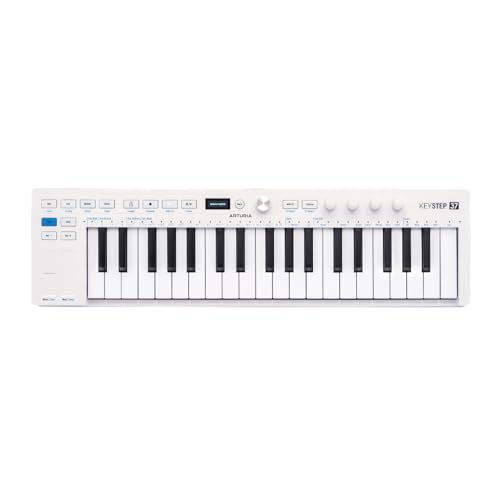
The KeyStep mk2 blends a velocity-sensitive 37-note Slimkey keyboard with a robust polyphonic step sequencer and an expansive arpeggiator. It excels as a creative hub for both studio and live use, offering chord and scale modes that simplify melodic exploration. The hardware-focused design includes USB-C MIDI, MIDI DIN, CV/Gate I/O, and four CV outputs for modular setups. Best for: producers who want a compact controller with deep sequencing and modular compatibility. Limitation: smaller footprint means fewer keys for wide-spread piano parts.
Buying Guide: Key Considerations For Your Arpeggiator Controller
- Arpeggiator capabilities: Look for multiple arpeggio modes, resolution control, latch options, and timing features. A versatile arpeggiator speeds up idea generation and live performance.
- Keybed and playability: Decide between mini keys for portability or full-sized keys for comfort in long sessions. Consider velocity sensitivity and aftertouch if expressive control matters.
- Connectivity: USB power is convenient, but consider models with USB-C compatibility and optional MIDI CV/Gate for modular setups or external synthesizers.
- DAW integration: Native Kontrol Standard (NKS) or other DAW-specific mappings can streamline workflow and control over your software instruments.
- Portability vs. feature set: Smaller units are ideal for travel and quick sketches; larger options add octave ranges, more keys, and expanded control surfaces.
- Additional controls: Look for assignable knobs, sliders, pads, and expression pedals, which enhance live performance and sound shaping.
Frequently Asked Questions
- What is an arpeggiator in a MIDI controller? An arpeggiator automatically plays notes in a selected pattern, transforming chords into arpeggios for more dynamic melodies and patterns.
- Do I need 37 keys or 25 keys? It depends on your use case. More keys offer greater melodic range and more comfortable piano-like playing, while smaller keyboards maximize portability.
- Can these controllers control external synthesizers? Yes, many offer CV/Gate I/O or MIDI outputs to control external gear in addition to software instruments.
- Are arpeggiators compatible with all DAWs? In general, yes, but some features may map differently. Check DAW compatibility and any included software integration notes.
- Which controller is best for beginners? A compact model with an intuitive arpeggiator and straightforward DAW integration is typically best for beginners, such as the Rhymo or Akai MPK Mini MK3.
- Can I use these controllers without a computer? Some units offer standalone arpeggiator modes or clock outputs, but most require a computer or powered device for full functionality.