
Best Popular Bass Effects Pedals for Versatile Tones and Live Performances
Finding the right bass effects pedal can expand your tonal palette without extra gear. This guide highlights five popular bass effects pedals that suit different players—from beginners building a basic rig to gigging players needing flexible tone shaping. Each option is chosen for distinct strengths: wide effect libraries, robust looping, amp modeling, clean blend, and intuitive controls. Read on to see who each pedal is best for and why.
| Product | Best For | Why It Stands Out |
|---|---|---|
| Zoom B1X Four | All-around players needing 70+ effects | Extensive library with built-in looper and expression pedal |
| MOOER GE100 | Compact multi-effects with rich presets | Large preset library, 8 effect modules, easy editing |
| LEKATO Bass Multi Effects | IR loading and live/improv tones | 9 amp models, IR loading, three preset modes |
| JOYO Bass Overdrive | Affordable, versatile overdrive with blend | Blend control plus dual boosts for tonal versatility |
| SONICAKE Bass Pedal | Analog preamp with compression and EQ | Analog warmth, three-band EQ, XLR output |
Zoom B1X Four Bass Multi-Effects
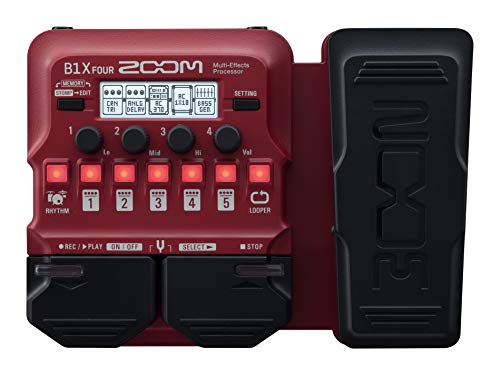
Best for players who want a comprehensive setup in one unit. The B1X Four provides seventy-plus effects and nine amp models for bass, covering everything from clean compression to synth tones. A built-in looper with 68 rhythm patterns supports timing practice and layered parts without extra gear. The expression pedal enables real-time shaping of volume, wah, delay, and pitch, making it ideal for live performances and conceptual songwriting. Best for players seeking a broad sonic toolbox without carrying multiple pedals.
Who this is for: intermediate to advanced players who value a wide effect range and on-the-fly control. Caution: the expansive feature set may require initial setup time to dial in favorite presets.
MOOER GE100 Multi-Effects

Best for players who want a compact unit with a large sound library. The GE100 offers 80 preset patches and 80 user patches, with eight effect modules totaling 66 effect types, giving a broad Mooer sound library. Its user-friendly navigation and assignable expression pedal parameters ease live tweaking. Best for: players who value variety and quick patch changes at gigs or in practice. Caution: some users may prefer deeper editing options found on higher-end units.
LEKATO Bass Multi Effects Pedal

Best for players needing IR loading and flexible live presets. This LEKATO pedal offers 9 amp models and 8 IR cabinets, plus 3 preset modes (Lead, Rhythm, Clean). It supports importing third-party IR files and lets users edit and save presets for live or studio use. Best for: players who want to shape tone with cabinet simulations and tailored live presets. Caution: the software setup for IR management may require extra steps for first-time users.
JOYO Bass Overdrive (Double Thruster R-28)

Best for players seeking a versatile overdrive with clean-blend capabilities. The Double Thruster blends a clean bass signal with overdriven tone, preserving low-end integrity while adding grit. Dual boost switches (Mid Boost and Gain Boost) provide four tonal voicings from a single pedal. Best for: players who need to cut through a dense band mix without losing bass punch. Caution: operation relies on blending; extreme gain can still thin the low end if used poorly.
SONICAKE Bass Pedal With Overdrive And Preamp
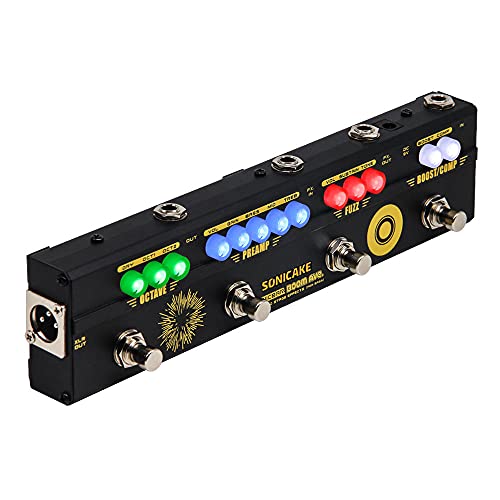
Best for players needing an analog preamp with compression and EQ in one box. The SONICAKE unit combines an analog preamp, compression, overdrive, and a 3-band EQ with PRE/POST options, finished with a high-impedance input and XLR balanced output. Best for: live performers who want warmth and straightforward tone shaping in a single pedal. Caution: analog circuits can be more sensitive to continuous high gain; use moderation to avoid unwanted hiss or noise.
Buying Guide
What should you consider when choosing a bass effects pedal?
- Sound goals: Are you after a broad palette (multi-effects) or a specific effect (overdrive, compression, or amp model)?
- Ease of use: Do you need a quick setup for gigs or deep editing for studio tones?
- Connectivity: Do you require IR loading, XLR outputs, or expression pedal integration?
- Presets and editing: How important is saving and loading custom tones for live sets?
- Budget and portability: Are you prioritizing compact form factors and affordability?
FAQ
- What is an IR cabinet, and why use it? An IR (impulse response) simulates speaker cabinet tones, adding realism to amp-like sounds without a guitar amp.
- Do multi-effects pedals replace individual pedals? They can cover many needs in a compact form, but some players still prefer dedicated pedals for updates and feel.
- Is a blend control important on overdrive pedals? Yes, it preserves low-end while adding grit, preventing a thin bass tone.
- Can I use these pedals for live gigs? Yes, all listed pedals are designed for practice, rehearsal, and live play in various setups.
- Do these pedals require software to operate? Some devices offer PC/Mac software for deeper editing, while others are fully functional with onboard controls.
- Are XLR outputs common on bass pedals? Some models include XLR outputs for direct connection to sound systems or mixers, offering balanced signals.