
Best Multi Tap Delay Pedal for Guitars: Top 5 Picks for Stage and Studio
Answering the search for a reliable multi tap delay pedal, the following options excel at offering multiple delay modes, tap tempo, and looping capabilities suitable for live performances and studio work. Best for live performers who want immediate tempo control, and for producers seeking versatile textures in ambient and rock contexts. The table below highlights the five top picks with key strengths to help you compare at a glance.
| Product | Best For | Key Benefit |
|---|---|---|
| SONICAKE Delay Reverb 2 in 1 | Gigging players needing compact versatility | Two-in-one delay and reverb with tap tempo |
| SONICAKE Delay Reverb Pedal Sonic Ambience | Ambient sounds and texture lovers | Four modes with real-time rate control |
| MOOER D7 X2 Delay Pedal | Studio and stage players with wide sound design | 14 built-in stereo delays and looper option |
| Donner Tap Delay Guitar Effect Pedal | Budget-conscious players needing classic options | Three delay modes with precise tap tempo |
| JOYO Multi-Mode Delay & Looper | Players who want both delay and looping | 8 delay modes plus 5-minute loop |
SONICAKE Delay Reverb 2 in 1 Guitar Effects Pedal Digital Levitate

Best for players who want a compact two-in-one solution. This pedal combines digital delay with plate reverb, offering up to 2000 ms of delay time and a large decay control for rich ambient tails. The trail function helps with on-stage continuity, and the tap tempo supports live timing changes. Choose this if you prioritize quick setup and reliable on-board effects in a single pedal.
Who it’s best for: guitarists needing a straightforward, space-saving setup for both delay and reverb textures. Caution: the two-in-one format means fewer separate parameter controls per effect compared to dedicated units.
SONICAKE Delay Reverb Pedal Sonic Ambience Multi Mode Tap Tempo Delay and Reverb Guitar Bass Effects Pedal

Best for ambient players and sound designers seeking multiple modes in one box. This pedal features four delay and four reverb modes with a real-time rate control and a 2000 ms delay ceiling. The inclusion of multiple modes makes it a flexible choice for textures ranging from subtle echoes to expansive, spacey washes. Choose this if you want multi-mode versatility without swapping pedals mid-session.
Who it’s best for: players exploring textured ambient tones or live soundscapes. Caution: interface can be less intuitive for beginners due to the number of modes.
MOOER D7 X2 Delay Pedal, Dual Footswitch Stereo Delay Guitar Pedal
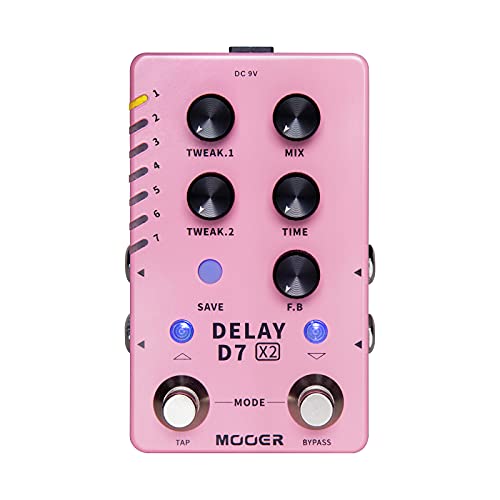
Best for players needing an extensive library of delay textures in a compact unit. The D7 X2 provides 14 built-in stereo delay effects and adjustable parameters via multiple knobs, plus tape-style and modern delays. Tap-tempo lets you lock in tempo on the fly. This option is ideal for players who want broad sonic options and precise control in a pedalboard-friendly footprint.
Who it’s best for: performers and creators who crave a wide palette of delay types. Caution: some users may prefer deeper parameter menus available on higher-end units.
Donner Tap Delay Guitar Effect Pedal, 3 Delay Modes Digital Reverse Analogue with Tap Tempo Control

Best for budget-conscious players seeking essential delay options. This pedal offers three modes (digital, analog, and reverse) along with a straightforward Level, Feedback, and Delay control, plus a tap tempo function. It’s a solid entry point for beginners or players adding a second delay voice to their rig. Choose this if price is a primary concern and you want a dependable, simple setup.
Who it’s best for: beginners and players building a compact, affordable pedalboard. Caution: fewer sound-shaping controls than higher-end models.
JOYO Multi-Mode Delay & Looper Guitar Pedal, 8 Effects incl. Galaxy/Tape Echo with Tap Tempo & 5-Min Loop, Aquarius R-07

Best for players who want both a broad delay palette and looping functionality. The Aquarius R-07 provides eight delay modes, including Galaxy and Tape Echo, plus a five-minute looper with unlimited overdubs. Tap tempo and a four-knob layout enable flexible live tweaking. The looper pairing makes it a strong choice for build-and-layer performances. Choose this if you value simultaneous looping and delay textures.
Who it’s best for: performers who want the ability to stack loops with delayed texture in real time. Caution: the looper can complicate setup for players who only need quick-on presets.
Buying Guide
What to consider when choosing a multi tap delay pedal:
- Delay Time Range: Look for up to 2000 ms or more if you want long echoes for ambient soundscapes.
- Tap Tempo and Tempo Accuracy: A robust tap tempo helps with live performance synchronization; consider pedals with tempo hold or rhythm options.
- Number and Type of Modes: More modes (digital, analog, reverse, galaxy, etc.) expand sonic possibilities but may add complexity.
- Looper Capability: If you need live layering, choose pedals with built-in looper functionality and adequate loop length.
- Isolation and Noise: Power requirements and potential ground loops matter; consider isolated power supplies for noise-sensitive rigs.
- User Interface: Four-knob layouts are common; ensure you can quickly dial in your tone on stage.
- Footprint and Build: Compact pedals save space on crowded boards; rugged builds are better for gigging.
FAQ
- What is a multi tap delay pedal?
- A multi tap delay pedal offers several delay voices and often includes a tempo tap feature, enabling multiple echo patterns and textures from a single unit.
- Do I need a looper on a delay pedal?
- Not always; choose a pedal with a looper if you perform live looping or want to layer sounds without a separate device.
- Which delay pedal is best for ambient tones?
- Pedals with multiple delay modes (galaxy, reverse, shimmer) and reverb options are typically best for ambient textures.
- How important is tap tempo?
- Tap tempo is crucial for syncing delays to the beat during live performance; a stable tempo function improves timing accuracy.
- Can these pedals power other pedals?
- Some pedals require dedicated isolated power supplies; check power requirements to avoid noise or hum on your pedalboard.