
Best Pedal Board Power Switches for Clean, Reliable on/Off Control
When selecting a pedal board power switch, look for devices that provide safe, convenient, hands-free control without clutter. This guide highlights top options suited for guitarists, studio setups, and workshop users who need reliable power switching for pedals, amps, lights, and accessories. The picks below emphasize compatibility with IEC power cords, foot-pedal operation, and durable construction for ongoing use on a board or workbench.
Summary table of chosen products
| Product | Best For | Key Benefit | Limitations |
|---|---|---|---|
| HangTon IEC320 C13/C14 Power Cord With Switch | Pedal boards needing integrated on/off control | Inline switch on a standard IEC power cord | Non-flexible mounting on board without extra hardware |
| YINGAYOU C14 to C13 With On/Off Switch | Compact, inline switch for gear with IEC inlet/outlet | Water-resistant switch casing and LED indicator | Short length may increase cable management needs |
| iKKEGOL Foot Pedal Power Switch | Hands-free power control in workshops | Self-locking ON/OFF with anti-slip base | 5–10A range; ensure compatibility with your load |
| Xinshare Foot Pedal Control Switch | Variable-speed or pedal-style control for tools | Embossed non-slip surface and rubber bottom | Designed for power tools; verify pedal current needs |
| Hiree Guitar Pedal Power Supply | Pedal boards needing managed, isolated outputs | Seven isolated outputs with independent protection | Not a simple on/off switch; complementary component |
HangTon IEC320 C13 C14 Power Supply Cable with Switch On/Off

The HangTon power cord combines a standard IEC C13/C14 connection with a built-in on/off switch. It is rated for 250V at 6A or 125V at 10A, making it suitable for pedal boards, UPS, monitors, and other equipment. Best for users who want a simple, inline switch integrated into their power cord. The cord uses H05VV-F 3G 0.75mm² construction for flexible use in home studios or small setups. Caution: ensure your total draw stays within the 6A/125V or 6A/250V rating to avoid overheating.
Twidec On/Off Foot Pedal Switch Extension
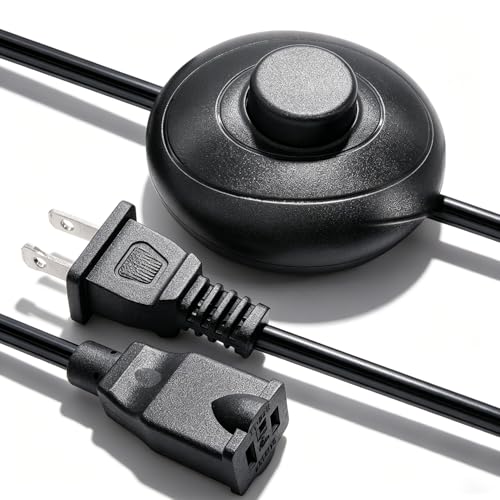
This 6-foot extension includes a built-in foot pedal switch, enabling hands-free control for light-duty applications. It is ideal for pedal boards where a separate action is preferred or where space constraints require a long, flexible cord with a switch in the middle. Best for users who want easy foot control without reaching for a power switch. Limitation: maximum current is advised not to exceed 3A, so it’s best for lower-power devices.
YINGAYOU C14 to C13 With On/Off Switch

The YINGAYOU C14-C13 switch cord is a compact, heavy-duty option with an inline on/off switch and a clearly visible LED indicator. It uses a 3×1.0mm² copper core and offers a practical, short length to minimize cable clutter. Best for readers needing an inexpensive, effective way to add a power switch to standard IEC-powered devices. Caution: LED indicator means some power draw may be visible even when off depending on setup.
iKKEGOL Foot Pedal Power Switch Outlet

The iKKEGOL model offers a self-locking ON/OFF switch with a 6.5-foot cable and a 3-prong US plug. It supports 250V, 10A max, and features a stable anti-slip base. This hands-free option is suitable for tools, lights, and devices on a workbench or pedal board when a quick toggle is necessary. Best for users who want straightforward, reliable foot activation. Limitation: ensure your load stays within the 10A max rating.
Hiree Guitar Pedal Power Supply

The Hiree pedal power supply provides seven isolated outputs for guitar pedals. It distributes power across six 9V/100mA ports and one 9V/300mA port, with short-circuit protection on each channel. Best for pedal boards that require clean, independent power lines to minimize noise between pedals. A limitation is that it’s a power supply rather than a simple switch; pair it with a compatible pedal setup for best results.
Buying Guide: Power Switches And Pedal Boards
- What power switch type fits your setup: inline cord switches, foot pedals, or multi-output power supplies? Inline cords are simple; foot pedals offer hands-free operation; multi-output supplies help manage multiple pedals with isolated channels.
- Current and voltage ratings: match devices to stay within 125V/10A or 250V/6A ratings where listed. Exceeding ratings can cause overheating or failure.
- Cable management: shorter cords reduce clutter; longer cords add flexibility but may require organization to avoid tangles on stage or in studio.
- Safety features: look for anti-slip bases on foot switches, rubberized casings, and LED indicators to verify on/off status at a glance.
- Isolated outputs: if using multiple pedals, isolated channels help minimize noise and interference between effects.
- Durability and mounting: consider whether the switch or cord can be mounted on a pedal board or needs a separate housing or cable management solution.
Frequently Asked Questions
- What is the advantage of an inline IEC switch cord for pedal boards? It provides quick, portable on/off control without modifying equipment.
- Should I use a foot pedal switch for all pedals? Foot pedals are ideal for hands-free control of a live rig or workshop tools, but for stationary setups a simple inline switch may suffice.
- Can I mix a power supply with a switch cord on the same board? Yes, but ensure total load stays within ratings and consider isolation to prevent pedal noise.
- How important is LED indication on a switch? LED indicators help confirm when a device is powered, reducing accidental power cycling during performances.
- What safety features should I look for in a pedal power switch? Look for non-slip bases, water-resistant or rugged housings, and protection against short circuits.