
Best Guitar Pedal Effects for Every Player’s Tone
Direct answer for shoppers: the right pedal effects setup blends versatile tones, reliability, and ease of use. This guide highlights five top options suitable for various players—from beginners seeking basic versatility to professionals chasing studio-ready tones. Each product is evaluated for best use cases, with practical pros and a candid note on any limits. The quick summary table below helps you compare key features at a glance.
| Product | Best For | Key Benefit | Limitations |
|---|---|---|---|
| MOOER GE100 | All-around players | Extensive presets and tones in one unit | Smaller screen, learning curve for beginners |
| AFOT Heavy Metal Distortion | High-gain metal players | Defined high-gain with explicit tone shaping | Limited to heavy genres |
| LEKATO Multi Effects | Studio and stage riders | 125 effects, multiple amp/cab sims, app access | Cluttered if you only need basics |
| MOOER GE150 Pro | Live players and keyboardists | Massive presets, multiple amp/cab options | Complex setup for new users |
| EX Inferno Death Metal | Extreme metal players | Three-mode distortion with precise control | Specific genre focus |
MOOER GE100 Multi-Effects Guitar Pedal

The MOOER GE100 is a compact multi-effects unit with 80 preset patches plus 80 user patches and 8 effect modules totaling 66 effect types. It offers 6 assignable expression pedal parameters for hands-free tone control and an adjustable output mode for line-out use without an amp. This makes it a versatile choice for players seeking a broad library of tones in a single board. Best for performers who value quick access to a wide tone palette and on-the-fly tone shaping during gigs.
Why selected: It consolidates a large, reusable tone library in a single pedal, reducing the need for multiple gear. A caution: the onboard interface can be complex, so beginners may need time to master patch saving and navigation.
AFOT Heavy Metal Distortion Guitar Pedal

This pedal targets aggressive high-gain styles, offering clear definition at high gain levels. It emphasizes a wide range of metal and rock sounds with independent tone controls and a 3-section EQ. It is best for players who want bold metal tones without losing clarity in the riffs and solos. The pedal supports 3-mode shaping with Treble, Mid, Bass, Boost, and Dist knobs, allowing substitution of tones across metal, rock, and punk. A caution: the device is tuned toward metal emphasis, so it may feel less natural for clean or blues tones.
LEKATO Multi Effects Guitar Pedal

LEKATO’s model packs 125 effects across eight modules, plus 40 amp models and 40 cab sims, making it a robust all-in-one solution for both practice and performance. It also features a built-in looper, drums, NAM/IR support, and USB audio interface capability, which supports recording and sound design workflows. Best for players who want studio-grade flexibility, deep editing via app, and a comprehensive tone ecosystem. A limitation to consider: the extensive feature set can require a deeper learning curve for new users.
MOOER GE150 Pro Guitar Multi Effects Processor

The GE150 Pro blends 200 factory presets with 55 amp models and 26 cabinet simulations, plus 20 speaker IR slots. It supports MNRS sample files and offers four multi-purpose footswitches for flexible patch navigation. Battery life variant exists, and the standard unit is mains-powered; the Pro Li edition extends mobile usability. Best for players who need a broad tonal range, strong live performance capabilities, and flexible patch switching. A caution: its depth of features may be overkill for casual players who only need a few core sounds.
EX Inferno Death Metal Distortion
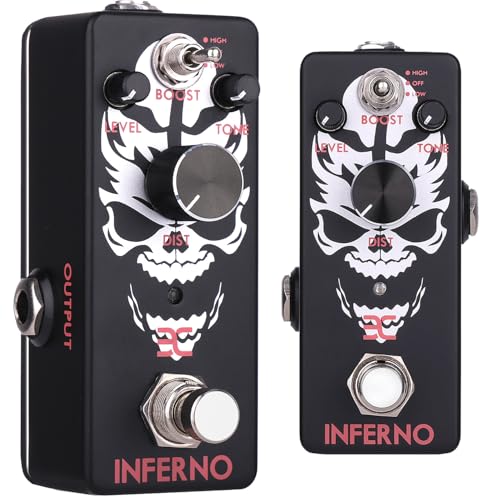
The EX Inferno focuses on extreme metal tones with a three-mode boost switch and true bypass. It provides Level, Tone, and Dist controls to dial in precise distortion characteristics, from tight rhythm to screaming solos. Best for players who want a compact solution tailored to brutal metal tones with straightforward control. A caution: the three modes are tuned for metal; it may not deliver clean or blues tones effectively.
Buying Guide
What should I consider when choosing guitar pedal effects?
Ask about your genre needs, the level of tonal versatility you require, and how much space you can dedicate on your pedalboard. Consider whether you want built-in looper, drum tracks, or USB audio interface capabilities for studio work. For live settings, prioritizing reliable bypass, true- bypass if possible, and easy patch switching can matter most.
Best types of pedals by use case
- All-around versatility: multi-effects pedals with many presets and built-in features.
- Metal or high gain: pedals designed for tight, high-gain tones with clear definition.
- Studio and stage: units offering amp/cab simulations and USB/app integration for editing and recording.
How to compare tone shaping capabilities
Look for user-friendly control layouts, independent EQ, and the number of modulation or delay options. Pedals with dedicated knobs for Treble, Mid, Bass, and Drive typically yield more intuitive tone sculpting. Check if the unit supports loading third-party impulse responses for cab simulation.
What about battery life and power options?
Some models offer rechargeable batteries or Li-ion options for portability. Consider whether you need a mains-powered pedal for consistent stage use or go wireless with integrated power options to reduce cables.
Which one is best for beginners?
Beginner-friendly options include units with clear displays, simpler patch navigation, and a good balance of presets vs. tweakability. A model with helpful built-in tutorials or app-based editing can accelerate learning curves.
Integration and expansion considerations
Check compatibility with your guitar rig, existence of MIDI or expression pedal support for real-time control, and whether you can export or import user presets to streamline your workflow across shows or projects.
FAQ
- Q: Do multi-effects pedals replace separate amps and pedals?
- A: They can substitute for many tones in a compact setup, but professional players may still use individual pedals for specific effects or nuanced control.
- Q: Is a larger number of presets always better?
- A: More presets provide more tonal options, but you should value ease of use and reliable sound quality as well.
- Q: Can I edit tones with a smartphone app?
- A: Some models offer app-based editing and NAM/IR integration; check compatibility with your device.
- Q: Which pedal is best for live performance?
- A: Pedals with USB/aux capabilities, reliable bypass, flexible patch switching, and robust build are favorable for live use.
- Q: Are there pedals specialized for metal vs. rock?
- A: Yes; high-gain dedicated distortion units emphasize metal tones, while multi-effects can cover a broader rock spectrum.
- Q: Should I worry about price differences?
- A: Price often reflects feature depth, tone quality, and expansion options. Choose a model aligning with your workflow rather than price alone.