
Best Acoustic Guitar Pedal Effects for Rich, Natural Tones
Answering the buyer’s search, this guide highlights pedal effects designed for acoustic guitars. It helps players choose between dedicated acoustic preamps, multi-effects pedals, and simulators. The top picks suit different needs: live performers seeking a complete pedal board, recording players needing versatility, and hobbyists aiming for studio-quality tone. The following table summarizes the five best options and what they excel at.
| Product | |||
|---|---|---|---|
| SONICAKE Acoustic Guitar Effects Pedal with Analog Preamp and Digital Reverb | Analog Preamp / Digital Reverb | Live players needing direct XLR output | Notch filter and mute with gain/frequency control |
| SONICAKE Acoustic Pedal Guitar Effect Acoustic Pedal Multi Effects | Multi-effect / Preamp | All-in-one tone shaping | Warm, natural acoustic sound with chorus, delay, reverb |
| LEKATO Multi Effects Pedal For Acoustic Guitar | Multi-effects with IR loading | Original tone as well as amp/cab modeling | 9 amp models + 8 IR cabinets, third-party IR support |
| IOppWin Acoustic Guitar Simulator Pedal | Acoustic simulator | Electric-to-acoustic conversion | 3 cabinet modes (Piezo, Standard, Jumbo) |
| BOSS AC-3 Advanced Acoustic Simulator | Acoustic simulator | Professional acoustic voice for gigs | Compact, optimized acoustic-guitar modeling |
Keep in mind the buying criteria: console-like control surface, direct-output options, effects variety, and how each unit handles acoustic dynamics. The sections below break down each product, highlighting who benefits most and where to beware of limitations.
SONICAKE Acoustic Guitar Effects Pedal with Analog Preamp and Digital Reverb

The pedal combines an analog preamp with digital reverb to deliver a refined, natural acoustic tone. It includes a built-in notch filter and a mute option, plus adjustable gain and frequency ranges to suppress feedback. It features a high-impedance input and an XLR balanced output for direct connection to a mixer or stage box. Best for solo performers who need clean, studio-like signal without an external interface.
Who it’s best for: performers needing clear acoustic presence with easy output to PA. Why selected: strong balance of preamp warmth and flexible tone shaping in a compact unit.
Caution: The feature set favors tone shaping over advanced modulation; players seeking heavy multi-effects may want a broader pedalboard solution.
SONICAKE Acoustic Pedal Guitar Effect Acoustic Pedal Multi Effects Preamp Chorus Delay Reverb

This all-in-one acoustic pedal offers a main effects chain with chorus, delay, and reverb plus an analog preamp that recreates a classic acoustic amplifier vibe. It’s well suited for players who want quick access to a complete tonal palette on stage or in rehearsal. The built-in preamp supports a warm, natural response suitable for intimate gigs and small venues.
Who it’s best for: acoustic players seeking a single-unit solution with a classic sound. Why selected: convenience and a cohesive chorus-to-reverb chain for varied performances.
Limitation: It may be less flexible for players who need deep custom presets compared to dedicated multi-effects units.
LEKATO Multi Effects Pedal For Acoustic Guitar

LEKATO offers a compact unit with 9 amp models and 8 IR cabinets, enabling both body and presence control. It supports IR loading and third-party IR files via a USB connection, making it possible to tailor cabinet response. It includes preset, edit, and live modes for versatile stage and studio use. Best for players who want extensive cabinet and amp emulation without a large rack.
Who it’s best for: players seeking deep tone sculpting with external IR customization. Why selected: flexible IR loading and multiple modes for live or studio switching.
Caution: IR management requires software and setup; beginners may need time to optimize presets.
IOppWin Acoustic Guitar Simulator Pedal
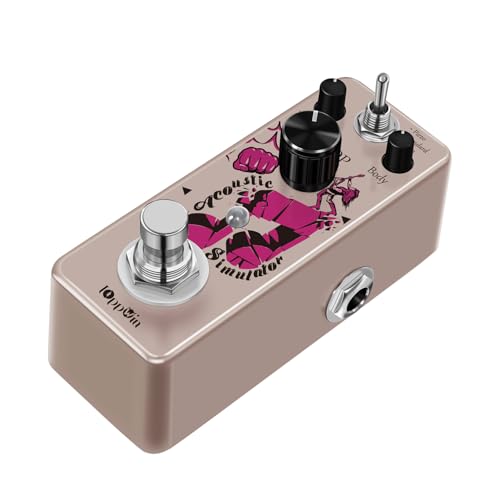
The IOppWin pedal focuses on electric-to-acoustic conversion with three cabinet modes: Piezo, Standard, and Jumbo. It emphasizes organic, dynamic textures and aims to minimize digital artifacts. Best for electric guitar players looking to quickly achieve an acoustic voice in a compact pedal.
Who it’s best for: players transitioning from electric to acoustic tones on stage. Why selected: straightforward conversion modes and natural-sounding acoustic options.
Limitation: may not offer as much direct preamp control as dedicated acoustic pedals.
BOSS AC-3 Advanced Acoustic Simulator

The AC-3 is a compact, purpose-built acoustic simulator for electric and acoustic guitar players seeking a realistic acoustic voice. It includes built-in reverb and is optimized for acoustic-guitar modeling in a standalone stompbox format. Best for players who need reliable, consistent tone with minimal setup.
Who it’s best for: gigging players wanting a dependable acoustic voice in a small pedal format. Why selected: renowned Boss modeling technology in a straightforward pedal.
Limitation: modeling depth is good but not as expansive as some multi-effects units with broader preset libraries.
Buying Guide: Key Considerations For Acoustic Guitar Pedal Effects
How do you choose the right pedal for acoustic guitar tones? Consider signal path, output options, and tone-shaping capabilities. If your setup centers on PA or DI, prioritize devices with XLR outputs or line-level balanced outputs. For live versatility, look for presets, live-mode switching, and robust expression control. If you record, IR loading and cabinet simulations help achieve fuller, studio-like tones. Budget-conscious players may favor single-purpose pedals, while touring players may want a comprehensive multi-effect solution.
What to look for in a good acoustic pedal
- Output quality: XLR or balanced out helps prevent noise on stage.
- Preamp behavior: clean gain staging with a natural response toPlaying dynamics.
- Cabinet and room simulations: IR loading or built-in reverb for depth.
- Ease of use: intuitive controls for quick on-stage tweaks.
- Presets and editability: ability to save and recall tones quickly.
When to choose a single-pedal solution vs. multi-effects
- Single-pedal: best for straightforward live gigs or minimal board setup.
- Multi-effects: ideal for players needing diverse tones across genres or recording scenarios.
Direct-use tips for optimal tone
- Match your guitar’s pickup type to the pedal’s input design for best response.
- Experiment with notch filters or mid-shift controls to reduce feedback in high-gain environments.
- Test with your typical playing dynamic to ensure the preamp remains musical across volumes.
Frequently asked questions
- What is the difference between an acoustic simulator and a multi-effects pedal? An acoustic simulator focuses on mimicking acoustic guitar sounds, while a multi-effects pedal provides a wider range of effects and tones, including amp simulations and modulation.
- Should I choose a pedal with IR loading? If you want cabinet realism and deep tone shaping, IR loading helps reproduce mic’d cabinet responses more accurately.
- Are XLR outputs important for live gigs? Yes, they provide balanced signals with reduced noise when connected to mixers or DI boxes.
- Can I use these pedals with an electric guitar? Some models offer electric-to-acoustic conversion modes, but performance will vary; dedicated acoustic focus typically yields better results for acoustic tone.
- Do these pedals require a power supply or batteries? Most operate with standard 9V DC power supplies or batteries; check each model’s power requirements.
- Is a high-end pedal necessary for beginners? A simple, well-rated acoustic pedal can be enough to establish a good tone, with upgrades as skills and needs grow.