
Best Car Chargers for Your Lighter Socket: Fast, Safe USB-C Solutions on the Road
If you need reliable charging on the go, these car chargers plug into your vehicle’s 12V lighter socket and deliver fast, stable power to multiple devices. The top picks below are best for road trips, daily commutes, and families that rely on smartphones, tablets, or laptops while driving. Each option emphasizes safety, heat management, and multi-device support to keep everyone powered without clutter or overheating. The list focuses on five models that balance speed, versatility, and value for American drivers.
| Product | Ports / Power | Best For | Why Pick It |
|---|---|---|---|
| JUNVANG USB C Car Charger | 4 Ports, up to 90W | Multi-device households | Highest total output with two USB-C ports for PD/QC fast charging |
| KENHAO Car Charger USB C | 3 Ports, 67W | Compact travel with quick charges | Strong PD/QC speeds in a slim form |
| power-7 USB C Car Charger | 3 Ports, 70W | Three-device on-the-go charging | Balanced PD and QC performance with dual USB-A and one USB-C |
| LISEN LISEN Car Charger USB C 2 Pack | 2 Ports, 36W PD USB-C + USB-A QC | Low heat, minimal clutter | Smart, balanced power distribution for two devices |
| Anker 323 52.5W USB C Car Charger | 2 Ports, 52.5W | Fast charging for two devices | PowerIQ 3.0 compatibility for broad device support |
JUNVANG USB C Car Charger — 90W Four-Port Powerhouse

The JUNVANG charger offers 90W total output across 4 ports (2 USB-C, 2 USB-A) with PD/QC fast charging. It’s designed to power iPhones, iPads, and many Android devices quickly, with high-speed charging for multiple devices at once. Best for households or road trips where several devices need fast charging simultaneously. A potential limitation is heat under heavy load due to 4-port operation, so avoid charging too many power-demanding devices at full speed for extended periods.
KENHAO Car Charger USB C — 67W Three-Port

KENHAO’s 67W three-port charger combines a USB-C PD output and USB-A fast charging. It’s an excellent pick for travelers who need strong power to a laptop or tablet while also charging a phone. It’s best for individuals who want a compact, capable hub in the dash without excessive heat. A limitation is that the USB-C port maxes at 37W, which may limit some ultra-fast charging scenarios for larger devices.
Power-7 USB C Car Charger — 70W, 3 Ports

This 3-in-1 charger delivers 70W total with a PD-enabled USB-C port and two USB-A ports. It supports iPhone and Android fast charging and is noted for intelligent power management that protects devices from overcharging and overheating. It’s best for users prioritizing multiple device charging in a single, reliable unit. A caveat is that the USB-A ports max out faster than the USB-C port; plan device assignments accordingly to maximize speed.
LISEN Car Charger USB C 69W — 2 Pack
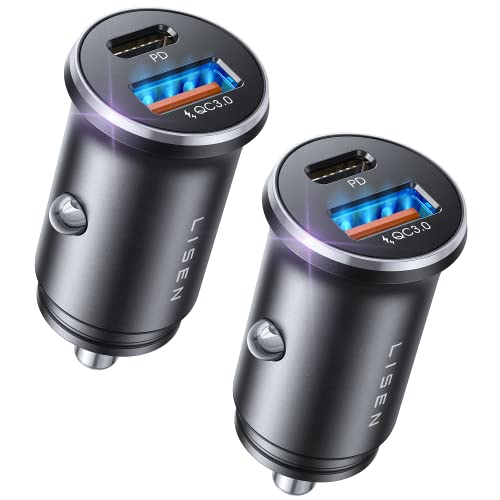
LISEN offers a 2-pack 69W solution with one PD USB-C port and one USB-A port per unit, designed to minimize heat while delivering fast charging for common devices. It’s ideal for drivers who want a tidy setup with balanced performance and less cable clutter. It does not support CarPlay or data transfer, which is a consideration if you need power for data-heavy accessories.
Anker 323 52.5W USB C Car Charger

Anker’s 52.5W dual-port charger uses PowerIQ 3.0 to deliver fast charging to a wide range of devices. With up to 30W on USB-C and 22.5W on USB-A, it’s a strong option for drivers who want reliable two-device charging without excess heat. Best for those who prioritize proven brand reliability and broad compatibility. A limitation is lower total wattage compared with larger multi-port chargers, which may affect simultaneous charging speed for high-demand devices.
Buying Guide: Key Considerations For Car Chargers
What power level do you need? If you regularly charge laptops or tablets in the car, aim for 60W+ on USB-C with multiple ports. For phones and small devices, 30–45W total is usually enough.
How many ports and which types? A mix of USB-C PD and USB-A ports covers most devices. Consider two USB-C ports for higher-end devices and two USB-A ports for older gear.
Heat management and safety features matter. Look for intelligent chips, short-circuit protection, over-voltage protection, and auto-shutoff when fully charged to avoid battery wear and overheating.
Size, build, and durability. All-metal housings and robust connectors help with heat dissipation and long-term reliability in a vehicle environment.
Compatibility and future-proofing. Check PD 3.0/PD 4.0 support and fast-charge standards like QC 3.0 or PPS to ensure broad device compatibility over time.
FAQ
- Do car chargers work with iPhones and Android phones at the same time? Yes. Many models provide USB-C PD for phones and USB-A for older devices, enabling simultaneous charging with appropriate speed based on port capabilities.
- Will charging in a car harm my device’s battery? Not if you use a charger with proper protection circuits (over-current, over-voltage, over-heating). Auto shutoff helps prevent battery strain during long trips.
- Is higher wattage always better? Higher wattage enables faster charging but only if the device supports it. Use ports that match your device’s fast-charging standard.
- Can I use these chargers with any vehicle? Most are designed to fit standard 12V cigarette lighter sockets in cars, trucks, and SUVs. Check voltage compatibility if you drive a specialty vehicle.
- Are retractable chargers more convenient? Retractable cables reduce clutter and are helpful for tidy dashboards, but ensure the mechanism remains durable with daily use.
- Do these chargers support data transfer? Some do not support data transfer; read product features to confirm if you need data capabilities beyond charging.