
Best Phono Preamp and Turntable Adapters for Clear Vinyl Playback
Yes—getting pro-level sound from a vinyl setup often starts with the right phono preamp or adapter. This guide highlights five top options suited for different buyers, from beginners connecting a turntable to modern speakers, to DJs seeking stable 45 RPM playback. Whether you need a compact preamp, a 45 RPM adapter, or a reliable all-purpose accessory, these picks help you achieve clearer, louder vinyl sound with minimal hum and interference. The table below summarizes each product’s core strengths.
| Product | Best For | Key Benefit |
|---|---|---|
| Pyle Phono Turntable Preamp – PP999 | Beginner to mid-level setups | Low-noise amplification with 3 mV input sensitivity |
| Phono Turntable Preamp – cotsoco | Standard home audio systems | RCA inputs/outputs with 12V DC adapter |
| Kedok 45 RPM Adapter | 7-inch singles on standard turntables | Solid aluminum dome for stable playback |
| Jancane Phono Turntable Preamp | High-fidelity vinyl listening | RCA inputs and RCA/TRS outputs |
| Pyle Phono Turntable Preamp (12V DC) – New model | Compact setups needing multiple devices | Low-noise operation with 2V max output |
Pyle Phono Turntable Preamp PP999
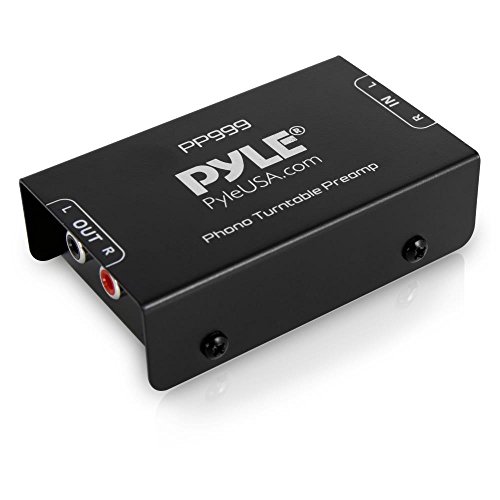
The Pyle PP999 converts phono signals to line level, enabling a turntable to connect with modern audio equipment lacking dedicated phonograph inputs. It supports magnetic pickups with 3 mV input sensitivity at 50K ohms, and provides a low-noise performance with a 2V maximum output (p-p) at 10K ohms. Best for small home systems where the preamp can sit close to the source to minimize noise. Use this when you need a compact, budget-friendly solution to drive speakers or a receiver.
Who it’s best for: casual listeners with basic turntables and compact setups who want simple integration with RCA inputs and outputs. This model is convenient for those prioritizing low-noise operation in a near-field listening environment.
Limitations: place near the turntable to reduce hum; ensure your receiver’s inputs are compatible with the preamp’s line-level output. No built-in USB or Bluetooth; not ideal for wireless setups.
Phono Turntable Preamp – cotsoco

The cotsoco phono preamp turns phono signals into line level for better overall sound. It supports a 3 mV input sensitivity at 50K ohms and delivers low-noise performance with a 2V max (P-P) output at 10K ohms. It includes RCA input/output and requires a 12V DC adapter. Best for home audio systems where the turntable lacks a built-in preamp and users want straightforward RCA connectivity.
Who it’s best for: listeners upgrading from a built-in turntable preamp to a dedicated unit to improve clarity and reduce background noise. Good for users who want a compact, wall-to-system setup with stable RCA connections.
Limitations: ensure your turntable does not have its own preamp engaged, as this can introduce excess noise. Battery-free operation requires the included DC adapter.
Kedok 45 RPM Adapter (Black)

The Kedok 45 RPM adapter is a robust aluminum dome designed for 7-inch vinyl records. It improves contact between the record and platter, reducing resonance and vibration for more stable playback. Best for home DJs or casual listeners using Crosley, Victrola, or similar turntables that need reliable 45 RPM playback without wobble.
Who it’s best for: users who frequently play 7-inch singles and want a durable, easy-to-install adapter that minimizes misalignment. Not a preamp; a helpful accessory to optimize critical 45 rpm playback.
Limitations: not a replacement for a preamplifier; must be used in conjunction with a suitable turntable drive system and proper tonearm alignment.
ReadyWired Turntable Belt – Kenwood KD Series

The ReadyWired belt is included as a compatibility-focused accessory for specific turntables. It is not a preamp but supports proper platter speed and reliability when replacing worn belts. Best for users restoring or maintaining turntables that require belt-driven operation to preserve accurate playback without motor strain.
Who it’s best for: vinyl enthusiasts performing routine turntable maintenance who need a dependable replacement belt to keep playback stable. Limitation: compatibility must be confirmed for your exact turntable model.
Jancane Phono Turntable Preamp

The Jancane phono preamp converts phono signals to line level for clearer audio with enhanced volume. It emphasizes low-noise operation, ensuring vinyl playback matches the needle reading. The unit provides RCA inputs and RCA/TRS outputs, with a 12V DC adapter included. Best for audiophiles seeking more precise sound separation and a straightforward setup.
Who it’s best for: listeners who want a higher-fidelity sound and flexible output options (RCA and TRS). Caution: verify that your turntable does not have an incompatible built-in preamp to avoid noise or distortion.
Pyle Phono Turntable Preamp – New Model

This Pyle model focuses on converting phono signals to line level with 3 mV input sensitivity at 50K ohms and low-noise performance. It outputs up to 2V peak-to-peak at 10K ohms and recommends placing the preamp near the source for optimal noise reduction. Best for compact spaces needing strong compatibility with modern receivers and speakers.
Who it’s best for: users who want a compact, low-noise preamp that integrates easily with standard RCA inputs and a variety of sound systems. Limitation: lacks USB/Bluetooth; use with wired setups only.
Buying Guide: Phono Preamp And Turntable Adapters
What is a phono preamp and why do you need one? A phono preamp boosts the weak signal from a turntable’s phono cartridge to line level, and applies RIAA equalization so the sound matches how it was recorded. If your amplifier or receiver lacks a dedicated phono input, a standalone preamp is essential for proper playback.
Key decision points:
- Input compatibility: Most models support magnetic cartridges, with typical input sensitivity around 3 mV at 50K ohms. Confirm your cartridge type before buying.
- Output level: Look for a stable line-level output, commonly 2V peak-to-peak, to drive different receivers without distortion.
- Noise performance: Low-noise op-amps reduce hum and interference. Place the preamp close to the turntable to minimize cable-induced noise.
- Connectivity: RCA inputs and outputs are standard. Some models offer TRS outputs for flexible connections to mixers or audio interfaces.
- Power: Check whether the unit uses an external DC adapter (commonly 12V). Ensure you have a suitable power source.
- Form factor: If space is tight, choose a compact unit that can sit near the record player without adding clutter.
Accessory considerations:
- 45 RPM adapters are practical for playing 7-inch singles on standard spindles. Aluminum designs tend to be more stable than plastic.
- Turntable belts are maintenance items. If your table suffers speed inconsistency, a compatible replacement belt may be necessary for accurate playback.
Comparison at a Glance
- Best overall for simple, plug-and-play setups: Pyle PP999
- Best for versatile home audio connections: cotsoco
- Best for 7-inch singles: Kedok 45 RPM Adapter
- Best for high-fidelity listening: Jancane
- Best compact option with reliable output: Pyle New Model
FAQ
- Q: Do I need a phono preamp if my receiver has a phono input?
- A: No. If your receiver already has a phono input, you can connect the turntable directly to it without a separate preamp. A preamp is only needed when there is no dedicated phono input or when you want to improve performance.
- Q: Can I use a 45 RPM adapter with any 7-inch record?
- A: Most 7-inch records have a standard center hole, but ensure the adapter fits your turntable’s spindle and tonearm weight to avoid wobble.
- Q: Is a separate preamp better than a built-in preamp?
- A: A dedicated phono preamp can offer lower noise and better RIAA equalization in many cases, especially for higher-fidelity setups or older turntables.
- Q: How should I place a preamp to minimize noise?
- A: Place the preamp close to the turntable to reduce cable length, which helps minimize hum and interference.
- Q: Do these devices enhance vinyl sound quality beyond preamp gain?
- A: They improve signal strength and noise performance, but raw vinyl quality, cartridge condition, and record cleaning also significantly affect sound quality.