
Best Phono Preamp With Equalizer for Vinyl Enthusiasts
Answered: this guide highlights top phono preamps with built-in equalizers to restore vinyl warmth and balance. These selections suit analog purists, home stereo setups, and hobbyists who want precise tone control without extra gear. Each pick is described for the most relevant buyer type, with clear pros and a cautious note where data supports it. A quick comparison table helps you scan key features at a glance.
| Product | Best For | Key Feature |
|---|---|---|
| Fluance PA10 | Analogue purists seeking accurate RIAA with clean bass | High-fidelity MM/RIAA amplification |
| Douk Audio T9 | Vintage-tone lovers who want vacuum-tube warmth | Tubes for warm, natural sound |
| MICNAUX Phono Preamp | Accurate vinyl tone with flexible EQ | 3-band independent EQ, MM/MC capable |
| Douk Audio P7 | Balanced-output enthusiasts and clean line-level output | Vacuum-tube preamp with XLR output |
| Dynasty PX1 | Multi-source setups with phono and digital inputs | Phono RIAA plus optical and multiple outputs |
Fluance PA10 High Fidelity Phono Preamp

Best for: Vinyl purists who want precise RIAA equalization with minimal noise. The Fluance PA10 delivers uncompromised phono amplification and a high-accuracy RIAA curve, designed with premium components and a low-noise power supply. It provides distinct left and right channel separation for a vivid stereo stage, making it ideal for dedicated turntable setups where accuracy matters.
Why chosen: It emphasizes faithful reproduction with low distortion and a robust output stage, helping turntables resolve vinyl detail without colorization. The integrated MM/RIAA path suits most common cartridges without additional gear.
Caution: Limited variable tone controls beyond RIAA; best used when you want a straightforward, high-fidelity phono path rather than extensive EQ customization.
Douk Audio T9 Vacuum Tube Phono Preamp

Best for: Listeners seeking vintage warmth and a rich mids-and-treble character. The T9 uses two 6E2 vacuum tubes and a warm color display, providing a distinctive natural glow to the sound. It supports MM and RCA inputs, making it a versatile option for retro-inspired systems.
Why chosen: The dual-tube design adds harmonic richness, and the independent headphone amplifier offers detailed listening without stressing the main amp. The backlight display enhances the listening ambiance while tuning is straightforward with treble and bass controls.
Caution: Tube-equipped gear can require more maintenance and may introduce more microphonics depending on placement and isolation.
MICNAUX Phono Preamp With 3-Band EQ
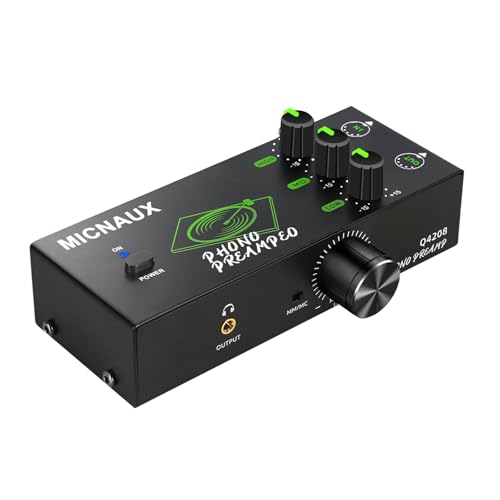
Best for: Vinyl enthusiasts who want precise tonal shaping across highs, mids, and lows. The MICNAUX unit emphasizes a low-noise design and independent 3-band EQ, enabling personalized room correction and cartridge matching for both MM and MC carts.
Why chosen: It offers accurate EQ compensation based on vinyl standards, restoring warmth and fullness while reducing EMI through careful grounding. The ±15dB range provides meaningful musical adjustments without overprocessing.
Caution: The EQ adjustments require careful listening to avoid over-eQing, especially in smaller rooms with reflective surfaces.
Douk Audio 7 Band EQ Preamp

Best for: Setups requiring flexible tone shaping with both XLR and RCA connectivity. The Douk Audio T7 provides a 7-band EQ for nuanced control and a high SNR, suitable for users who want to tailor sound for different amplifiers or speakers.
Why chosen: The dual output options and balanced XLR output reduce noise and improve dynamic range in more complex systems, making it a strong choice for serious home theaters or hi-fi rigs.
Caution: The 7-band EQ may require careful calibration to prevent coloration in acoustically challenging rooms.
Dynasty ProAudio PX1 Phono Preamplifier

Best for: Multi-source environments needing a single preamp that handles phonographs and digital devices. The PX1 combines a phono RIAA stage with optical and RCA inputs, plus multiple outputs for flexible routing to amps, TVs, and dedicated speakers.
Why chosen: The low-noise circuitry and 3-band EQ deliver clean audio with room for subtle tone shaping. It also provides a ground terminal for turntables and a front-panel headphone output for monitoring without routing to the main system.
Caution: With multiple inputs, the setup can become more complex; ensure proper input selection to avoid accidental source mismatches.
Buying Guide: Key Considerations for Choosing a Phono Preamp With Equalizer
- Cartridge compatibility: Confirm MM or MC compatibility and whether the unit supports both. MM cartridges are common, MC needs careful gain matching.
- Equalization needs: Decide if you want a fixed RIAA path with optional EQ bands, or a 3- or 7-band independent EQ for room tuning.
- Output options: Look for line-level outputs, balanced XLR outputs, or multiple RCA/optical connections to match your amp or receiver.
- Noise and power: Low-noise design helps preserve delicate vinyl details. Consider whether a standalone power supply is necessary in your setup.
- Tube vs solid-state: Tube-based units add warmth but may require more maintenance. Solid-state options tend to be more neutral and reliable.
- Placement and cooling: Tubes and analog circuits can heat up; place units away from vibration sources and heat.
- Room and system integration: If you already have a high-end amp, choose a preamp with a clean phono stage compatible with your cartridge.
Frequently Asked Questions
- What is a phono preamp with equalizer used for?
It processes the phono signal from a turntable, applying RIAA equalization and optional tone controls to restore natural frequency balance before amplification.
- Do I need an equalizer if my turntable already has a built-in EQ?
Some setups benefit from independent, adjustable EQ to tailor sound to room acoustics or personal taste; however, many turntables with good RIAA accuracy may not require an extra EQ.
- What’s the difference between MM and MC cartridges for these preamps?
MM cartridges are simpler to drive and typically require standard gain; MC cartridges are more sensitive and may need higher gain and low noise for best results.
- Are tube preamps with phono stages worth it?
Tubed stages can add warmth and harmonic richness, but they may introduce more noise and require care around placement and maintenance.
- Can I use a phono preamp with any amplifier?
Most preamps output line-level signals compatible with typical AV receivers and power amps, but always match the input sensitivity and impedance to your system.
- What should I consider when choosing output options?
Balanced XLR outputs reduce noise in longer runs; RCA outputs are common and compatible with most home audio setups.